National Assembly Budget Committee National Audit
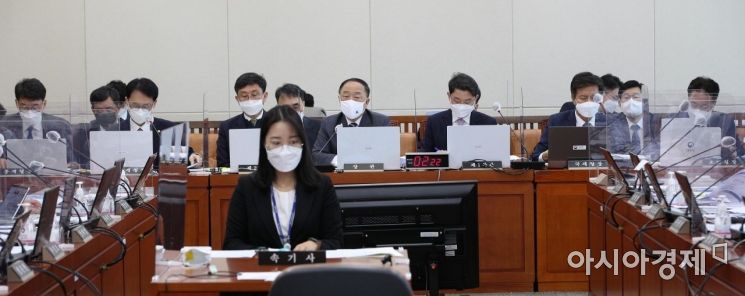 Deputy Prime Minister for Economy Hong Nam-ki is attending the National Assembly's Public Administration and Security Committee's audit of the Ministry of Economy and Finance held at the National Assembly on the 20th, responding to questions from lawmakers. Photo by Yoon Dong-joo doso7@
[Sejong=Asia Economy Reporter Son Sunhee] The government has virtually decided to cut fuel taxes to alleviate the impact on the livelihood economy caused by soaring oil prices. It is expected to be announced at the Emergency Economic Central Countermeasures Headquarters meeting scheduled as early as the 26th.
On the 20th, Hong Nam-ki, Deputy Prime Minister and Minister of Economy and Finance, said, "Domestic gasoline prices have risen significantly, and there is an impact on the real economy, so the government is currently reviewing a fuel tax cut," adding, "There will be measures around next week."
At the National Assembly's Planning and Finance Committee's audit on the same day, in response to a question from Seo Byung-soo, a member of the People Power Party, about the possibility of a fuel tax cut, Deputy Prime Minister Hong replied, "We have been reviewing it internally." He added, "We are looking into a method of reducing the tax per liter similar to the approach in 2018," but refrained from specifying the exact reduction rate, saying, "We are considering several alternatives."
Since this year's tax revenue has exceeded expectations significantly, the burden of reduced tax revenue due to the fuel tax cut is expected to be minimal. As of August, the excess tax revenue was about 55.7 trillion won. Looking at the 2018 fuel tax cut case, it was applied for a total of 10 months?15% for 6 months and 7% for 4 months?with a resulting tax revenue reduction of about 2.6 trillion won. The annual fuel tax scale is around 28 trillion won. Under current law, the maximum limit for fuel tax reduction is 30%, so the reduction rate is expected to be decided between 10% and 30%.
According to the New York Mercantile Exchange on the previous day (Eastern Time), the November West Texas Intermediate (WTI) crude oil price closed at $82.96 per barrel, up $0.52 (0.63%) from the previous day. This is the highest level in about seven years since October 2014.
With international oil prices approaching $83 and the won-dollar exchange rate rising, the perceived burden of oil prices domestically has intensified. According to Opinet, the oil price disclosure information from Korea National Oil Corporation, the average gasoline price in Seoul on the day recorded 1,813.83 won per liter, up 5.21 won from the previous day, also marking the highest level in seven years. With food prices such as rice, pork belly, and eggs already high, the rising fuel prices are immediately impacting the livelihood economy.
At present, it is difficult to predict how long this high oil price trend will continue. When asked about the oil price outlook, Deputy Prime Minister Hong said, "International oil prices are at their highest level since October 2018," and added, "I think the high oil prices will not drop quickly for the time being."
© The Asia Business Daily(www.asiae.co.kr). All rights reserved.












