KEPCO Engineering & Construction, Report Release Contradicting Government Policy Draws Attention
[Sejong=Asia Economy Reporter Kwon Haeyoung] A report from a Korea Electric Power Corporation (KEPCO) affiliate has emerged, stating that nuclear power is necessary to mass-produce clean hydrogen, which is essential for creating a carbon-neutral society. This report contradicts the Moon Jae-in administration's policy direction, which completely excluded domestic nuclear hydrogen production plans under the 'anti-nuclear dogma.' Analysts interpret this as a challenge to the government's unrealistic and complacent energy policy, which intends to import most hydrogen from overseas while not even considering domestic nuclear hydrogen production.
According to the public institution management information disclosure system 'Alio' on the 18th, Korea Electric Power Technology (KEPCO E&C) recently released a report titled "Current Status of High-Temperature Steam Electrolysis Hydrogen Production Technology Using Nuclear Power." The report stated, "Major nuclear power countries are developing large-scale clean nuclear hydrogen production technologies by utilizing stable and continuous electricity and energy from nuclear power, which can reduce carbon emissions," and argued, "In Korea, it is necessary to develop electrolysis technology using commercial nuclear power plants to contribute to achieving carbon neutrality goals and to secure competitiveness in overseas nuclear power exports." KEPCO E&C is a public enterprise in which KEPCO holds a 65.7% stake.
Electrolysis technology produces hydrogen by electrolyzing water. When the electricity used is supplied by renewable energy sources such as solar and wind power, no carbon is emitted during production, so it is called green hydrogen. The report suggests that nuclear power can also produce green hydrogen like renewable energy.
KEPCO E&C revealed that countries including the United States, the United Kingdom, France, and Russia are also promoting the development and demonstration of hydrogen production technology using nuclear power. According to the report, the U.S. Department of Energy is developing electrolysis technology aiming to build gigawatt-scale hydrogen production facilities at commercial nuclear power plants through its national research institutions. In France, ?lectricit? de France (EDF) is conducting a 2 MW-scale electrolysis demonstration project at the Sizewell nuclear power plant in the UK. Russia’s state-owned nuclear company Rosatom plans to construct and operate a 1 MW hydrogen test facility at the Kola nuclear power plant, the oldest in the country, in 2023.
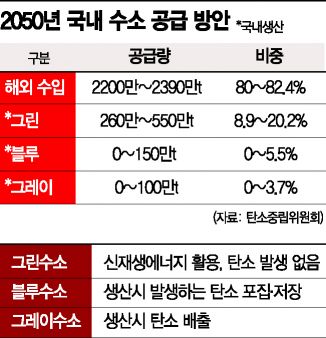
The KEPCO E&C report is seen as an example that highlights how unrealistic the government’s hydrogen policy is. Although the government has announced its intention to become a leading hydrogen nation, it does not consider nuclear hydrogen production under its anti-nuclear power stance. The government’s '2050 Carbon Neutral Scenario' released by the Carbon Neutrality Committee in August, the 'Hydrogen Leading Nation Vision' unveiled earlier this month, and the 'Basic Plan for Hydrogen Economy Implementation' to be disclosed in mid-next month all exclude hydrogen production using nuclear power. According to the 2050 Carbon Neutral Scenario, the government plans to supply virtually 100% of domestic hydrogen demand in 2050 with carbon-zero clean hydrogen (including carbon capture and storage), but intends to import 80-82.4% of it from overseas. This has raised concerns about threats to energy security.
Professor Jung Dongwook of the Department of Energy Systems Engineering at Chung-Ang University said, "Securing economic feasibility in hydrogen production is key," adding, "The nuclear power-based approach is more efficient compared to renewable energy." He emphasized, "Globally, significant investments are being made in developing hydrogen production technology based on nuclear power, and we should actively consider this as well."
© The Asia Business Daily(www.asiae.co.kr). All rights reserved.












