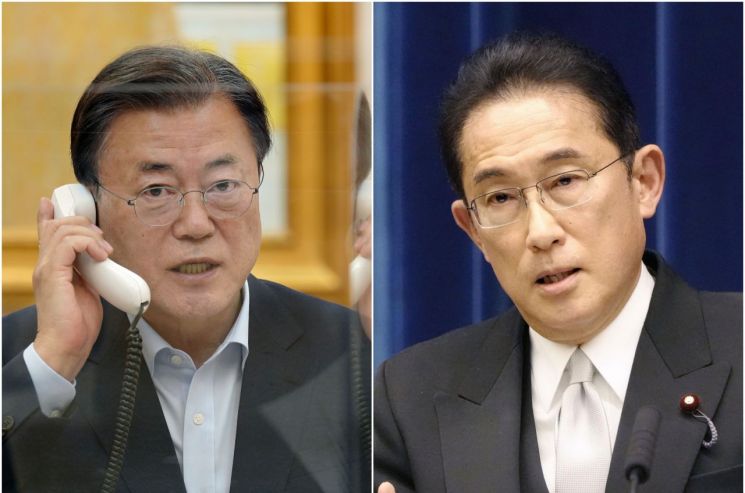
[Asia Economy Reporter Lee Ji-eun] President Moon Jae-in had his first phone call with Japan's new Prime Minister Fumio Kishida, but the two countries' positions on historical issues remained unchanged.
During the call with Prime Minister Kishida on the afternoon of the 15th, President Moon stated regarding the forced labor issue, "The problem lies in the difference in legal interpretation of the scope of application of the 1965 Korea-Japan Claims Agreement," and added, "It is desirable to seek a diplomatic solution between the two countries."
Japan views the forced labor issue as resolved through the Korea-Japan Claims Agreement, but Korean courts have ruled that this agreement did not extinguish individual claims. While clearly stating South Korea's position, President Moon appeared to extend a hand to find a diplomatic resolution.
Regarding the comfort women issue, President Moon said, "I believe it is most important to seek a solution that the victims can accept while not harming diplomatic relations," and noted, "There are only thirteen surviving victims, so there is not much time for the two countries to resolve this."
However, after the call, Prime Minister Kishida met with reporters at the Prime Minister's Official Residence and demanded an appropriate response from South Korea regarding lawsuits on forced labor and Japanese military comfort women during the Japanese colonial period, showing no sign of stepping back from Japan's existing stance.
Japanese media also reported that the two leaders failed to narrow their differences during the call. The Yomiuri Shimbun reported that the call "ended in parallel lines," and the Nihon Keizai Shimbun also covered the news under the headline "Korea-Japan leaders at a standstill over forced labor issue."
The call between President Moon and Prime Minister Kishida took place on the 12th day of Kishida's tenure, three days later than former Prime Minister Suga's call on the 9th. Unlike Suga, who called South Korea after the United States and Canada, Kishida first spoke with Quad alliance countries such as the United States, Australia, and India, as well as leaders of the United Kingdom, China, and Russia. Japanese media interpreted this as South Korea being relegated to the second priority group rather than the first.
© The Asia Business Daily(www.asiae.co.kr). All rights reserved.












