Last Year, Financial Sector Debt Reached 6.5 Trillion KRW
Financial Institution Insolvency and Consumer Recession Could Become Triggers
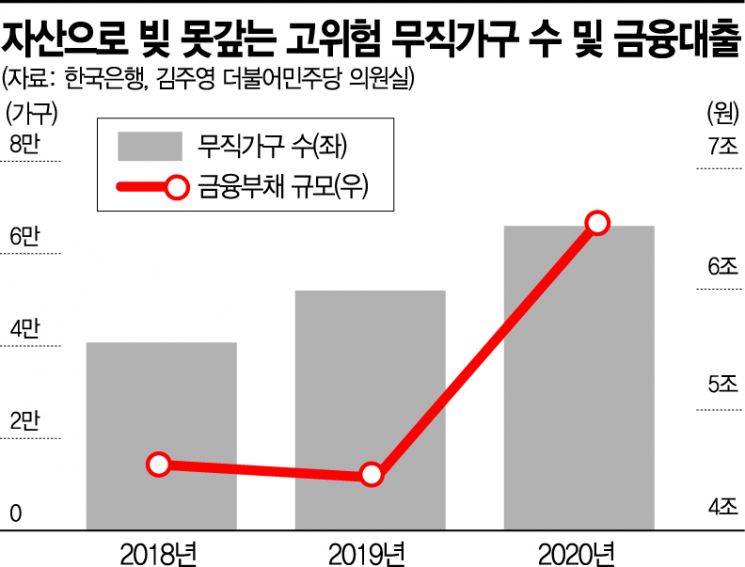
[Asia Economy Reporter Jang Sehee] The number of unemployed households classified as high-risk, unable to clear their debts even after selling all assets such as real estate and stocks, has increased by 65% over two years. The debt per unemployed household has also approached 100 million won. This is the result of a vicious cycle where reduced earned income due to job losses leads to borrowing again. With the burden of loan interest rising due to the increase in the base interest rate, the possibility of bankruptcy among vulnerable groups is expected to rise accordingly.
According to the "Status of the Proportion of Unemployed Households among High-Risk Households" submitted by the Bank of Korea to the office of Kim Ju-young, a member of the National Assembly's Planning and Finance Committee from the Democratic Party of Korea, the number of unemployed households among high-risk households reached 66,000 last year. This is an increase of 26,000 households (65%) compared to 40,000 households in 2018. High-risk households refer to those that find it difficult to fully repay their debts even after selling all their assets.
The financial sector debt of unemployed households classified as high-risk also reached 6.5 trillion won last year, averaging 98.48 million won per household. Their financial debt per household decreased from 112.5 million won in 2018 to 84.62 million won in 2019 but increased again last year.
There are concerns that the economic recession and worsening employment conditions amid the COVID-19 situation are fueling the increase in high-risk unemployed households. Especially as the economic power of vulnerable groups has further declined, it is expected to have adverse effects on the economy and society overall, including the widening wealth gap. Professor Sung Tae-yoon of Yonsei University pointed out, "The worsening employment situation seems to be reflected in the financial market as well," adding, "If the number of unemployed households increases, it could lead to insolvency of the relevant financial institutions." He also added, "Consumption across the economy could shrink significantly."
However, the financial burden on these vulnerable groups is expected to increase further. The Bank of Korea has made additional interest rate hikes within the year a foregone conclusion due to concerns over worsening financial imbalances and rising inflation. Bank of Korea Governor Lee Ju-yeol said in his opening remarks at the National Assembly audit on the same day, "We plan to adjust the degree of monetary policy easing in line with improvements in financial and economic conditions." However, he also stated, "We will continuously improve support systems for loans to vulnerable sectors."
© The Asia Business Daily(www.asiae.co.kr). All rights reserved.












