Due to consecutive tightening of loans, even banks with decades of transactions are finding it difficult to provide loans.
[Asia Economy Reporter Park Sun-mi] "My main bank says that mortgage loans are temporarily unavailable until November. Is there any bank where mortgage loans are still possible?"
The concept of a main bank is gradually fading. There are frequent cases where financial transactions are conducted under much better conditions at other banks rather than the main bank, and recently, due to a series of tightened loan regulations, even banks that customers have dealt with for decades are rejecting loan applications.
According to the financial sector on the 28th, internet real estate and finance communities are increasingly posting complaints from customers who have been rejected for loans by their main banks. These customers expressed frustration that their long-term banks have stopped handling loan products, leaving them unable to access funds when needed, let alone receive benefits. Along with inquiries about banks where loans are possible or where the maximum loan limit can be obtained, advice to compare loan limits and interest rates through consultations with loan specialists introduced by real estate agents or by visiting multiple banks in person is also noticeable.
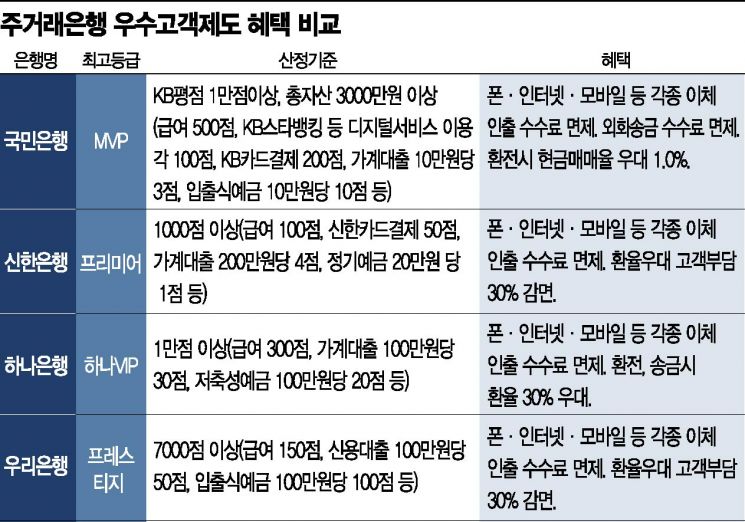
In the market, the prevailing view is that the significance of the main bank’s premium customer system is inevitably diminishing. This is because product comparison is becoming increasingly active through fintech and open banking, making access to other banks’ products much easier. Currently, the top-tier customers of the four major commercial banks commonly receive benefits such as exemption from various transfer and withdrawal fees via phone, internet, and mobile, as well as partial reductions in customer burden on preferential exchange rates.
Even with high grades, difficulty in funding due to suspension of loan product sales
For example, in KB Kookmin Bank’s KB Star Club system, to achieve the highest MVP grade, one must meet total assets of over 30 million KRW and a score of over 10,000 points. The scoring is meticulously divided by product, such as 300 points for salary transfers, 3 points per 100,000 KRW of loans, and 10 points per 100,000 KRW of deposits, making it difficult to achieve the highest grade with just ordinary transactions.
Shinhan Bank’s Top Club system requires a score of over 1,000 points to reach the highest Premier grade. Points can be accumulated through salary transfers (100 points), Shinhan card payments (50 points), household loans (4 points per 2 million KRW), and time deposits (1 point per 200,000 KRW). Customers with this grade receive benefits such as exemption from various transfer and withdrawal fees via phone, internet, and mobile, and a 30% reduction in customer burden on preferential exchange rates.
A bank customer explained, "Because of the benefits that come with a high grade, I continue to transact with one bank, but in the current situation where loan handling varies by bank, regardless of being a premium customer, I look for banks where loans are possible and the limits are high. Since services are similar across banks, switching banks does not cause much inconvenience."
Prolonged loan tightening will inevitably lead to loss of loyal customers
As loan tightening by banks is likely to continue until next year, it is expected that existing loyal customers will actively move. If one qualifies as a top-tier customer of their main bank, it is easy to meet preferential interest rate conditions for various financial products, but even without a high grade, there is a path to receive preferential benefits by simply meeting the basic conditions required for loans.
A representative from a commercial bank said, "Due to the suspension of loan product handling, customers have no choice but to look for banks where loans are possible. When they settle in a new bank that offers loans, they inevitably take additional actions such as moving their salary accounts or installing the bank’s application to receive even slight interest rate benefits."
Meanwhile, the household loan growth target set by financial authorities for this year has reached its limit. The authorities plan to manage the household loan growth rate at 5-6% annually this year and around 4% next year. Although more than three months remain until the end of the year, among commercial banks, Hana Bank (4.89%) and Kookmin Bank (4.31%) have loan growth rates approaching 5%, while Woori Bank (3.72%) and Shinhan Bank (2.61%) have some leeway.
© The Asia Business Daily(www.asiae.co.kr). All rights reserved.












