Increase in Rider Accidents... Safety Measures Discussion Only Recently Started
Assigning Responsibility and Examining Control and Management in Each Accident
Industry "Major Accident Punishment Act Should Be Deferred Until Measures Are Established"
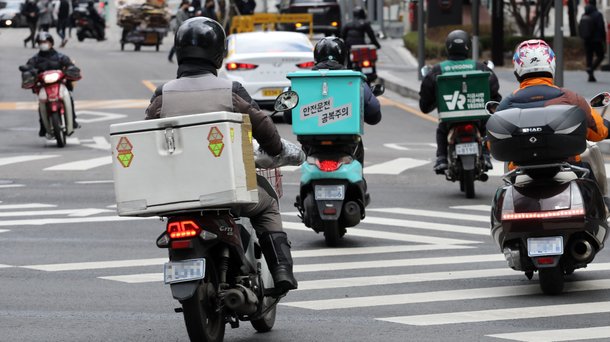
[Asia Economy Reporter Kim Bo-kyung] On the 30th of last month, a delivery rider in his 60s was fatally struck by a sports utility vehicle (SUV) in Geumcheon-gu, Seoul. The rider, who was delivering food and equipped with safety gear including a helmet, was hit from behind by the SUV driver and died on the spot. A representative of the delivery company said, "The rider had only recently started delivery work, and considering his age, we assigned him a smaller number of deliveries," adding, "If business owners are held responsible every time an accident occurs under the Serious Accident Punishment Act, it will only produce more lawbreakers and make it difficult to properly operate the business."
No Rider Protection Measures... Concerns Over 'Mass Production of Lawbreakers'
The delivery market has rapidly grown due to the COVID-19 pandemic, and accidents causing death or injury during work have also increased significantly. According to data obtained by Democratic Party lawmaker Lim Ho-seon from the Road Traffic Authority, nationwide motorcycle accidents increased from 18,241 cases in 2017 to 17,611 in 2018, 20,898 in 2019, and 21,258 in 2020. The number of fatalities during the same period hovered around 500 annually, with an average of 103 injuries per day. Particularly, as the industry competition intensifies with single-order delivery and fast delivery models that generate revenue per delivery, riders are being pushed into blind spots. Only recently have public-private joint discussions begun to establish safety measures for delivery motorcycles.
In this context, the industry views the Serious Accident Punishment Act, which will be enforced from January next year, as a significant managerial burden. The problem lies in the ambiguity over who should be held responsible when a serious accident occurs. The delivery ecosystem is highly complex, consisting of △delivery applications like Baedal Minjok and Coupang Eats △restaurant owners △delivery agency platforms such as Barogo, Saenggakdaero, and Vroong △and about 700 regional delivery agencies. A Ministry of Employment and Labor official stated, "Responsibility may vary depending on whether the entity only mediates delivery or has contractual relationships that control and manage workers," adding, "Specific details by industry have not been pre-established."
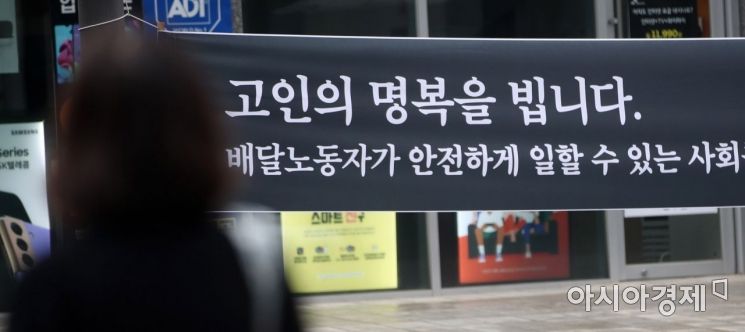 On the 29th, a memorial space was set up in front of Seolleung Station in Gangnam-gu, Seoul, for a platform delivery rider who was hit and killed by a truck on a road near Seolleung Station on the 26th. Photo by Jinhyung Kang aymsdream@
"Calling Responsible Parties When Accidents Occur"... Safety Management System Standards Also Unclear
Another blind spot is the need to investigate whether business owners are responsible every time a major accident occurs during delivery. For example, if a rider dies after removing their helmet against instructions to wear one, it must be examined whether the business owner bears responsibility. A Ministry of Employment and Labor official acknowledged, "The purpose of this law is to ensure that management does not focus solely on cost reduction and profit generation but establishes systems for worker safety," but also admitted, "The summons for investigation to determine whether the business owner or management fulfilled their safety responsibilities after an accident can be burdensome."
Moreover, standards for the safety and health management systems that business owners must establish are not clear. A delivery industry representative said, "Currently, the system relies on riders self-checking whether they are wearing helmets through the app," adding, "The government is in favor of strengthening regulations further, such as using facial recognition technology to verify helmet use."
Delivery agency work is a purely freelance occupation, and policies for rider safety education have not been properly established. For example, delivery agency company A conducts indoor training for riders using video materials distributed by the National Police Agency and the Korea Transportation Safety Authority before deploying them in the field. The industry is considering "establishing safety training centers where professional instructors provide education," and argues that "the application of the law should be deferred until practical measures to prevent rider accidents are put in place."
© The Asia Business Daily(www.asiae.co.kr). All rights reserved.












