[Asia Economy Reporter Ji-hwan Park] Korea Investment & Securities evaluated on the 26th that Uber Technologies is expected to turn profitable faster than anticipated due to continued improvement in its performance.
Uber is a smartphone-based mobility technology platform. It provides customer transportation services through ride-sharing, freight transportation services connecting shippers and truck drivers, and food delivery services connecting riders and restaurants. As of the second quarter of this year, the revenue composition is 41% from ride-sharing, 50% from food delivery, and 9% from others. More than 70% of total revenue is generated in the US and Europe, but it also holds stakes in emerging market mobility platforms such as China's Didi Chuxing (14%) and Southeast Asia's Grab (16%).
Recently, there has been an evaluation that the restructuring focused on profitability is showing effects. Tae-wan Oh, a researcher at Korea Investment & Securities, stated, "It is positive that the management policy is shifting from ‘early market capture and securing future growth engines’ to ‘sustainable growth centered on profitability.’"
Following the layoff of 3,700 employees, accounting for 14% of the total workforce, in May last year, in December Uber sold its air taxi division (Uber Elevate) to aviation startup Joby Aviation and its autonomous driving division (ATG) to autonomous driving startup Aurora. Researcher Oh said, "Instead of investing long-term in divisions exposed to technical uncertainties and regulatory risks, Uber can now focus on divisions that show immediate results."
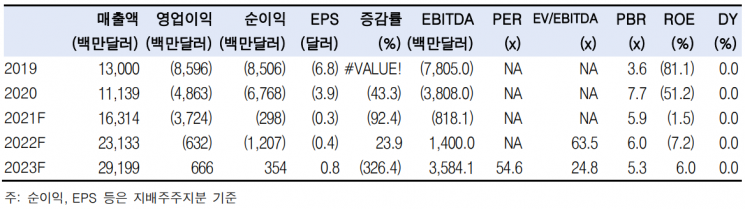
He forecasted that the food delivery segment (Uber Eats) high growth and the continued profitability improvement in the ride-sharing segment will enable reaching the break-even point based on EBITDA in the third quarter. He analyzed, "Especially, the Gross Booking Value (GBV) of the food delivery segment increased from $4 billion per quarter before COVID-19 to $12 billion, and the commission rate rose from below 10% to the mid-teens. Although the ride-sharing segment faced difficulties due to driver recruitment and reduced mobility caused by COVID-19, the volume of rides is increasing and the commission rate is entering a normalization phase, rapidly improving profitability."
Uber itself has also raised its third-quarter EBITDA guidance from the previous -$100 million to a range of -$25 million to $25 million, increasing expectations for turning profitable.
© The Asia Business Daily(www.asiae.co.kr). All rights reserved.












