Below 20% for the First Time in About 23 Months
KOSPI Composition Diversifies Unlike Past Semiconductor Dependence
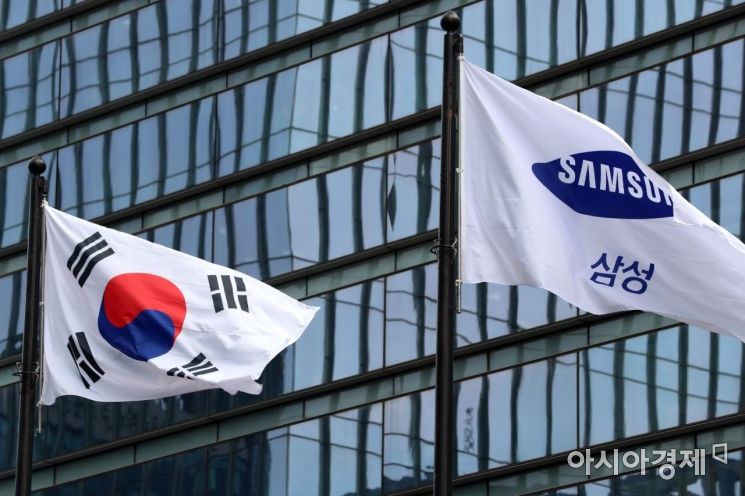 On the 12th, one day before the parole of Samsung Electronics Vice Chairman Lee Jae-yong, the Samsung flag was fluttering at the Samsung Electronics Seocho Building in Seocho-dong, Seoul. Vice Chairman Lee was sentenced to 2 years and 6 months in prison and detained in court during the retrial in January. Having already served one year in detention during the first trial, he completed more than 60% of his sentence and was subject to parole review under the relaxed screening criteria. Photo by Kim Hyun-min kimhyun81@
[Asia Economy Reporter Gong Byung-sun] Samsung Electronics' market capitalization (market cap) weight has fallen below 20% of the entire KOSPI market for the first time in 23 months. However, unlike the past when it was heavily dependent on the semiconductor sector, various industries such as platforms and batteries have brought diversity to the stock market.
According to the Korea Exchange on the 15th, as of the 13th, Samsung Electronics' market cap was 444.151 trillion KRW, down 3.38% from the previous day.
On the 13th, the total KOSPI market cap was 2,285.376 trillion KRW, of which Samsung Electronics accounted for 19.43%. Samsung Electronics' market cap weight was 20.17% on the 11th but fell to 19.87% on the 12th, remaining below 20% for two consecutive days.
Samsung Electronics' market cap weight falling below 20% is the first time in 23 months since September 4, 2019 (19.84%). At that time, Samsung Electronics' stock price was 44,100 KRW, and its market cap was 263.267 trillion KRW. The 19.43% market cap weight as of the closing price on the 13th is the lowest since July 8, 2019 (19.27%).
Until the first half of this year, Samsung Electronics' market cap weight significantly exceeded 20%. On January 11, Samsung Electronics' market cap was 543.25 trillion KRW, accounting for 25.01% of the KOSPI market cap. On March 19 last year, Samsung Electronics' market cap rose to 256.402 trillion KRW, reaching 26.10% of the entire KOSPI.
However, concerns over the semiconductor industry's downturn have increased recently, causing Samsung Electronics' stock price to fall. It closed at 82,900 KRW on the 4th but has since dropped about 10.25%. In particular, it has declined for four consecutive trading days since the 10th.
Although Samsung Electronics' weight has fallen below 20% for the first time in about two years, the domestic stock market situation has changed. On September 4, 2019, the KOSPI was 1,988.53, and the total market cap was only 1,326.785 trillion KRW. Currently, the KOSPI stands at 3,171.29, and the total market cap has increased by nearly 1,000 trillion KRW.
Unlike the past when it relied on semiconductors, various industries are now leading the stock market. Platform companies such as Naver and Kakao have made significant advances, and battery stocks and the automobile sector have also grown. Additionally, large IPO stocks such as KakaoBank and HYBE have appeared, increasing the market cap of newly listed stocks by nearly 200 trillion KRW last year and this year.
© The Asia Business Daily(www.asiae.co.kr). All rights reserved.












