KAIST Professor Choi Byeokpa's Team Reveals 3D Distribution of Ligand Molecules on Nanoparticle Surfaces Using Atomic Layer Tomography Technology
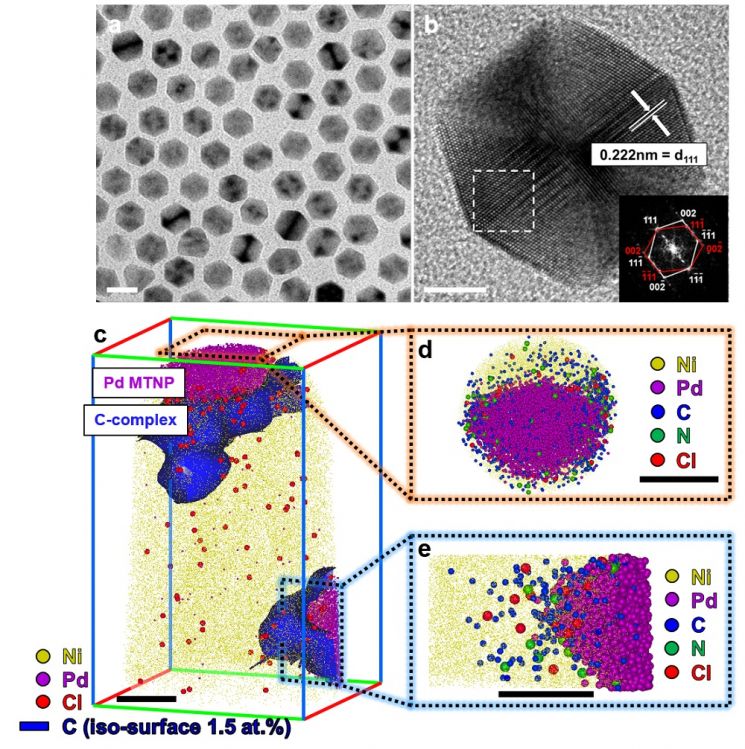 Distribution of palladium nanoparticles and ligands analyzed by Transmission Electron Microscopy (TEM) and Atom Probe Tomography (APT). (a,b) TEM images of nanoparticles used for atom probe tomography. (c~e) Distribution of palladium nanoparticles and cetyltrimethylammonium ligands (C19H42ClN) present on the particle surface revealed by atom probe tomography. Image courtesy of KAIST
[Asia Economy Reporter Kim Bong-su] The Korea Advanced Institute of Science and Technology (KAIST) announced on the 9th that a research team led by Professor Choi Byeok-pa of the Department of Materials Science and Engineering, in collaboration with Professor Lee Sang-heon of Ewha Womans University, has for the first time identified the three-dimensional distribution of ligand molecules present on the surface of nanoparticles using atomic layer tomography technology.
Ligands (Capping ligands) are organic molecules generated during the synthesis of metal nanoparticles. It has been revealed that they not only prevent aggregation between particles but also control the shape and various properties of the particles, increasing their importance in the synthesis and design of nanoparticles.
To analyze the spatial distribution of ligands composed of complex organic molecules, a technology capable of atomic-scale spatial resolution, high detection sensitivity for light elements, and three-dimensional analysis is required. Due to the lack of such analytical technology, there have been no cases of observing the distribution of ligands on nanoparticle surfaces in three dimensions until now. As a result, the behavior of ligands during particle synthesis remains largely unknown. For example, bromide (Br) ions, which are halide ligands, are known to promote the formation of cubic metal nanoparticles, but several papers have reported different results.
Professor Choi’s research team succeeded in observing the three-dimensional distribution of cetrimonium ligands (Cetrimonium chloride) present on the surfaces of two types of palladium nanoparticles synthesized using different halide ligands at the atomic level by utilizing atom probe tomography.
Atom probe tomography is an analytical technique that sequentially evaporates atoms from the surface of a specimen processed into a very thin needle shape by applying high voltage or high-energy pulses, causing them to collide with a detector. Using the recorded collision positions, collision order, and mass-to-charge ratio of the atoms on the detector, the three-dimensional atomic distribution of the specimen is reconstructed.
This atom probe tomography technology not only enables three-dimensional atomic-scale analysis and chemical quantitative analysis but also offers excellent detection sensitivity at the ppm level for all elements with spatial resolution at the angstrom scale (one ten-billionth of a meter), attracting significant attention recently in the field of materials analysis.
The research team calculated the density of cetrimonium ligands present on the surface of each nanoparticle from the tomography data of the three-dimensional ligand distribution. Through this, the researchers identified previously unknown interactions between cetrimonium ligands and halide ligands. These interactions between different ligands determine the final shape and oxidation resistance properties of nanoparticles and explain why previous research results were inconsistent.
Professor Choi said, "The significance lies in presenting experimental and theoretical results that can encompass previously conflicting research findings," adding, "We expect this to enhance fundamental understanding of nanoparticle synthesis and be applied to designing nanoparticles with superior properties."
The research results were published online on the 14th of last month in the international academic journal 'Nature Communications.'
© The Asia Business Daily(www.asiae.co.kr). All rights reserved.












