Bank of Korea Announces June 2021 and First Half International Balance of Payments (Provisional)
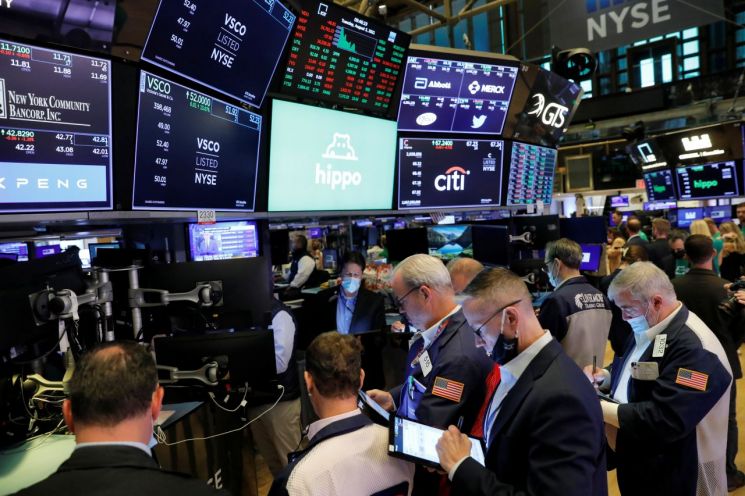 Traders are working at the New York Stock Exchange (NYSE) in Manhattan, New York, USA. [Image source=Yonhap News]
Current Account Surplus of $44.34 Billion in the First Half... 2.3 Times Higher than Last Year
Exports Up 26.6%, Imports Up 23.6% YoY... Impact of Global Economic Recovery
[Asia Economy, Reporter Kim Eunbyeol] In the first half of this year, domestic investors' overseas stock investments increased by $39.47 billion, marking the largest increase ever. This is due to the stock market boom continuing since last year, with not only individuals but also non-financial corporations investing in overseas stocks.
According to the Bank of Korea's announcement on the 6th, domestic investors' overseas stock investments increased by $39.47 billion in the first half, showing the largest increase on a half-year basis. The second largest was $28.48 billion in the first half of last year, and the third was $27.84 billion in the second half of last year. Following the COVID-19 pandemic, as money flooded globally and overseas stock investment yields were high, many rushed into overseas stock investments.
The scale of domestic investors' overseas bond investments recorded $710 million in the first half, and the total overseas securities investment including stocks and bonds amounted to $40.18 billion.
On the other hand, foreigners realized gains on domestic stocks and withdrew $13.58 billion in the first half. Instead, foreigners' domestic bond investments increased by $46.42 billion, marking the largest increase ever. It is understood that domestic bonds attracted investment because they are stable yet offer relatively high yields.
With the global economy recovering faster than expected since the beginning of this year, exports increased, leading to a significant rise in the current account balance. The current account surplus in the first half was $44.34 billion, an increase of $25.3 billion compared to $19.04 billion in the first half of last year. This is about 2.3 times higher than the first half of last year. The current account surplus in the first half of last year was the smallest in eight years due to the impact of COVID-19, but this year showed a completely different picture.
The main driver of the current account surplus in the first half was exports. Exports in the first half reached $301.79 billion, up 26.6% ($63.39 billion) compared to $238.4 billion in the same period last year. As major countries' economies recovered, exports of most items increased, including passenger cars (50.4%), auto parts (42.8%), chemical products (39.6%), steel (28.7%), and semiconductors (21.2%). By region, exports to the European Union (EU) increased by 44.5%, showing the largest growth, followed by the United States (34.5%), China (23.9%), Southeast Asia (21.2%), and Japan (11.5%).
Imports also increased across the board due to rising raw material prices, expanded exports and facility investments, and improved consumer sentiment, with raw materials (25.5%), capital goods (22.9%), and consumer goods (22.7%) all rising. Imports in the first half were $263.62 billion, up 23.6% ($50.35 billion) compared to the first half of last year. The trade balance, which is the difference between exports and imports, recorded a surplus of $38.17 billion, expanding by $13.04 billion compared to the same period last year.
The service account deficit in the first half was $2.9 billion, narrowing by $6.69 billion compared to the same period last year. This was influenced by a sharp increase in freight transport demand along with the economic recovery, which significantly increased freight transport income. The Shanghai Containerized Freight Index (SCFI) in the first half of this year rose 232.2% compared to the same period last year. Accordingly, transport income increased by $19.33 billion, resulting in a record-high transport surplus of $5.81 billion.
Meanwhile, on a monthly basis, the current account surplus in June recorded $8.85 billion, expanding by $1.68 billion compared to $6.18 billion in June last year. Exports in June were $53.63 billion, and imports were $46.02 billion. The service account recorded a deficit of $950 million.
© The Asia Business Daily(www.asiae.co.kr). All rights reserved.












