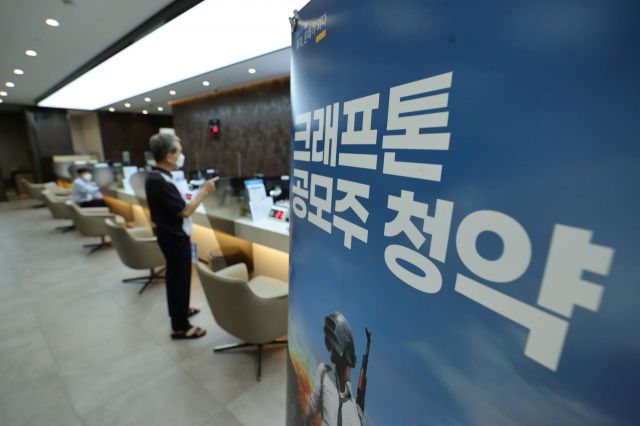
[Asia Economy Reporter Lee Seon-ae] Amid the ongoing controversy over the 'overvalued IPO price,' the employee stock ownership association (ESOP) subscription rate for Krafton, which failed in its subscription, also appeared to be very low.
According to the securities issuance performance report disclosed by Krafton on the 5th, the initially allocated IPO shares to the ESOP were 1,730,846 shares, but the final allocated shares after subscription amounted to only 351,525 shares. The ESOP subscription rate was 20.3%. There were 1,379,321 forfeited shares.
Looking at the ESOP subscription rates of other large IPOs, Kakao Games had a perfect 100%, followed closely by Kakao Bank (97.4%), SK Bioscience (97.8%), and HYBE (99.7%). Even SK IE Technology (66.0%) and SK Biopharm (62.5%), which had relatively lower ESOP subscription rates, exceeded 60%.
Earlier, Krafton recorded a poor performance in the general subscription with a deposit of 5.0358 trillion KRW and a competition rate of 7.79 to 1, failing to quell the controversy over the overvalued IPO price. Krafton's IPO price was 498,000 KRW, and the total IPO amount was 4.3098 trillion KRW, the second largest ever.
The mandatory lock-up ratio for institutional investors was calculated at 44.91%. In other words, more than half of the institutional shares are not subject to lock-up and can be traded immediately after listing. Based on the allocated shares, Krafton's lock-up ratio was significantly lower than Kakao Bank (59.82%), SK IE Technology (64.57%), and SK Bioscience (85.26%).
Out of the 5,706,436 shares allocated to institutions by Krafton, 2,562,603 shares were subject to mandatory lock-up agreements ranging from a minimum of 15 days to a maximum of 6 months.
By lock-up period, 3 months accounted for the largest portion with 1,354,953 shares (23.8%), followed by 1 month with 966,400 shares (16.9%), 6 months with 210,900 shares (3.7%), and 15 days with 30,350 shares (0.5%).
Notably, among foreign institutions that received 3,427,011 shares, the lock-up shares amounted to only 20%, combining 2,500 shares (0.1%) locked up for 3 months and 683,500 shares (19.9%) locked up for 1 month. The lock-up ratio for domestic institutions, which were allocated 2,279,425 shares, was 82.33%.
© The Asia Business Daily(www.asiae.co.kr). All rights reserved.












