[Asia Economy Reporter Ki-min Lee] Although employment sentiment has recently improved, recovery trends vary by industry, leading to calls for the government to extend the employment retention subsidy period and support the competitiveness of small self-employed businesses.
The Korea Employers Federation (KEF) identified three key characteristics of recent employment trends in its report "Three Features and Implications of Recent Employment Flows," released on the 5th: ▲ improvement in employment sentiment ▲ asymmetric employment recovery by industry ▲ increase in self-employed without employees (solo entrepreneurs).
The report stated that due to this year's economic recovery, more companies are experiencing labor shortages and increasing new hiring, indicating improved employment sentiment. According to the Ministry of Employment and Labor's survey, the number of planned hires by companies in the second and third quarters of this year was 296,000, a 24.2% increase compared to the same period last year. The job openings-to-applicants ratio also rose for five consecutive months since February, reaching 55.2% in June.
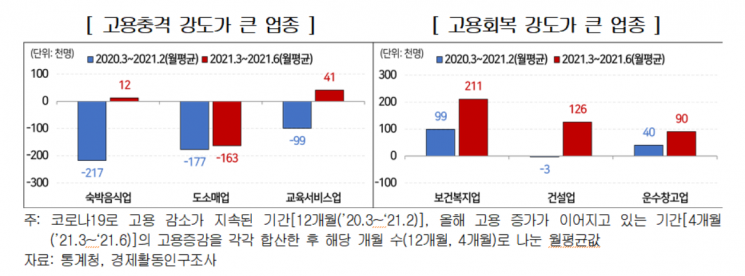
However, industries severely impacted by COVID-19, such as accommodation and food services, wholesale and retail trade, and education services, showed less employment growth or even declines during the recovery period compared to other sectors.
Conversely, health and welfare, construction, and transportation and warehousing industries, which saw employment increases or smaller declines despite COVID-19, experienced relatively larger employment growth.
Notably, industries with severe employment shocks had not recovered to pre-COVID-19 employment levels by June this year, whereas industries with strong employment recovery surpassed pre-pandemic levels since February.
However, employment growth in health and welfare, construction, and transportation and warehousing was mainly driven by temporary/daily workers and self-employed without employees. Among the 211,000 new health and welfare workers from March to June this year, 70.5% were temporary or daily workers. The number of self-employed without employees has also increased for ten consecutive quarters since the first quarter of 2019.
KEF emphasized the need to extend the employment retention subsidy period for industries severely affected by COVID-19 and support the competitiveness of small self-employed businesses to ensure that economic recovery leads to full employment recovery.
Lim Young-tae, head of KEF's Employment Policy Team, said, "Following the third quarter, when social distancing was strengthened due to the resurgence of COVID-19, employment market uncertainties are expected to expand significantly. The employment retention subsidy period should be extended until the first half of next year for industries such as tourism accommodations and airlines."
© The Asia Business Daily(www.asiae.co.kr). All rights reserved.












