Rapid Increase in Jeonse Prices Accelerates Loans
Despite July Off-Season, Loans Rise by 2 Trillion Won from Previous Month
Loan Balance May Reach 130 Trillion Won This Year
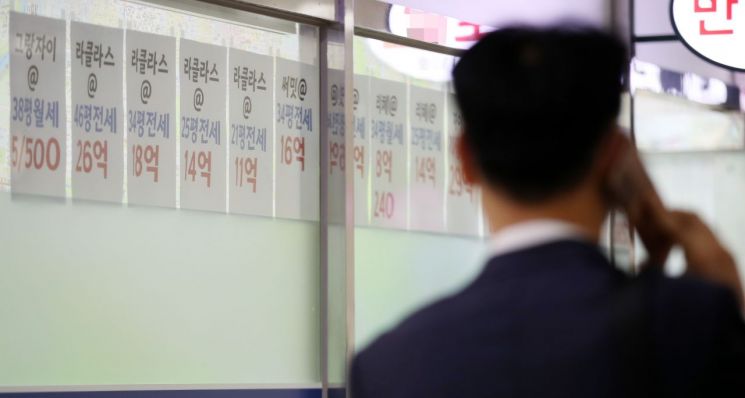
[Asia Economy Reporter Kiho Sung] Park Seongmin (36 years old, pseudonym), who works in Seoul, faced a deep dilemma while looking for a jeonse deposit for his newlywed home ahead of his October wedding. The jeonse deposit for a 59m² apartment in the area Park and his spouse are considering surged to 350 million KRW. Since tenants with a jeonse deposit exceeding 300 million KRW in the metropolitan area cannot receive the government-supported ‘Buteummok Jeonse Fund,’ they ultimately had no choice but to turn to bank jeonse loans.
As jeonse prices soared, jeonse loans increased by as much as 13 trillion KRW in the first half of this year. In particular, despite July being an off-season due to the rainy season and summer vacations, jeonse loans rose by about 2 trillion KRW compared to the previous month, accelerating the surge in jeonse loans. With the full-fledged moving season in the second half of the year, jeonse prices may rise even further, and there are predictions that the total jeonse loan balance could exceed 130 trillion KRW this year.
According to the financial sector on the 5th, the jeonse loan balance at the end of July for the five major banks?KB Kookmin, Shinhan, Hana, Woori, and NH Nonghyup?was 118.3064 trillion KRW, an increase of 1.9727 trillion KRW from the previous month. If this trend continues, it is expected to exceed 120 trillion KRW by the end of August.
The jeonse loan balance is also showing a sharp upward trend compared to last year. The jeonse loan balance, which was 106.7176 trillion KRW in January this year, increased by 13.2076 trillion KRW in seven months. This figure is over 1 trillion KRW higher than the 12.1399 trillion KRW increase during the same period last year.
The problem is that the loan amount surged even during the off-season, which is not the usual moving season. The jeonse loan balance exceeded 2 trillion KRW during the moving season from February to April but decreased to around 1.5 trillion KRW by the end of June. However, it turned to an increase in July, an off-season due to the rainy season and summer vacations, and when the government implemented the Debt Service Ratio (DSR).
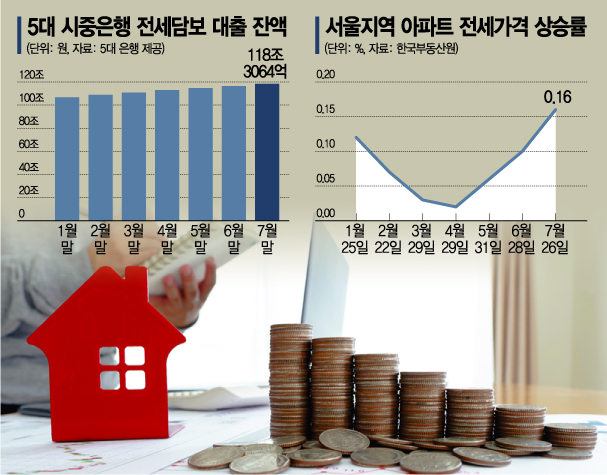
The background for this is attributed to the simultaneous rise in jeonse prices as housing prices surged. According to the Korea Real Estate Board, the jeonse price change rate for apartments in Seoul in the fourth week of July recorded a 0.16% increase. This surpassed the highest rate this year of 0.12% in January and was the largest increase since the first week of August last year (0.17%), right after the new lease law was implemented. The apartment prices in the metropolitan area rose by 0.36% in the fourth week of July, marking the highest increase for two consecutive weeks since statistics began in May 2012.
Lee Eunhyung, a senior researcher at the Korea Construction Policy Institute, analyzed, "Since July is usually an off-season for moving, it is difficult to say that the number of jeonse loan cases itself increased. However, overall real estate prices are rising, and accordingly, jeonse prices themselves are increasing, which has led to an increase in loan balances."
The market expects more jeonse loans to be made with the autumn moving season. Accordingly, there are predictions that the jeonse loan balance could exceed 130 trillion KRW this year. There is concern that if the jeonse loan balance rises sharply, a future drop in housing prices could lead to jeonse loan defaults.
The senior researcher said, "Typically, moves are made mostly in spring and autumn, excluding cold or hot seasons. Considering the increase rate during this spring moving season and forecasting demand for the autumn moving season, the demand for jeonse loans this year could approach 130 trillion KRW."
© The Asia Business Daily(www.asiae.co.kr). All rights reserved.













