Enhancing Village Bus Service Quality to Strengthen Citizen-Centered Transportation Welfare
Increasing Village Bus Stop BIT Installation Rate to 55.5% and Promoting Introduction of 600 Eco-Friendly Buses Including Electric Low-Floor Buses by 2026
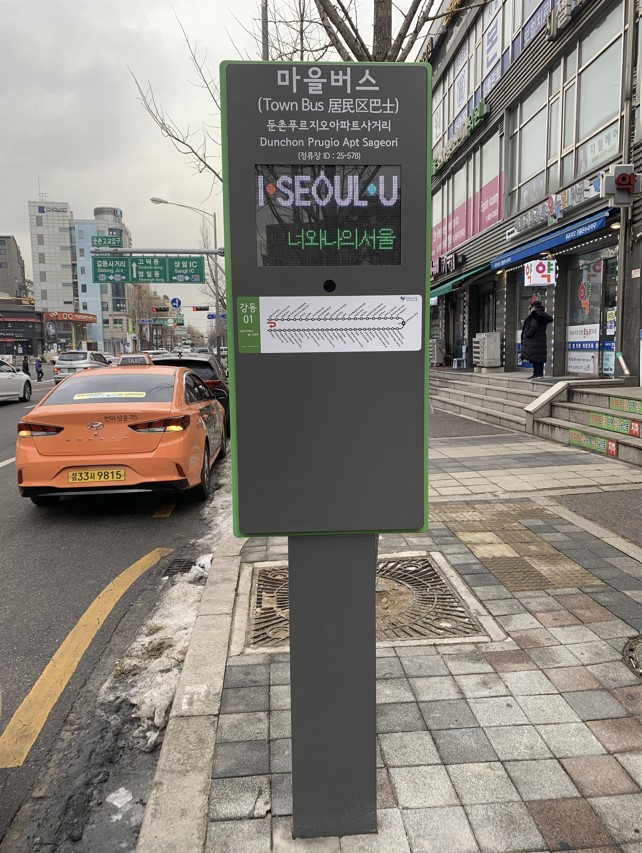
[Asia Economy Reporter Lim Cheol-young] The Seoul Metropolitan Government is set to improve the service quality of village buses, used by 880,000 people daily, to the level of city buses by upgrading outdated facilities such as bus stops and vehicles.
On the 5th, Seoul announced plans to increase the installation rate of BITs (Bus Information Terminals), which provide bus arrival information, from the current 32.4% to 55.5% by 2026 by adding BITs to 1,271 village bus stops.
Seoul plans to invest 10.2 billion KRW to prioritize installation at 600 major locations with daily ridership of over 300 by 2023 and complete installation at 1,271 stops by 2026. Out of the total 5,525 village bus stops, BITs will be installed at more than half, 3,066 stops, allowing passengers to conveniently check bus arrival information on village buses just like on city buses.
The management of village bus stop BITs will also be unified under the Seoul Metropolitan Government. Previously, maintenance was handled by the village bus companies operating the respective routes.
Currently, there are only 10 electric buses, but Seoul aims to purchase subsidies to introduce and replace an additional 600 electric buses by 2026. Electric buses offer a smooth ride with minimal vibration and, given the nature of village buses running through residential and local roads, switching to noiseless and eco-friendly electric buses is expected to reduce noise and exhaust emissions around residential areas.
Safety and convenience facilities on village bus vehicles will also be expanded. By the end of the year, all village buses will be equipped with new high-definition CCTV systems. So far, 822 buses, accounting for 50% of all village buses in Seoul, have been equipped, and an additional 800 million KRW will be invested to complete installation on the remaining 825 buses. Upgrading to high-definition CCTV will enable accurate assessment and handling of various incidents related to village buses and can also be utilized for COVID-19 epidemiological investigations.
Additionally, Seoul has completed installation of LED information boards displaying route numbers and stop names on 81% of all village buses and plans to invest an additional 700 million KRW by 2022 to finish installing them on the remaining 592 buses.
Meanwhile, alongside infrastructure improvements, Seoul plans to focus on management and education to enhance satisfaction among village bus users. Training will be provided to transportation workers on vehicle cleanliness and safe driving, and regular management will be conducted on frequently requested passenger services such as maintaining heating and cooling temperatures, announcement systems, and route information guidance.
Baek Ho, Director of Urban Transportation, said, "We expect this service improvement to create a more comfortable and safe environment for village bus users. We will do our best to enhance various conveniences for diverse passengers, including local residents and transportation-vulnerable groups, so that village buses, which serve as the lifeline for 880,000 daily users, can truly fulfill their role in transportation welfare."
© The Asia Business Daily(www.asiae.co.kr). All rights reserved.












