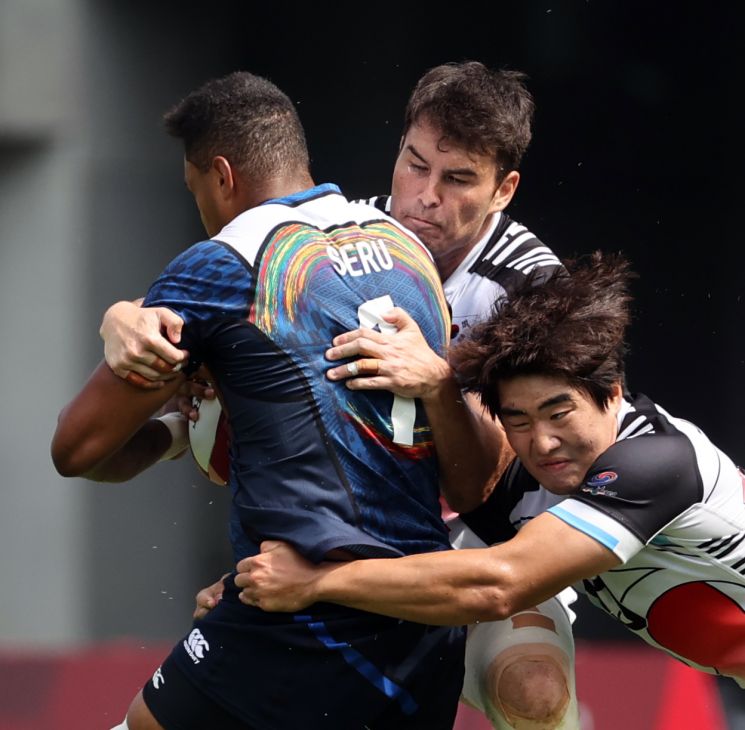
On the 28th of last month, there was a young man who sobbed bitterly for a long time at Tokyo Stadium in Japan. He was Kim Jin (Andre Jin Coquillard), Korea's first naturalized rugby player. With his Western appearance, he was always misunderstood. "Everyone asks if I'm a mercenary just by looking at my appearance, but I am Korean."
Kim Jin was born to a first-generation model, Kim Dong-su, a professor at Dongduk Women's University, and an American father. He naturalized as a Korean citizen in 2017. He was more disappointed than anyone else when Korea lost to Japan 19-31 (12-19, 7-12) in the 11th-12th place playoff of the Japan vs. Korea 7s rugby match. "Losing hurts, but losing to Japan hurts even more. I wanted to win the Korea-Japan match and raise the Taegeukgi at Tokyo Stadium." He also has a strong affection for Korean rugby. "My mother used to work as a model abroad and promoted Korea. Like my mother, I feel a sense of responsibility and want to promote Korean rugby to the world."
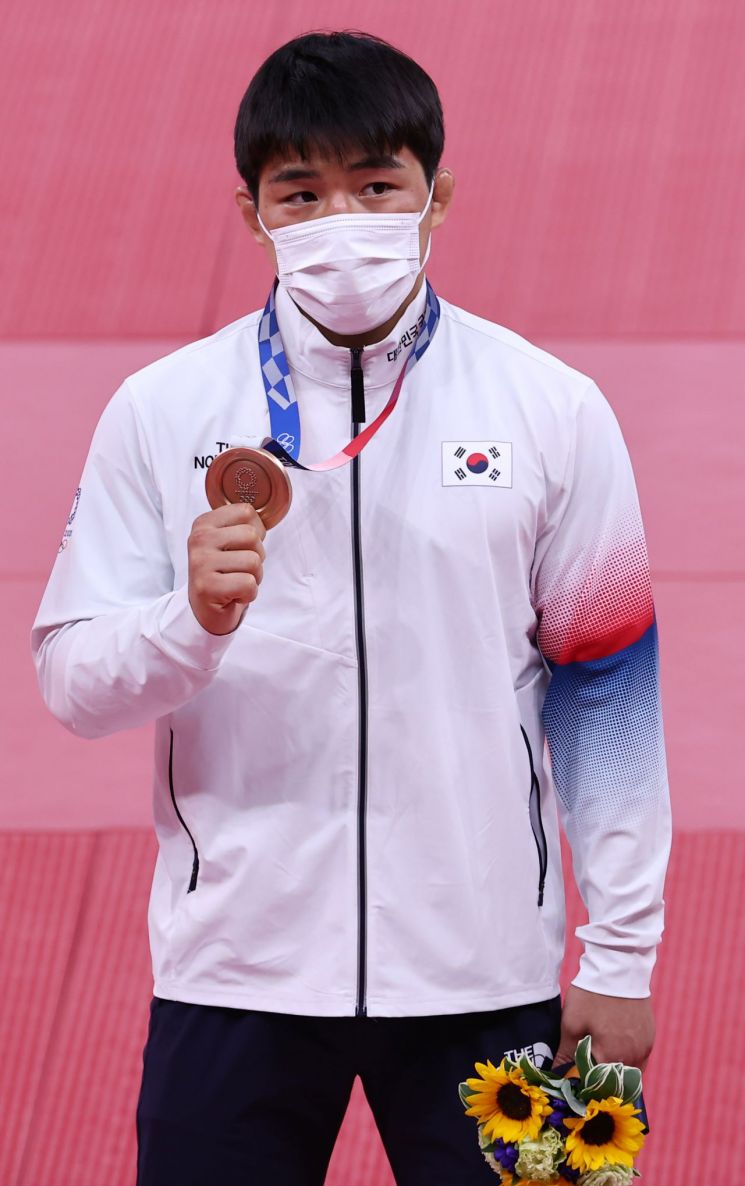
Judo athlete An Chang-rim, who won the bronze medal after four consecutive overtime battles, is also a third-generation Korean-Japanese who had to endure numerous discriminations. When he was recognized as the next ace in Japan, his judo coach at the time encouraged him to naturalize. Wanting to bring a medal to his homeland, he firmly refused and transferred to Yongin University. The following year, in 2015, he proudly wore the Taegeuk mark on his chest.
An Chang-rim was born in Kyoto, Japan, but never considered himself Japanese. However, in Japan, he was regarded as Korean, and in Korea, he was considered Japanese. Having to be treated as a foreigner everywhere, he mentioned discrimination against Korean-Japanese after winning the bronze medal. "I wanted to win a medal at the Olympics to improve perceptions of Korean-Japanese people. I hope children (of Korean-Japanese) gain strength by seeing me."
There are also foreigners who have made Korea their home through precious connections. O Juhan (track and field), originally from Kenya, obtained Korean nationality in 2018. His name means "running only for Korea (走韓)." His surname follows the late coach Oh Chang-seok, who taught him. Coach Oh was a leader who worked hard for the development of Korean marathon, serving as the director of the military sports marathon team. In 2007, while coaching promising marathon runners in Kenya, Coach Oh embraced O Juhan like family. Knowing this, O Juhan expressed a special determination ahead of his marathon race on the 8th. "I will definitely bring a medal to the grateful Republic of Korea, my new homeland."
© The Asia Business Daily(www.asiae.co.kr). All rights reserved.












