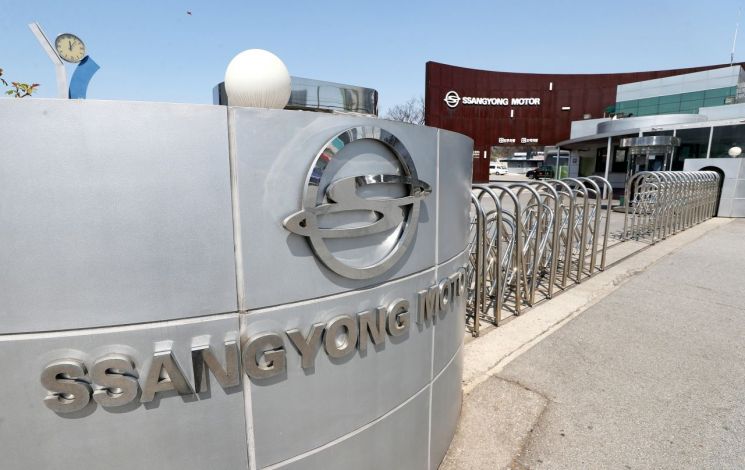
[Asia Economy Reporter Ki-min Lee] The acquisition battle for Ssangyong Motor, initially expected to have low interest, is heating up significantly with the participation of major domestic conglomerates and large private equity funds. The key factors for a successful acquisition are considered to be the candidates' financial mobilization capabilities and their expertise in eco-friendly electric vehicle businesses.
According to Ssangyong Motor and legal sources on the 31st, the lead sales agent EY Han Young Accounting Corporation closed the submission of letters of intent (LOI) yesterday, with a total of nine companies participating.
The companies entering the Ssangyong Motor acquisition battle are ▲ KS Project Consortium (including K-Pop Motors and three other companies) ▲ Edison Motors Consortium (including Edison Motors and two other companies) ▲ Samra Midas ▲ Cardinal One Motors ▲ Park Seok-jeon ▲ World Enercy ▲ INDI EV ▲ Future Motors Consortium (including Hyzen Solution and three other companies) ▲ ELB&T.
Initially, due to the investment cost reaching 1 trillion won, the industry widely believed that new acquisition candidates would be unlikely to appear. Therefore, the acquisition battle was mainly a two-horse race between Cardinal One Motors, a new corporation of the previous preferred bidder HAAH Automotive, and Edison Motors, a domestic electric bus specialist.
However, with SM Group entering the acquisition battle to synergize with its automotive parts affiliates Namseon Aluminum, Vexel, chemical fiber company TK Chemical, and to enter the electric vehicle market, the competition has turned into a three-way race.
It is observed that the ability to mobilize funds and expertise in eco-friendly electric vehicle businesses will determine whether these candidates can complete the acquisition. Ssangyong Motor plans to transition from producing internal combustion engine vehicles to eco-friendly vehicles and secure liquidity by selling and relocating its Pyeongtaek plant.
SM Group, newly entering the acquisition battle, has grown to rank 38th in the business world (as of last year) through various mergers and acquisitions (M&A) besides its construction business since its founding in 1988. SM Group, with total group sales reaching 5 trillion won last year, is reportedly planning to prepare acquisition funds using capital raised through the initial public offering (IPO) of its core affiliate SM Line and its own funds. However, since it submitted a preliminary listing review application to the Korea Exchange KOSDAQ Market Headquarters in mid-June, the progress will need to be monitored. The securities industry expects SM Line’s corporate value to exceed 3 trillion won, supported by recent surges in shipping freight rates.
In the case of Edison Motors, it has resolved doubts about its financial mobilization capability by forming a consortium with major domestic private equity firm Keystone Private Equity (PE) and micro electric vehicle manufacturer Ssemisysco. The participation of the existing negotiating party, Kang Sung-bu Fund (KCGI), will be confirmed once CEO Kang Sung-bu, currently in the U.S., returns.
Edison Motors plans to leverage its electric motor and battery management system (BMS) technologies to grow Ssangyong Motor into a global electric vehicle manufacturer and establish local joint ventures (JVCs) worldwide to produce and sell eco-friendly vehicles. However, Edison Motors’ sales amount to 89.7 billion won, less than one-thirtieth of Ssangyong Motor’s 2.9297 trillion won sales. Nevertheless, Edison Motors, which announced securing 270 billion won from individual investors and others, plans to raise an additional approximately 250 billion won through Ssemisysco’s paid-in capital increase and convertible bond (CB) issuance. Additionally, it plans to secure about 400 billion won from financial investors (FI) such as Keystone PE to fund the acquisition.
The participation of these companies is narrowing the position of Cardinal One Motors, the successor of the previously strong acquisition candidate HAAH Automotive. HAAH’s annual sales were only about 23 billion won as of 2019. Particularly, Duke Hale, chairman of Cardinal One Motors, recently stated plans to raise about 400 billion won for the Ssangyong Motor acquisition but has not disclosed the amount raised or key investors in detail. Since last year, HAAH has been suspected of lacking acquisition capability as it delayed by demanding that the Korea Development Bank provide matching funds if it invests in Ssangyong Motor.
Ssangyong Motor and the lead sales agent will review the submitted LOI packages, select qualified candidates for preliminary due diligence, and conduct the due diligence by the end of August. After the preliminary due diligence, acquisition proposals will be received in September, followed by the selection of preferred bidders, main due diligence, and investment contract procedures. The deadline for submitting Ssangyong Motor’s rehabilitation plan is September 1. Depending on the schedule for investment contracts and other sales procedures, the timeline may be delayed until after late October.
After the LOI submission deadline, Ssangyong Motor stated, "Many companies that submitted letters of intent expressed interest in expanding their electric vehicle business, which aligns with our current eco-friendly vehicle transition strategy. This will greatly help not only the possibility of mergers and acquisitions (M&A) but also the establishment of a long-term survival foundation."
© The Asia Business Daily(www.asiae.co.kr). All rights reserved.












