Controversy at Bangbae-dong Jokbal Restaurant Washing Radishes with a Loofah Used to Scrub Feet
Self-Employed Business Owner "Customers Were Few Already, Now They Will Decrease Even More" Frustrated
Expert "If Hygiene Is Not Maintained, the Damage Falls Entirely on the Business"
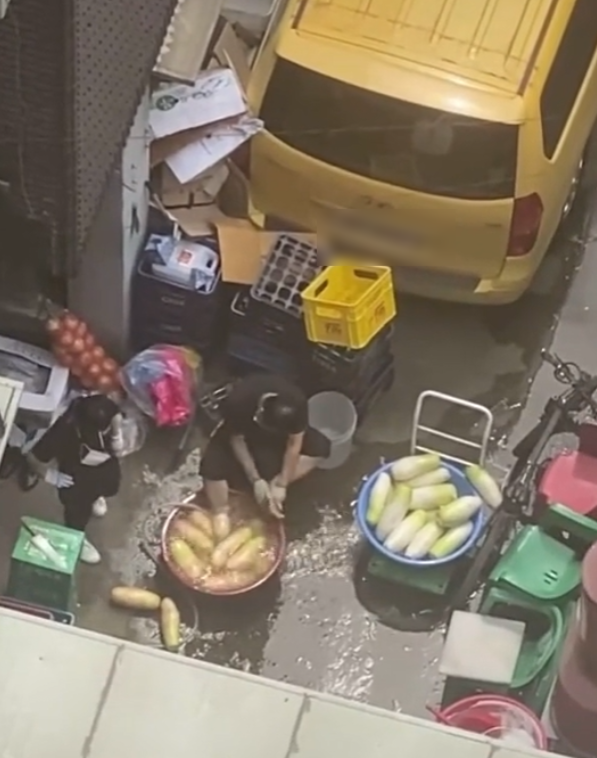 A video of a jokbal restaurant in Bangbae-dong, Seocho-gu, Seoul, criticized by netizens online for unhygienic radish washing. / Photo by Online Community
[Asia Economy Reporter Kang Juhee] Recently, a video showing unsanitary conditions in a restaurant, including a basin used for washing radishes in which a person soaked their foot, was released online, causing a stir and raising public concerns about food hygiene once again. Following the controversy in March over the so-called 'naked pickled Chinese cabbage' scandal that fueled rejection of Chinese-made kimchi, hygiene issues in domestic restaurants have also come under scrutiny.
Among citizens, voices expressing fear of using restaurants are emerging. Meanwhile, self-employed restaurant operators lament that they are also suffering losses due to a decrease in customers. Experts point out that if restaurants fail to maintain basic hygiene, the damage ultimately falls on the self-employed operators.
The Ministry of Food and Drug Safety (MFDS) recently identified a restaurant that was criticized by netizens online for unsanitary radish washing scenes on the 28th. The establishment is a jokbal (pig’s trotters) restaurant located in Bangbae-dong, Seocho-gu, Seoul. The MFDS identified the restaurant by analyzing vehicle registration information, buildings, and surrounding environments shown in the video.
The controversial video, shared under the title "Domestic Restaurant Radish Preparation," spread widely on social networking services (SNS) and online communities, causing a public uproar. The video showed a man washing radishes in a red rubber basin in a location behind a building.
Throughout the radish washing, the man also soaked his foot in the basin, rubbed his foot with a scrubbing sponge, and then wiped the radishes again. A woman appearing in the video watched this process without intervening. Citizens who saw the video reacted with shock, saying things like "Is this really Korea?" and "Is it true that radishes washed like that are actually used as ingredients in restaurants?"
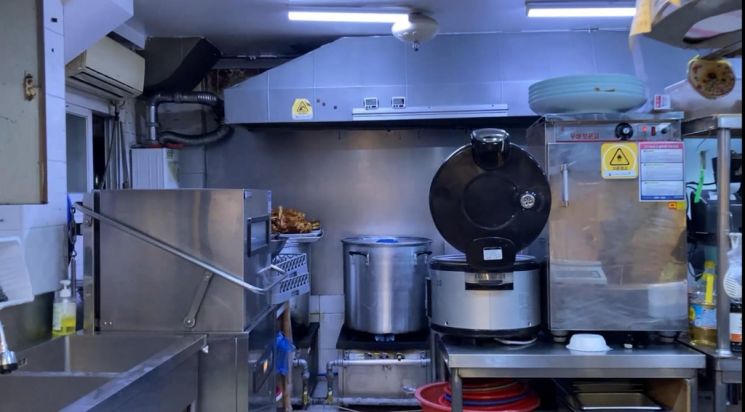 Interior of a jokbal restaurant in Bangbae-dong, Seoul, which caused controversy due to an unsanitary radish washing video. / Photo by the Ministry of Food and Drug Safety
Upon conducting an on-site inspection, the MFDS found the hygiene conditions at the establishment to be even more appalling. The restaurant used expired sauces in cooking, and knives and cutting boards used for preparing ingredients were not properly cleaned, indicating overall poor hygiene management.
Additionally, frozen products intended for cooking and sale, such as frozen dumplings and frozen jokbal, were not stored according to standards (below -18 degrees Celsius). The MFDS has requested administrative action from the relevant authorities and decided to proceed with an investigation regarding this establishment.
As this information became public, many citizens expressed fear about dining out. Netizens commented, "Is it acceptable to wash feet in the basin used for soaking radishes, which are food ingredients? This is not a joke about food," "People who cannot even maintain basic hygiene should not be allowed to run restaurants," and "How can we trust buying food outside from now on?" expressing their anxiety.
Self-employed restaurant operators also voiced their grievances. Mr. Lee, in his 50s, who runs a restaurant in Incheon, said, "Our place sweeps and cleans the hall every day, cleans the refrigerator, disinfects tools, and always pays close attention to strict hygiene," adding, "In the COVID-19 era, sales are already poor, and because of one restaurant like that, even the few customers who would come are leaving." He pointed out that distrust toward restaurants is inevitably causing damage to other businesses as well.
In fact, after the March report on the 'naked pickled Chinese cabbage,' imports of Chinese-made kimchi sharply declined. According to the Ministry of Agriculture, Food and Rural Affairs, kimchi imports in June dropped 21.8% year-on-year to 17,900 tons, marking a decrease for three consecutive months since April this year. Monthly kimchi import trends show a 24.1% increase in March compared to the previous year, but declines of -7.2% in April, -13.2% in May, and -21.8% in June.
Experts emphasize that if basic hygiene is not maintained, the damage directly affects the self-employed restaurant operators.
Professor Lee Eunhee of Inha University’s Department of Consumer Studies said, "The foundation of running a restaurant is hygiene. Operators must have the mindset of preparing food as if for their own family," adding, "When this is not observed, consumers suffer, but ultimately the restaurant operators themselves bear the damage. It also harms restaurants that have maintained good hygiene."
She continued, "It is necessary to review whether the Ministry of Food and Drug Safety and local governments, which supervise hygiene, need to improve food safety inspection guidelines and preventive measures. However, it is true that supervisory agencies have limitations in inspecting every restaurant individually," emphasizing, "Restaurant operators themselves must make efforts to alleviate consumer anxiety."
© The Asia Business Daily(www.asiae.co.kr). All rights reserved.

![Clutching a Stolen Dior Bag, Saying "I Hate Being Poor but Real"... The Grotesque Con of a "Human Knockoff" [Slate]](https://cwcontent.asiae.co.kr/asiaresize/183/2026021902243444107_1771435474.jpg)















