Sighs Over 'Split Contracts' Exploiting Retirement Allowance System Loopholes
Experts: "Abuse of Retirement Allowance System Causes Great Harm to Workers"
 Due to employers engaging in so-called 'trick contracts' that are less than 12 months to avoid paying severance, workers' grievances are increasing. Photo by Getty Images Bank (unrelated to the article content).
[Asia Economy Reporter Kang Juhee] "The tricks to avoid severance pay are really frustrating." , "I wish there were stronger penalties."
As the job market freezes due to the economic recession and the COVID-19 pandemic, job seekers are facing more difficulties than ever. Even when they manage to find jobs, their hardships do not lessen. Many employers engage in so-called 'trick contracts' that are less than 12 months to avoid paying severance pay.
This method mainly involves contracting the employment period as an '11-month contract' or slightly less than one year to evade the severance pay payment criteria. Such contracts are frequent not only in part-time jobs (Alba) but even in public institutions as a common practice. Job seekers who urgently need employment say they have no choice but to sign these contracts reluctantly. There are calls for supplementary measures to prevent exploitation of loopholes in the severance pay system.
Experts suggest that severance pay should be regarded as part of the working conditions, paid retrospectively at retirement for wages that were not paid to workers during their employment.
In April, Go Eun-sil from the Jeju Provincial Council office (Justice Party) analyzed the contract status of fixed-term workers in 43 towns and townships in Jeju and found many cases of trickery in employment contracts.
They contracted the working period to be 3 to 7 days less than one year to fall short of the severance pay payment criteria. In some towns and townships, contracts were initially written for a worker to work from January 1 to December 31, but to avoid severance pay, the original contract was terminated and re-contracted to work only until mid-December.
The payment criteria also varied by town and township. Some paid severance pay to workers who completed the same contract from January 2 to December 31, while others did not pay severance pay, citing that the period was one day short of 365 days. There were also many so-called 'split contracts' where workers engaged in regular employment tasks were contracted in monthly units such as 5 months, 6 months, or 11 months.
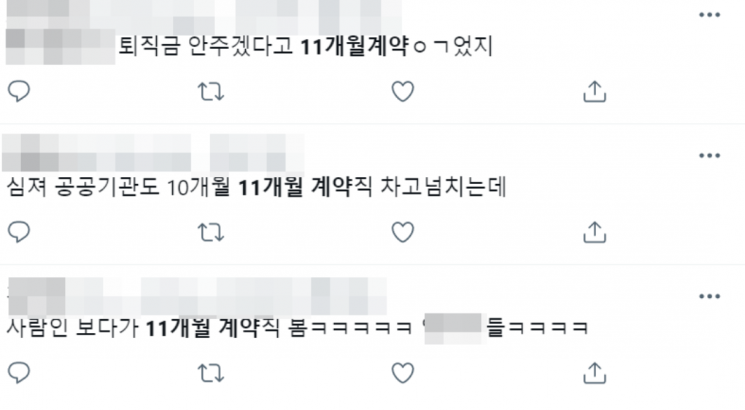 A post expressing complaints about 'tricky contracts' on social networking services (SNS). Photo by Twitter
Entering trick contracts to avoid paying severance pay is not a new issue. Searching related keywords on social networking services (SNS) or online communities reveals many cases of workers not receiving severance pay due to 11-month contracts or split contracts.
A 30-year-old worker A, employed on a contract basis at a workplace in Seoul, said, "When I was a job seeker, I had no money even for next month's living expenses, so I had no choice but to accept an 11-month contract," adding, "I can't even raise objections because I'm afraid it might cause problems with HR."
He said, "I always have to live with the anxiety of possibly being fired at any time, and even if I get fired, I don't receive severance pay to live on until I find another job, so I just keep working. This practice is really disheartening, but the problem is that even if I quit here, other places are not much different."
As trickery related to severance pay occurs frequently, discussions on related legal amendments have taken place in the National Assembly. In May, Ryu Ho-jeong of the Justice Party introduced the 'Partial Amendment to the Worker Retirement Benefit Guarantee Act' (Anti-Split Alba Act) to require severance pay for workers employed less than one year (excluding those working less than 4 weeks).
The amendment aims to change the clause that exempts severance pay for workers employed less than one year and those working less than 15 hours per week, so that all workers except those with continuous employment periods under 4 weeks can receive severance pay.
 File photo. In April, Go Eun-sil, a member of the Jeju Provincial Council (Justice Party), analyzed the contract status of temporary workers in 43 towns and townships across Jeju Island, revealing numerous cases of contract manipulation. Photo by Yonhap News
However, employers are opposing this law. They argue that it is difficult to provide severance pay to short-term workers amid worsening business conditions and declining sales due to the COVID-19 pandemic.
In self-employed communities, posts expressing burdens about severance pay are common, such as "With the minimum wage rising significantly, there's nothing left if we also pay severance pay," and "Employers cannot bear this burden."
Experts point out that it is undesirable to enter short-term contracts to avoid severance pay when workers are willing to work and workplaces need manpower.
Labor attorney Kim Hyoshin (Sonamu Labor Law Office) said, "Severance pay should be regarded as part of working conditions, paid retrospectively at retirement for wages not paid to workers," and "Entering trick contracts like 11-month contracts solely to evade severance pay causes great harm to workers."
She added, "Especially, when such cases occur in public institutions that must comply with the law, it seems to be a budget issue, so efforts are needed to clearly distinguish between short-term and long-term tasks and allocate budgets accordingly," emphasizing, "Self-employed employers should consider whether they can afford the total expenditure beyond workers' monthly wages."
© The Asia Business Daily(www.asiae.co.kr). All rights reserved.