'With Corona Transition' Expert Emergency Diagnosis
"Tighten Quarantine Measures and Put Out Urgent Fires First" in Unison
"After Vaccine Inoculation and Transition Preparation, 'Manage at Flu Level'"
[Asia Economy reporters Seo So-jeong, Kim Ji-hee, Lee Chun-hee] As the number of new domestic COVID-19 cases continues to break records daily, discussions have begun on shifting the quarantine direction to ‘with corona’?living with COVID-19. While health authorities remain cautious, experts are divided between opinions that it is ‘premature’ and that ‘we need to start considering it.’
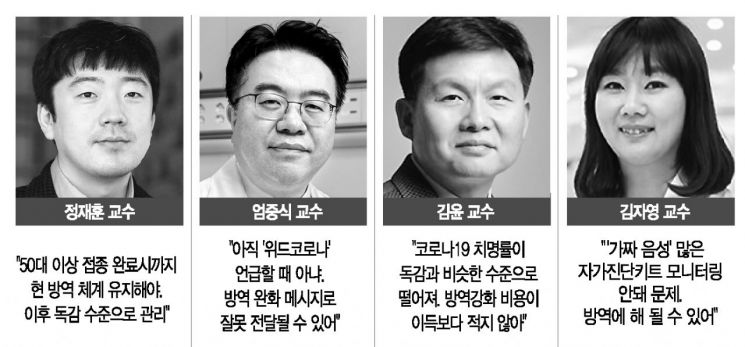
Many experts believe that given the recent severe COVID-19 outbreak, it is necessary to tighten quarantine measures and put out the urgent fire first. Professor Eom Jung-sik of the Department of Infectious Diseases at Gachon University Gil Medical Center pointed out, "At the end of last month, as talks about the new social distancing system emerged, messages about easing quarantine, such as not wearing masks outdoors, were conveyed. Since this could send the wrong message, we need to approach it cautiously." On the other hand, Professor Kim Yoon of the Department of Medical Management at Seoul National University College of Medicine stated, "As the fatality rate of COVID-19 has decreased to a level similar to the flu, it is worth considering managing it at the flu level."
◆"It is still time to tighten quarantine measures"= Experts argue that the current quarantine system should be maintained firmly for the next month or two. Especially, the fact that the domestic vaccination rate has stagnated in the low 30% range strengthens this argument. Health authorities also cite vaccination rates as the biggest difference between Korea and countries like the UK and Israel, which have adopted with corona. Park Young-jun, head of the epidemiological investigation team at the Central Disease Control Headquarters, drew a clear line, saying, "Currently, there is a big difference in vaccination rates between the UK and Korea, so it is not easy to directly apply the UK’s approach of easing quarantine."
Professor Jung Jae-hoon of the Department of Preventive Medicine at Gachon University Gil Medical Center said, "Since the COVID-19 outbreak has not been controlled, there is not enough basis to lift the current quarantine measures, so we need to extend them for a few weeks and focus on quarantine," adding, "(The shift in quarantine paradigm) is appropriate after the end of August when vaccination is completed up to people in their 50s."
There are also claims that even discussing with corona at this point interferes with quarantine efforts. Professor Eom emphasized, "While someone needs to prepare for it, discussing it before the outbreak is severe and vaccination rates are sufficiently high sends a message of easing quarantine," adding, "Even overseas, despite adult vaccination completion rates exceeding 50%, confirmed cases surged, leading to reconsideration of strengthening quarantine. In Korea, where the completion rate is in the 10% range, it should not be publicized yet."
There are also concerns that the currently used self-diagnosis kits may harm quarantine efforts and should be discontinued. Professor Kim Ja-young of the Catholic Kwandong University International St. Mary’s Hospital explained, "Self-diagnosis kits lack a monitoring system and are not highly sensitive. Since we have no idea how many false negatives there are in the current 4th wave, allowing individuals who are difficult to manage to use the kits creates holes in quarantine."
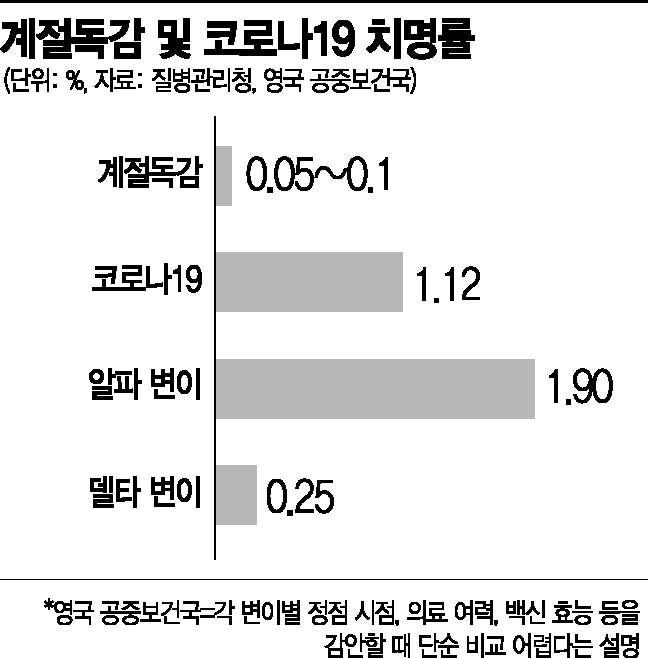
◆With corona transition "preparations must begin"= One reason discussions about with corona have started amid the 4th wave is the decreased fatality rate of COVID-19. The monthly fatality rate of COVID-19 in Korea was highest at 2.87% in March last year during the first wave and second highest at 2.70% in December last year during the third wave. However, after vaccination, it sharply dropped to 0.24% last month.
The recent wave is mainly driven by unvaccinated young people, most of whom are asymptomatic or have mild symptoms, which supports the argument that the quarantine system should move away from focusing on the number of confirmed cases, as seen in the UK and Israel. With the World Health Organization (WHO) forecasting that ending COVID-19 this year is difficult and the possibility of endemicity gaining weight, a quarantine system that restricts daily life is unsustainable.
Professor Jung said, "From a long-term perspective, it is right to shift the quarantine paradigm from focusing on confirmed cases to focusing on severe cases and deaths," adding, "As seen in the UK and Israel cases, the strategy of suppressing the spread of the Delta variant through vaccination is practically impossible."
Professor Eom also said, "Vaccination is fundamental, but talking about easing quarantine without efforts to develop and equip systems and hardware to socially prevent infection is like trying to do well on a test without studying," adding, "Technologies to properly ventilate indoor closed spaces and practical standards for space density linked to work environments are needed."
Conversely, there are opinions that discussions about with corona should accelerate. Professor Kim said, "The COVID-19 fatality rate of 0.24% is similar to the flu’s 0.1%, meaning it can be managed like the flu," adding, "The claim that quarantine strategies can only be shifted after reaching a certain vaccination level is intuitive but lacks evidence." He argued, "The current quarantine is unsustainable. Small business owners suffer greatly, public fatigue has increased, and there are many invisible deaths due to social distancing, so the costs cannot be considered lower than the benefits of quarantine."
© The Asia Business Daily(www.asiae.co.kr). All rights reserved.













