No Power Consumption or Heat... Increasing Possibility of Developing Dream Devices and Computers Operable with Low Energy
[Asia Economy Reporter Kim Bong-su] Domestic researchers have succeeded for the first time in the world in observing the spontaneous formation of next-generation information and communication device excitons, which consume almost no power and generate no heat, at room temperature. This is regarded as a breakthrough that could realize dream devices and computers without energy loss and heat generation.
The Institute for Basic Science (IBS) announced on the 16th that the research team led by Han-woong Yeom, Director of the Center for Atomic-scale Low-dimensional Electronic Systems (Professor of Physics at Pohang University of Science and Technology), has observed for the first time in the world the spontaneous formation of excitons?particles capable of transmitting information without resistance?at room temperature.
An exciton is a particle formed by the binding of a free electron (-) and a hole (+). It mainly occurs when light is shone on semiconductor or insulating materials. Since excitons have zero net charge, they experience no resistance when moving within a material, enabling information transmission without energy consumption. They are attracting attention as next-generation technology that can overcome the limitations of high-performance devices that consume large amounts of power and generate heat.
However, excitons created by lasers have very short lifetimes and low stability, making them difficult to use in information processing devices. Although research has attempted to directly manipulate electrons and holes to create long-lived excitons, there has been a limitation that excitons can only be formed at extremely low temperatures.
The research team designed experiments to observe excitons that spontaneously form in materials with special electronic structures. The excitonic insulator prediction theory proposed in the 1970s was a key motivation for the research. This theory predicted that in semiconductors or semimetals with unusual electronic structures, long-lived excitons could spontaneously form even at high temperatures. Several years ago, the University of Tokyo proposed a semimetal material meeting these conditions, but excitons were not experimentally confirmed.
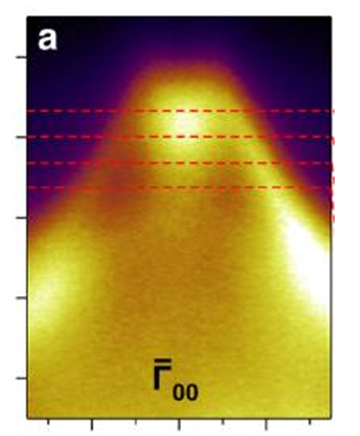
The research team successfully synthesized high-quality nickel diselenide tantalum (hereafter Ta2NiSe5), which was proposed by the University of Tokyo, and detected exciton signals. When excitons are stimulated by light, they collapse into free electrons and holes, and the free electrons that constituted the excitons are ejected by the light. However, to confirm that these photoelectrons originate from exciton collapse, it is necessary to distinguish them from countless other photoelectrons emitted from the solid.
To achieve this, the research team developed a photoelectron spectroscopy device with world-class performance. This device can measure photoelectrons while changing the polarization of light. Therefore, measurements could be taken under polarization conditions where ordinary photoelectrons from the material do not occur, and very strong photoelectron signals were detected. Analysis of the energy and momentum of these new photoelectrons confirmed that they were signals of excitons, which had only been theoretically predicted.
Director Han-woong Yeom stated, “By observing exciton particles spontaneously formed at room temperature for the first time in the world, we have proven that the so-called excitonic insulator prediction from the 1970s was correct,” and added, “The discovery of long-lived excitons increases the possibility of realizing devices and computers without resistance loss in the future.”
This research result was published on the 16th in the international academic journal Nature Physics (IF 20.034).
© The Asia Business Daily(www.asiae.co.kr). All rights reserved.

![Clutching a Stolen Dior Bag, Saying "I Hate Being Poor but Real"... The Grotesque Con of a "Human Knockoff" [Slate]](https://cwcontent.asiae.co.kr/asiaresize/183/2026021902243444107_1771435474.jpg)














