Domestic Researchers First Identify Mechanism of Upper Respiratory Tract Infection
[Asia Economy Reporter Kim Bong-su] It has been confirmed for the first time by domestic researchers that the COVID-19 virus initially infects and proliferates through ciliated epithelial cells in the human nasal cavity. Until herd immunity is achieved, it is necessary to continue wearing masks that fully cover the nose and mouth, and there is a need for preventive and therapeutic strategies that form immunity by administering vaccines to the nasal mucosa.
The Institute for Basic Science (IBS) announced on the 1st that a joint research team led by Director Ko Kyu-young of the Vascular Research Center captured the moment of replication of SARS-CoV-2 (coronavirus) for the first time and confirmed that the main target of initial infection and proliferation is the nasal (inside the nose) ciliated epithelial cells.
Although more than a year and a half has passed since the initial discovery of COVID-19, the infection route of the coronavirus in the human body remains unclear. It was only known that infection occurs through the upper respiratory tract tissues (upper respiratory system - nasal cavity, pharynx, larynx, bronchi), but the exact target site had not been identified. This was the reason for difficulties in establishing effective preventive measures.
The coronavirus penetrates cells by binding to ACE2, TMPRSS2, and Furin receptor proteins. These proteins act as the virus's entry route. However, the latest single-cell RNA sequencing technique had limitations in accurately identifying the distribution of these proteins. Since most COVID-19 patients have already completed primary viral infection and proliferation at the time of diagnosis, it was even more difficult to understand the initial infection mechanism.
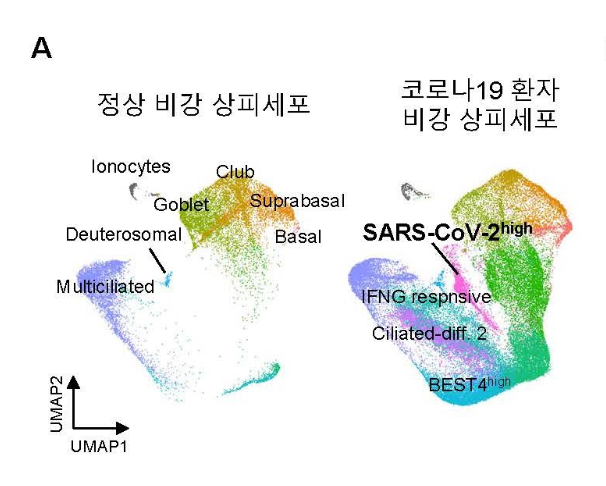
The research team overcame these limitations by analyzing precise specimens obtained from actual early COVID-19 patients using various experimental techniques. First, they confirmed that ACE2, TMPRSS2, and Furin receptor proteins are densely distributed on the air-exposed surface of ciliated cells inside the nose. This means that the coronavirus binds to the air-exposed surface of ciliated cells, penetrates into the cells, and then replicates and proliferates. This newly revealed that nasal ciliated cells are the starting point of coronavirus infection. In contrast, receptor proteins for the coronavirus were not found in respiratory mucus-secreting cells and oral epithelial cells, which had been considered major infection targets until now.
Additionally, by analyzing nasal and oral cells from early COVID-19 patients, the research team captured for the first time that the coronavirus replicates and proliferates only in nasal ciliated cells. No infection occurred in nasal secretory cells, stem cells, or oral epithelial cells that lack coronavirus receptor proteins. Mild COVID-19 patients showed that coronavirus proliferation ended within the first 8 days, and damaged ciliated cells rapidly regenerated, leading to recovery. This suggests that nasal mucosal immunity is key to COVID-19 treatment.
A research team official stated, “If the target nasal ciliated cells of the coronavirus are damaged, other organs including the lungs can be rapidly infected,” and added, “Follow-up research and development of vaccines and drugs to protect nasal ciliated cells are necessary. Masks should be worn to fully cover the nose and mouth until herd immunity is formed. Administering vaccines intranasally to form mucosal immunity will be a new preventive and therapeutic strategy against COVID-19.”
The results of this study were published as a cover article in the international medical research journal Journal of Clinical Investigation (IF 14.808) on the 2nd.
© The Asia Business Daily(www.asiae.co.kr). All rights reserved.












