[Asia Economy Reporter Kim Bong-su] On the morning of the 25th, the Korea Research Institute of Chemical Technology signed a technology transfer agreement for an anticancer drug applying the Proteolysis-targeting chimera (PROTAC) technology, a protein degradation new drug development platform, with the Korea Research Institute of Bioscience and Biotechnology and Dong-A ST.
Previously, the Chemical Research Institute and the Bioscience Research Institute developed PROTAC drugs that can treat intractable cancers by degrading and removing cancer-causing proteins through targeted protein degradation technology. According to this agreement, Dong-A ST plans to secure protein degraders, establish a next-generation new drug development platform technology, and proceed with the development of targeted anticancer drugs.
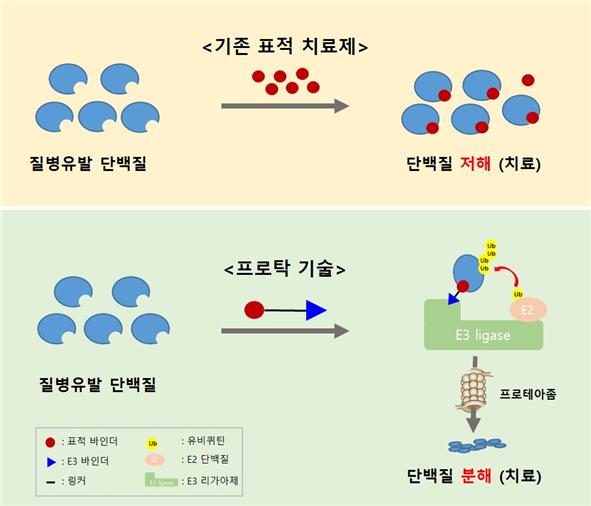
PROTAC drugs work by binding ubiquitin to disease-causing proteins and forcibly degrading them via the proteasome, fundamentally eliminating the cause of the disease. All cells in the body have a purification system called the ubiquitin proteasome system (UPS) that degrades proteins. In this process, ubiquitin acts as a tag indicating which proteins need to be degraded, and the proteasome recognizes the ubiquitin tag and functions as a shredder that destroys the tagged proteins.
Existing targeted therapies require binding to a specific site on the target protein that causes the disease to be effective. Drugs applying PROTAC technology, on the other hand, bind ubiquitin to the target protein regardless of the binding site and induce degradation by the proteasome.
This technology can be applied to various targets that were difficult to address with existing therapeutic drugs. It can overcome the limitations of drug resistance caused by mutations at the binding site and allows for reuse after the target protein is degraded. It achieves high therapeutic effects with low doses and reduces side effects.
© The Asia Business Daily(www.asiae.co.kr). All rights reserved.











