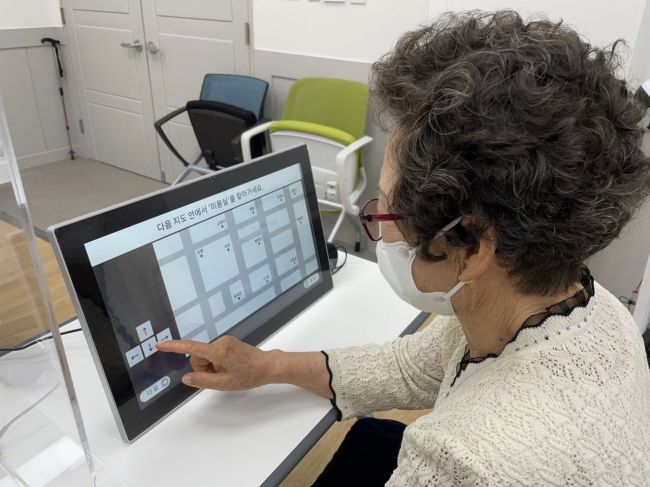
 At the Dementia Safety Center in Imsil-gun, Jeonbuk, a computerized cognitive training system program is being conducted for dementia patients and individuals with cognitive decline. (Photo by Imsil-gun Office)
[Asia Economy Reporter Lee Chun-hee] While 44% of the public feel a sense of rejection toward the term 'dementia,' only about half of that, 22%, responded that the term should be changed.
The Ministry of Health and Welfare announced the results of a "National Perception Survey on the Term Dementia" on the 25th, which contained these findings.
Due to the negative connotations associated with the term dementia, social prejudice against dementia has been induced, causing unnecessary suffering for patients and their families. Therefore, there have been ongoing calls to change the term. This survey, conducted for the first time in seven years since 2014, aimed to confirm the social perception of the term dementia among the public and gauge the response to changing the name, serving as basic data to reflect opinions in future dementia policies.
The survey was conducted by the Korea Gallup Survey Research Institute through telephone interviews over eight days from the 18th to the 28th of last month, targeting 1,200 general citizens aged 19 and older. Among the respondents, 319 were family members of dementia patients. The survey covered perceptions related to the term dementia and alternative terms for dementia.
The results showed that 43.8% of the public responded that they feel a "sense of rejection" toward the term dementia. Those who answered "do not feel rejection" accounted for 33.5%, and 20.5% said they "do not have any particular feelings." Among those who felt rejection, 60.2% cited "fear of the disease dementia" as the reason. This was followed by "social prejudice against the disease dementia" (17.9%) and "feeling that it belittles patients" (7.6%).
However, regarding changing the term dementia, the most common response was "it does not matter whether it is kept or changed" at 45%, and 27.7% said "it should be maintained." Only 21.5% responded that it "should be changed."
Among those who said it should be maintained, the most common reason at 28.5% was "because the current term is already well known to the public." This was followed by "changing the term could cause confusion" (22.2%) and "because the current term is familiar" (21.6%).
Those who answered that it should be changed most frequently cited "because the term has already created negative prejudice" (58.6%). This was followed by "because it feels belittling to dementia patients" (16.5%) and "because the term has an unpleasant connotation" (13.4%).
As the most appropriate alternative terms if the term dementia were to be changed, "Injijeohajeung (Cognitive Decline Syndrome)" (31.3%), "Gieokjang-aejeung (Memory Disorder Syndrome)" (21.0%), and "Injijang-aejeung (Cognitive Disorder Syndrome)" (14.2%) followed. However, except for Injijeohajeung, other terms were more often perceived as having no positive change or even a negative impact.
Kim Ji-yeon, Director of the Dementia Policy Division at the Ministry of Health and Welfare, said, "Through this perception survey, we were able to understand the overall public perception and opinions regarding dementia and the term 'dementia.'" She added, "Based on the survey results, we will carefully review the necessity of changing the term 'dementia'." She also stated, "We will continue efforts to create a dementia-friendly social environment through various awareness improvement activities, education, and publicity to eliminate vague fears, rejection, and negative prejudice toward dementia."
© The Asia Business Daily(www.asiae.co.kr). All rights reserved.












