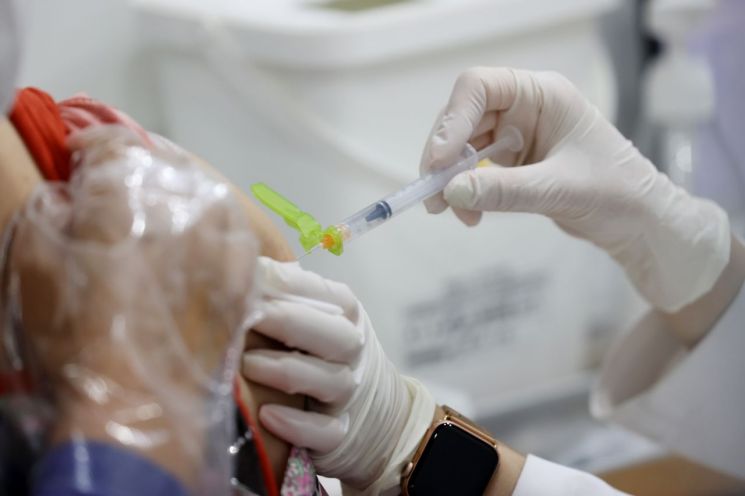
 On the morning of the 17th, an elderly person is receiving a COVID-19 vaccine at the COVID-19 vaccination center set up at Yeongdeungpo Art Hall in Yeongdeungpo-gu, Seoul. [Image source=Yonhap News]
[Asia Economy Reporter Lee Chun-hee] While the public agrees on the necessity of developing a domestically produced COVID-19 vaccine, they appear to be reluctant to actually participate in clinical trials for it.
The Ministry of Health and Welfare and the National Clinical Trial Support Foundation announced the results of a "Public Perception Survey on Domestic COVID-19 Vaccine Clinical Trials" on the 20th, which contained these findings.
This public perception survey was conducted by Macromill Embrain over three days from the 4th to the 8th to assess nationwide awareness regarding participation in domestic vaccine clinical trials before the full-scale launch of phase 3 clinical trials for the domestic COVID-19 vaccine. The survey was conducted both online and via mobile, targeting 1,600 adult men and women aged 18 and older nationwide. The confidence level was 95%, with a maximum allowable sampling error of ±2.45 percentage points.
According to the survey, the majority of the public shared a consensus on the necessity of developing a domestic COVID-19 vaccine. 92.3% of respondents answered that developing a domestic COVID-19 vaccine is necessary, and 87.8% said vaccine development is urgent. Additionally, 92.8% believed that developing a domestic vaccine is important at this point in time.
Regarding clinical trials for development, 74.3% showed a positive perception. This positive perception was especially high among those in their 60s (85.3%) and 50s (82.6%). Among the 1,188 respondents with a positive perception, the most cited reason (50.7%) was that domestic vaccine development would secure vaccine sovereignty. This was followed by "contributing to the end of COVID-19" (23.7%) and "contributing to the development of new drugs and medical advancement in our country" (19.4%).
However, only 33.8% of all respondents answered that the clinical trials are "safe." 14.9% said they are not safe, and 51.4% responded "average."
Those who answered "safe" cited "trust in domestically developed drugs that have undergone preclinical trials" (49.6%) and "trust in clinical trial medical staff" (24.4%) as reasons, whereas those who answered "not safe" pointed to "limited clinical trial information" (47.7%) and "use of unverified drugs" (44.0%) as reasons.
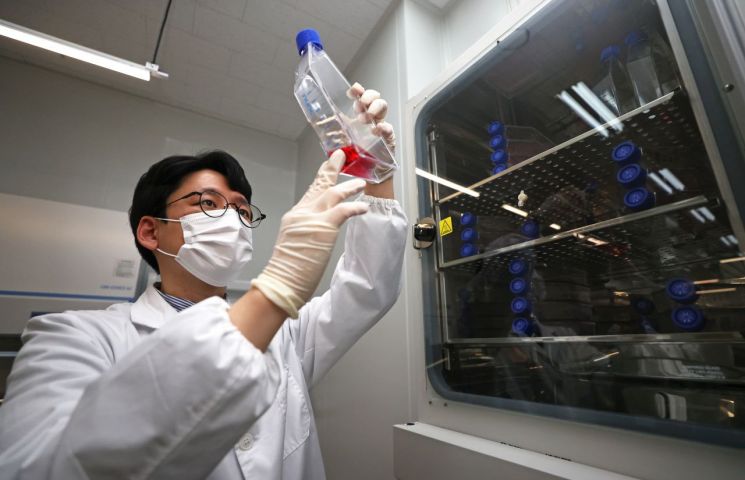 A researcher is conducting research related to COVID-19 vaccine development at the Cellid Cell Gene Therapy GMP Center in Seongnam-si, Gyeonggi Province.
 [Photo by Yonhap News]
Regarding willingness to participate in clinical trials for the development of a domestic COVID-19 vaccine, positive responses further decreased. Among respondents, 78.6% said they had "no intention to participate," while only 21.4% expressed willingness to participate. Willingness to participate increased with age. Those in their 50s and 60s showed the highest willingness at 24%, followed by 40s at 23.5%, 30s at 17%, and 20s at 16.5%.
Those who said they would not participate cited concerns about "side effects of the domestic vaccine" (30.7%), "limited clinical trial information" (22.7%), "distrust in the effectiveness of the domestic vaccine" (14.5%), and "insufficient compensation system" (11.0%) as reasons. Conversely, those willing to participate cited "securing vaccine sovereignty" (36.1%), "contributing to new drug development" (20.1%), and "contributing to the end of COVID-19" (15.4%) as reasons for participation.
Respondents answered that sufficient compensation in case of adverse reactions (71.2%) is necessary to encourage participation in clinical trials. They also suggested measures such as transparent disclosure of data (64.2%), paid leave and business trip recognition during clinical trial participation (56.5%), and priority vaccination rights if preventive effects are insufficient after participation (51.4%).
Lee Kang-ho, Director of the Health Industry Policy Bureau at the Ministry of Health and Welfare, said, "Large-scale recruitment of clinical trial participants is necessary to proceed with phase 3 clinical trials for domestic vaccine development, but as vaccination rates increase, difficulties in recruiting participants are expected," adding, "We plan to strengthen public promotion to recruit clinical trial participants and prepare various support measures to ensure participants can safely take part in clinical trials.”
Director Bae Byung-jun of the National Clinical Trial Support Foundation also stated, "Participation of the public in clinical trials for COVID-19 vaccine development is of utmost importance," adding, "We will work with the government to establish various patient-centered clinical trial environments that can encourage participation, such as disclosing clinical trial result data and expanding compensation limits.”
© The Asia Business Daily(www.asiae.co.kr). All rights reserved.













