Considering Employees with Metabolic Syndrome Risk Factors
Providing 'Healthy Meals' at Cheongju Campus Cafeteria
 Lee Sun-bae, a nutritionist at SK Hynix Cheongju Campus 1 (Jinpung Food Service), is smiling brightly while holding a healthy meal.
 [Photo by SK Hynix]
[Asia Economy Reporter Kim Heung-soon] SK Hynix is receiving positive feedback for providing a "special meal" that helps employees manage their health at the cafeteria in the Cheongju campus. This is a "healthy diet" prepared for employees with risk factors for metabolic syndrome. Metabolic syndrome refers to having three or more of the following five risk factors that can cause health problems such as heart disease and diabetes: high blood pressure, high blood sugar, high triglycerides, low high-density lipoprotein cholesterol, and central obesity.
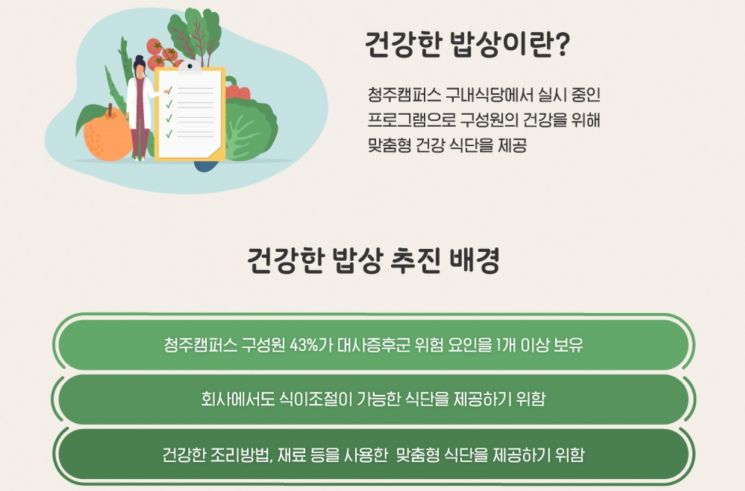
According to SK Hynix on the 19th, the "healthy meal" was prepared at the company level to manage the fact that more than 40% of the approximately 6,000 employees at the Cheongju campus have one or more risk factors for metabolic syndrome, as confirmed by health checkup results. When the program started in March 2019, the healthy meal was provided only to selected members by batch, but as employee interest grew, it was converted into a regular menu corner from October last year.
83% of Healthy Meal Users Show Symptom Improvement
Waist circumference, weight, cholesterol, fasting blood sugar improved
The healthy meal was planned by the Corporate Culture (ED) team at the Cheongju campus. Based on the theory of Dr. Nam Ki-seon, a food nutrition PhD from Seoul National University, the concept was a handmade menu with vegetables, protein foods, and whole grains in a 2:1:1 ratio, and a low glycemic index diet. Then, 53 members with metabolic syndrome were selected for a pilot test. This was to verify whether the body actually improved when eating one healthy meal a day.
The participants in the pilot test underwent basic tests such as waist circumference, weight, and cholesterol, then ate the healthy meal for lunch for two months. According to SK Hynix, 82.9% of users showed health improvement effects. In particular, five out of seven test items, including waist circumference, weight, total cholesterol, and fasting blood sugar, showed significant improvement.
Afterwards, a two-month test was conducted targeting 50 to 120 members selected by lottery through a reservation system at all cafeterias in the Cheongju campus. The healthy meal was operated in batches from 1st to 5th before becoming a regular menu corner; during the 1st to 3rd batches, only lunch was provided, and from the 4th to 5th batches, dinner was also included. The target range was also expanded to include partner company employees.
Upgraded to Regular Menu... 'Diet' and 'Operation Method' Transformed
Higher Satisfaction than Regular Meals
The Cheongju ED team improved two aspects?operation method and diet?to regularize the healthy meal corner. The initial diet focused on low-calorie foods such as vegetables and foods that do not cause weight gain. However, the low-calorie diet had the drawback of not providing satiety. Therefore, they devised menus that provide balanced nutrients and satiety at the same time.
Lee Sun-bae, a nutritionist operating the healthy meal at Cheongju 1 campus, explained, "When composing the healthy meal menu, we use fewer seasonings than regular meals or use healthier ones," adding, "We select ingredients low in fat or oil to develop the menu."
The operation method was also changed from providing only one meal time for lunch and dinner to three meal times for shift workers. Additionally, breakfast and late-night meals were added to the serving times.
After becoming a regular menu corner, employee responses improved. According to SK Hynix, the meal participation rate, which averaged 75.25% during the batch-based reservation system, increased to an average of 90.13% after becoming a regular menu corner. Also, in a satisfaction survey conducted among healthy meal users, the satisfaction score was 93.06 points, higher than the 88.98 points for regular meals.
The Cheongju ED team plans to develop menus that can be managed with themes such as diseases, diets, and blood sugar by day of the week. One employee using the healthy meal commented, "There is a stereotype that healthy food is tasteless, but the healthy meal tastes good and you can feel the sincerity from the menu."
© The Asia Business Daily(www.asiae.co.kr). All rights reserved.













