Mid-sized Companies SBHI at 98.3 in Q3 This Year... Up 8.8p from Q2
Primary Metals and Electronic Components Lead... Manufacturing Production SBHI Rises for 4 Consecutive Quarters
Raw Material and Labor Cost Risks Are 'Negative Factors'... "Urgent Policy Shift Needed"
[Asia Economy Reporter Junhyung Lee] The Domestic Mid-sized Enterprises Business Outlook Index (SBHI) for the third quarter of this year rose for the fourth consecutive quarter, reaching the highest level since the survey began in the third quarter of 2017.
The Korea Federation of Mid-sized Enterprises announced on the 20th that in the '2021 Q3 Mid-sized Enterprises Business Outlook Survey' conducted from the 20th of last month to the 3rd of this month targeting 500 mid-sized companies, the SBHI rose by 8.8 points from 89.5 in the previous quarter to 98.3. An SBHI above 100 means that more companies expect the next quarter’s business conditions to improve compared to the previous quarter, while below 100 indicates the opposite.
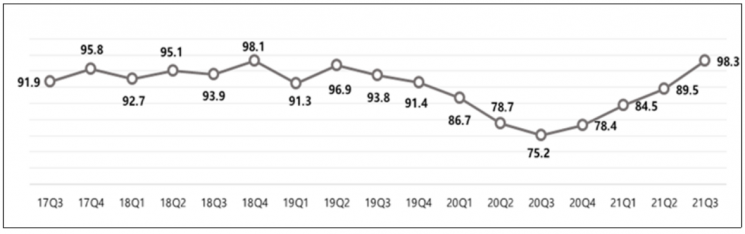 Trend of the Mid-sized Enterprise Business Outlook Index (SBHI).
 [Photo by Korea Federation of Mid-sized Enterprises]
The SBHI for Q3 this year increased by 23.1 points compared to the same period last year (75.2), which was the lowest ever due to the impact of COVID-19. A representative from the Federation explained, "This result appears to partly reflect expectations for recovery in investment and consumption due to increased domestic and overseas demand as the COVID-19 situation improves both domestically and internationally."
Specifically, the manufacturing sector’s SBHI rose centered on primary metals and electronic components industries, reaching a record high of 97.7. The non-manufacturing sector’s SBHI was 98.7, the second highest since Q4 2018 (100.6).
In the manufacturing sector, the primary metals SBHI increased by 14.1 points from the previous quarter to 105.6, continuing a double-digit growth. Electronic components also maintained a positive outlook by recording above 100 for four consecutive quarters. In the non-manufacturing sector, the SBHI rose led by publishing, telecommunications, and information services (112.5), and transportation industries (100), continuing the upward trend.
Both domestic demand and export SBHIs rose by 8.8 points and 6.7 points respectively from the previous quarter, marking four consecutive quarters of growth. Notably, the export SBHI in the manufacturing sector exceeded 100 at 100.7 for the first time in nine quarters since Q2 2019 (101). In domestic demand SBHI, primary metals (109.5) and publishing, telecommunications, and information communication services (110.9) increased by 13.8 points and 16.9 points respectively from the previous quarter.
The manufacturing production SBHI rose by 7.2 points from the previous quarter to 101.3, showing a recovery trend for four consecutive quarters. Primary metals (111.1) and chemicals (100) industries recorded increases for four consecutive quarters. However, the food and beverage industry recorded 80, the second lowest after Q2 last year (77.4) when COVID-19 first spread.
 Trends in the Raw Material Procurement Outlook Index for Mid-sized Companies.
 [Photo by Korea Federation of Mid-sized Enterprises]
The raw material procurement SBHI fell by 3.1 points from the previous quarter to 88.8. This was influenced by recent instability in raw material supply in the automobile and metal industries. In particular, the automobile industry’s raw material procurement SBHI recorded 85.1, the lowest since the survey began.
According to the survey, 45.9% of mid-sized companies cited 'domestic demand slump' as their management difficulty. This was followed by 'rising labor costs' (38.9%), 'excessive competition among companies' (36.1%), and 'rising raw material prices' (28.7%). Concerns about domestic demand slump decreased by 9.3 percentage points from 55.2% in the previous quarter due to expectations of economic recovery. However, difficulties related to rising labor costs and raw material prices increased by 2.5 percentage points and 3.1 percentage points respectively during the same period.
Ban Won-ik, Executive Vice Chairman of the Federation, said, "The rise in mid-sized enterprises’ expectations for economic recovery to an all-time high is a hope looking beyond COVID-19 and a determination toward an opportunity that will not come again easily." He added, "However, urgent bold policy shifts are needed to resolve factors that hinder corporate dynamism, such as the sharp rise in raw material prices, increased logistics costs, semiconductor supply risks, and the annual pressure of rising labor costs."
© The Asia Business Daily(www.asiae.co.kr). All rights reserved.














