Mismatch in Workforce Supply by Industry
Sharp Decline in Net Inflow of Youth in Manufacturing
Rapid Increase in Net Inflow of Elderly in Healthcare

[Sejong=Asia Economy Reporter Moon Chaeseok] The impact of population aging is spreading across industries without discrimination. Not only in manufacturing sites but also in the service sector, the influx of young people is decreasing, leading to increased aging by industry. In industries with low inflow of young people, a red light is on for workforce supply and demand. While young people are complaining about a lack of jobs, there is a growing possibility of a phenomenon where the other side struggles with labor shortages.
According to the Employment Information Service's report "Analysis of Aging of Wage Workers and Labor Market Changes by Industry" on the 14th, the aging index, which divides insured persons aged 55 and over by insured persons aged 19-29, increased significantly from 5 industries in 2010 to 10 industries in 2019. When this index exceeds 100, it means that workers aged 55 and over outnumber young workers, indicating a rapid aging speed.
Industries with rapid aging stood out not only in health and social welfare but also in education and personal services within the service sector. The Employment Information Service pointed out that this is the result of a complex interplay of ▲decrease in new young workforce entry ▲increase in elderly inflow ▲aging due to relatively long tenure under seniority-based pay systems. This means that beyond the simple dimension of reduced young inflow due to declining birth rates, a complex combination of workforce mismatches in industrial sites and pay systems favoring long-term employees is at work.
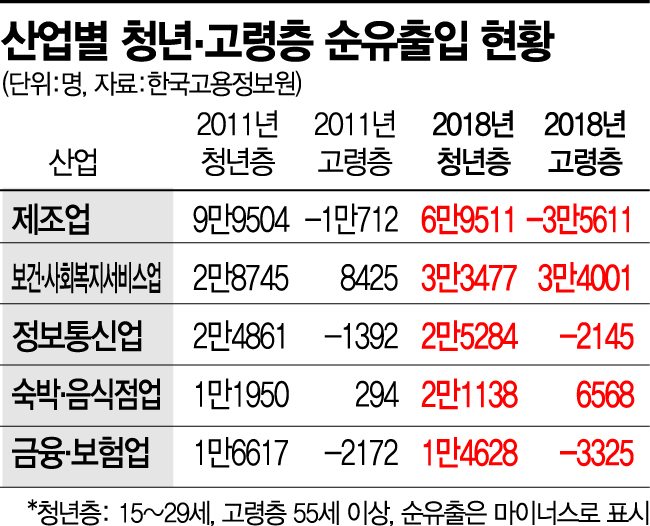
Manufacturing also faces a serious shortage of young workers. According to the Information Service, the net inflow of young people (aged 15-29) in manufacturing plummeted from 99,504 in 2011 to 69,511 in 2018. In health care, during the same period, the net inflow of young people increased by 16.5% from 28,745 to 33,477, but the net inflow of elderly workers surged more than threefold from 8,425 to 34,001. In the case of health care, with the advent of an aging society, demand for recruitment is expected to surge in the future, making it the industry most feared for severe 'mismatching.' According to Worknet, among the 21 industries classified under the Korean Standard Industrial Classification (10th revision), the share of health care expanded from 10.5% in 2009 to 16.9% in 2019.
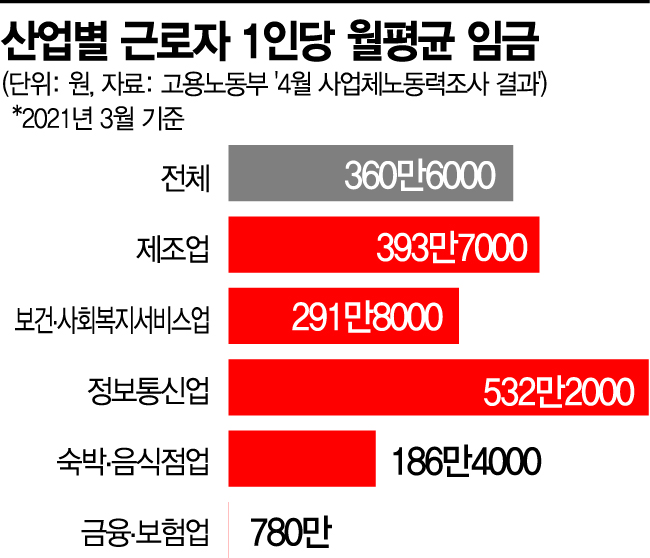
These industries share the commonality of relatively low wage levels compared to the nature of their work. This means the incentive to attract young people is relatively low. According to the Ministry of Employment and Labor's "April Business Labor Force Survey Results," the average monthly total wage per worker in March was 3,937,000 KRW for manufacturing and 2,918,000 KRW for health care. In health care, this is only 80.9% of the overall average of 3,606,000 KRW, and manufacturing faces risks such as the full implementation of the 52-hour workweek system in workplaces with five or more employees and the Serious Accident Punishment Act.
On the other hand, in high-income sectors such as finance and insurance, aging is relatively less severe, but the job-seeking demand of young people is high. However, the inflow of young people into finance and insurance is actually decreasing. The net inflow dropped from 16,617 in 2011 to 14,628 in 2018. Among the elderly, 2,172 left in 2011, increasing to 3,325 in 2018, meaning that as many people left as were not newly hired. This shows that due to the seniority-based pay system, the replacement of long-term employees with young workers is lower than in other industries. Park Sejeong, a senior researcher at the Employment Information Service, said, "The finance and insurance sector, which suffers from job-seeking difficulties, differs in nature from the health care sector, which suffers from labor shortages. To increase young inflow in this sector, it is urgent to improve the industrial structure where mid-to-late career employees have long tenure."
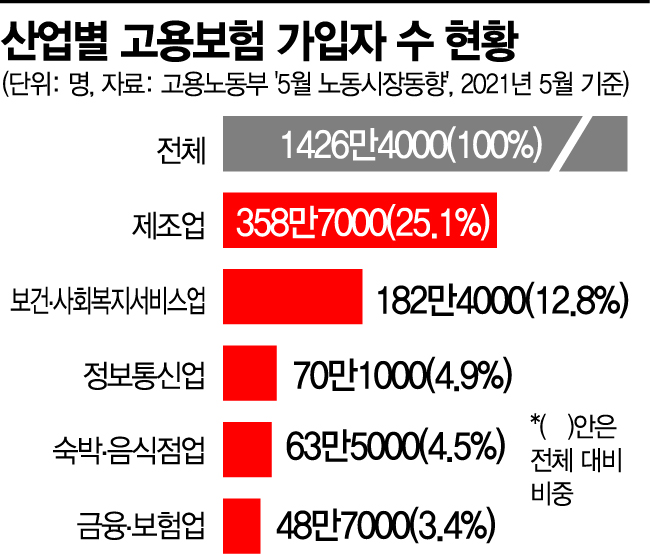
Experts advise that to resolve workforce supply and demand mismatches, the quality of work such as wages and working hours within workplaces should be improved through support for individual companies. However, the government continues to maintain employment policies focused on cash support for job seekers.
Hong Nam-ki, Deputy Prime Minister and Minister of Economy and Finance, and An Kyung-duk, Minister of Employment and Labor, have diagnosed that 'growth without employment' will continue for a long time and have stated that policy support is inevitable for the time being. The Ministry of Employment and Labor plans to allocate 53.1% (1.099 trillion KRW) of the 2.0697 trillion KRW increased in the first supplementary budget to cash support policies for youth job seekers and labor costs.
Choi Young-gi, visiting professor at Hallym University’s Business Administration Department and former director of the Korea Labor Institute, said, "As the economy enters a mature stage, youth recruitment will increase more in startup industries such as health and social welfare services or digital platforms rather than traditional industries like finance and manufacturing, and this trend will continue in Korea for the time being." He advised, "Support should be provided to companies so that youth job seeking can increase in health and public services, and even in face-to-face service sectors after COVID-19 herd immunity, to induce improvement in employment quality."
© The Asia Business Daily(www.asiae.co.kr). All rights reserved.














