<Asia Economy Inaugural Project - Questioning the Economy of the Republic of Korea>
'Competitiveness, System, Perception' Three Major Crises
"Korean Economy Must Ease Regulations for Competitiveness... Companies Plead 'Please Leave Us Alone'"
"Moon Administration Should Implement Policies Based on Respect and Understanding of the Market"
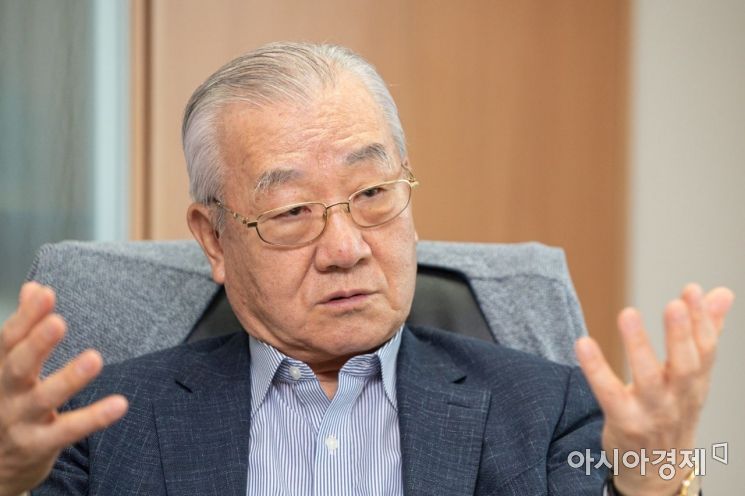 Former Blue House Chief Economic Secretary Kim In-ho is being interviewed on the 4th at the Railroad Policy Research Office in Yongsan-gu, Seoul. Photo by Kang Jin-hyung aymsdream@
[Interview=Choi Il-gwon, Head of Economic Department at Asia Economy, Summary=Reporter Son Sun-hee] "The moment the government tries to predict and decide how to lead the lives of its people, that economy is finished. The government is not that capable."
Kim In-ho, Chairman of the Market Economy Research Institute (79), who worked as a career economic bureaucrat for over 30 years, recently said in an interview commemorating the founding of Asia Economy, "It would be possible if the government had exceptional foresight, judgment, and even a moral foundation to lead the people, but no such government has ever existed on Earth." Having spent a long time in government formulating economic policies, he paradoxically developed a firm belief in the 'market economy' after his long public service. He emphasized the need to reduce government market intervention and reform regulations.
True to his identity as an 'eternal market advocate,' Chairman Kim pointed out the malfunctioning of the market as the problem of our economy. He described it as a crisis where competition is demonized and the market does not function, and he considered the fact that this crisis is not even recognized as a bigger problem.
Chairman Kim served as the first Fair Trade Commission Chairman at the ministerial level during the Kim Young-sam administration and was the Chief Economic Secretary to the Blue House during the 1997 International Monetary Fund (IMF) foreign exchange crisis. His remarks carry weight as he diagnosed new crises Korea might face from the perspective of a bureaucrat who responded to unprecedented economic crises.
In particular, he intensified his criticism of the current government's economic philosophy, which ignores the principles of market operation. Chairman Kim said, "It's not an issue of individual indicators. Fundamentally, there is a problem with the philosophy of running the economy." As a clear example, he raised real estate policy and said, "All of it should be scrapped."
He believes the enormous debt caused by COVID-19 will further fuel the crisis. According to the Institute of International Finance (IIF), global debt reached a record high of $281 trillion last year. This amount would take more than three years to repay even if the entire annual global gross domestic product (GDP) were used. He evaluated the economic risks that debt could trigger as "an area not yet even recognized," suggesting it could be the seed of a new crisis we have not anticipated.
The massive scale of debt makes crisis response difficult. Chairman Kim said, "Even during the 1998 foreign exchange crisis and the 2008 global financial crisis, the ultimate recourse was public funds," adding, "National finances are the 'last bastion.'" He pointed out, "South Korea is in a very dangerous situation with government debt exceeding 1,000 trillion won and household debt surpassing 2,000 trillion won." Regarding the government's continued insistence on an 'expansionary fiscal policy' and its passive attitude toward establishing fiscal rules, he strongly criticized, "Saying fiscal rules will be applied from 2025 means 'the current government takes credit, and the next government just pays it back.' No such government has ever existed."
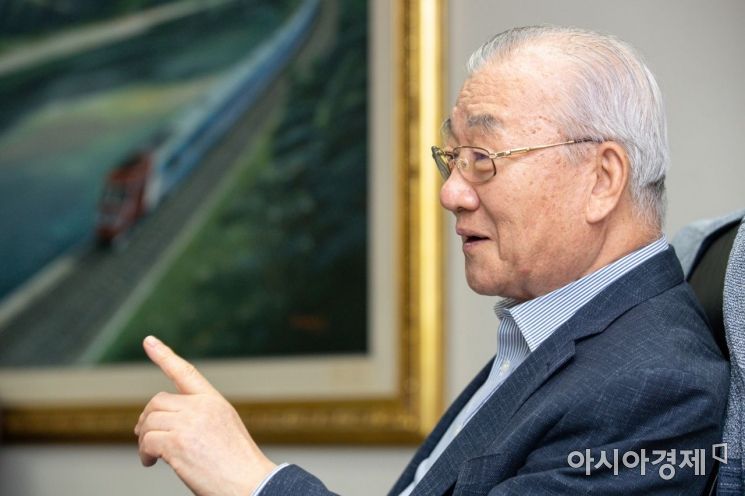 Former Blue House Chief Economic Secretary Kim In-ho is being interviewed on the 4th at the Railroad Policy Research Office in Yongsan-gu, Seoul. Photo by Kang Jin-hyung aymsdream@
Below is a Q&A with Chairman Kim.
-How do you view the current state of the Korean economy?
▲It is a crisis of competitiveness. Of course, some sectors like semiconductors are doing well, but that is just an illusion. It has been 20 years since semiconductors, shipbuilding, steel, automobiles, and petrochemicals became the main products. They still remain so. Look at the United States. How many changes have occurred? That is what industrial development means. The U.S. has started to regain control of the global value chain. But we are barely keeping up with the Fourth Industrial Revolution. Japan is the same. Japan was ahead of Korea until the Third Industrial Revolution but is lagging in the Fourth Industrial Revolution, characterized by 'superintelligence, hyperconnectivity, and superconvergence.' This is 'unknowable and unpredictable.' Even global scholars agree. In such a structure, what kind of economy survives? The most flexible and autonomous economy. That is why I advocate a 'market economy.' The reason the U.S. maintains its competitive edge is that it is the most flexible society with the least regulation. Honestly, I question whether Korea is truly a market economy country.
-Recent macroeconomic indicators suggest the fundamentals are good. What do you think?
▲It is not a problem of individual indicators. Fundamentally, there is a problem with the philosophy of running the economy.
-If the basic philosophy is wrong, isn't that a big problem?
▲Look at real estate policy. All the real estate policies attempted under the current government should be scrapped and restarted if possible. Otherwise, there will be no solution. There is nothing worth keeping from what has been done so far. The initial goal of real estate policy was set incorrectly. How can 'suppressing speculation and recovering unearned income' be a goal? Speculation and investment are practically indistinguishable. The government says the housing supply rate exceeds 100%, but considering people's desire to move to better homes, it falls short. The government treats all legitimate desires as speculation and tries to suppress them. The policy goal should be 'people's housing stability,' recognizing the basic human desire to move to better living environments. The government's attitude of directly building houses is also problematic. If it is for the lowest income group, that is understandable, but why should the government build houses for people who can buy homes through finance? Korea has many construction companies and world-class technology. There are plenty of materials. The government should focus solely on land supply.
-Given the current fiscal situation, will the next government have limited options?
▲Yes. First, the terms of the next administration and the National Assembly do not align. The government cannot do much without the consent of the National Assembly. It seems a very difficult political environment will be created. In that sense, while showing inclusiveness, important matters should be put to a national referendum.
-The government's role using fiscal policy has increased through the COVID-19 crisis.
▲Health and welfare are the government's main areas. The lowest income groups who cannot survive without government help must be cared for. But the government should not think it can solve all economic problems. Policy areas and market functions can harmonize sufficiently. For example, managing prisoners in prisons is the government's responsibility. But supplying food and lodging to prisons is essentially no different from private lodging businesses. There is no need for the government to do everything from start to finish just because it is a prison. There are many areas where the government can find 'things it does not necessarily have to do' and entrust them to the private sector.
-What does the market demand?
▲They are begging for regulations to be reduced. In the past, companies mainly requested financial support like 'give us more money at lower interest rates,' but nowadays, few companies say that. They neither want help nor need it; their hope is 'please leave us alone.' The idea that the government will solve employment with public jobs is problematic. Jobs are created by companies. Isn't that a very simple and ordinary logic? To create jobs, companies must be revitalized. There is a perception that companies do 'bad things' just to pursue profits. I also thought that way when I was young. But no matter how bad companies are, they are nothing compared to the harm caused by a huge government controlling the economy. Some politicians claim 'economic power overwhelms politics.' But these powers cannot be compared on the same level. No matter how strong economic power is, it is nothing before politics. Look at Lee Jae-yong.
-The government plans to prepare a second supplementary budget using additional tax revenue this year.
▲It can be done if necessary. But the temporary additional tax revenue to be used as funds should not be considered an increase compared to last year when COVID-19 completely collapsed revenues. This year's tax revenue is not a lot collected but a return to normal. The principle of fiscal management is that if there is a global surplus, pay off debt (government bonds) first. It is stipulated by law. In 1997, when I was Chief Economic Secretary to the Blue House and the presidential election was imminent, I proposed freezing the next year's budget at about 3%, similar to inflation. The ruling party then said, 'Are you crazy? If you lose the election, it's all over.' Despite shouts and finger-pointing, I held firm. That is how fiscal soundness was maintained. Korean finances have never had 'structural debt' like now, even if temporarily. The temptation of debt is the same for individuals, companies, and governments. Where is an easier means than debt?
-Do you think tax increases are necessary?
▲Crises come in various forms. Whether it becomes a national crisis depends on how soundly finances are managed. The best way is to reduce government roles, increase efficiency, and cut spending. If that is politically impossible, tax increases are inevitable. It is impossible to keep giving out money without tax increases. Historically, the beginning of parliament was not 'legislative power' but 'fiscal power.' Parliament was created basically to prevent authorities from arbitrarily imposing additional burdens on citizens. Even now, when the National Assembly increases expenditure budgets, it requires the executive branch's consent. That is the spirit of parliament. But now the National Assembly is pushing to increase fiscal spending and supplementary budgets. There needs to be a mechanism to restrain this. Already, the top 10% income earners pay 55% of all taxes. Forty percent pay no earned income tax at all. These issues must be fixed first.
-With less than a year left in the Moon Jae-in administration, do you have any advice?
▲We need to change the perspective on the economy. We must approach it based on respect and understanding of the market. Doing so will reduce the government's role, but actually, the opposite is true. There is no perfect market. Naturally, there can be flaws. The government must carefully study whether the economy is moving in the intended direction without interference and implement policies accordingly. Also, understanding companies is necessary. Not because companies are lovable, but even the worst company in terms of employment contributes more to the national economy than the best politician. When companies make money, it eventually flows back to the national economy. We must make it so that entrepreneurs want to do business.
© The Asia Business Daily(www.asiae.co.kr). All rights reserved.













