[Asia Economy Reporter Eunmo Koo] As Google is set to enforce in-app payments in the second half of this year, lawmakers who have proposed bills banning mandatory in-app payments in South Korea and the United States gathered to devise countermeasures. Attention is focused on whether this will reignite discussions within the National Assembly on the 'Google Abuse Prevention Act (Amendment to the Telecommunications Business Act),' which had somewhat cooled down.
On the 8th, Lee Won-wook, Chairman of the National Assembly's Science, Technology, Information and Broadcasting Committee, and Cho Seung-rae, a member of the Democratic Party of Korea, jointly hosted an online international conference titled 'The Direction of Global App Fairness (Mandatory In-App Payments)' together with the Korea Internet Corporations Association and the Northern Nevada International Center (NNIC).
At the event, Regina Cobb, Chairwoman of the Arizona House Appropriations Committee, delivered the keynote speech on 'The Status and Prospects of the U.S. Google In-App Payment Bill.' In March, the Arizona House passed a bill led by Representative Cobb that prohibits Google and Apple from forcing app developers to use only their own transaction methods (in-app payments), but the Arizona Senate later repealed the bill.
Starting in the second half of this year, Google plans to mandate that app developers listed on Google Play use its payment system when selling content, while imposing a hefty 30% commission fee in the process. This is expected not only to threaten the survival of domestic app developers but also to lead to price increases for major content such as webtoons, web novels, and music.
Representative Cobb's experience with proposing and seeing the repeal of the in-app payment ban bill is expected to provide various implications for related discussions in South Korea. At the event, discussions were held on the possibility of reintroducing the in-app payment ban bill in the U.S. House of Representatives, the positions of lawmakers from both countries regarding concerns over trade disputes related to the in-app payment ban, and the impact and scale of damage caused by mandatory in-app payment policies.
Representative Cho, who proposed a bill last year to prevent abuse by app market operators, said, "It is a meaningful occasion that the legislatures of South Korea and the United States are joining forces against the unilateral tyranny of global platforms." He added, "If Google's announced mandatory in-app payment policy is implemented, both small and medium app developers and consumers are expected to suffer damage. Therefore, South Korea must accelerate legal amendments to protect and nurture domestic app developers and startups."
Currently, seven bills have been proposed in the National Assembly to prevent app market operators from forcing specific payment methods, but they remain pending. The National Assembly's Science, Technology, Information and Broadcasting Committee is considering holding a subcommittee meeting on information and communication broadcasting bills (Bill Subcommittee 2) after the People Power Party's convention ends on the 11th to discuss the Google Abuse Prevention Act. However, it is unlikely that the bill will pass and enforcement regulations be revised before the mandatory in-app payment enforcement in October.
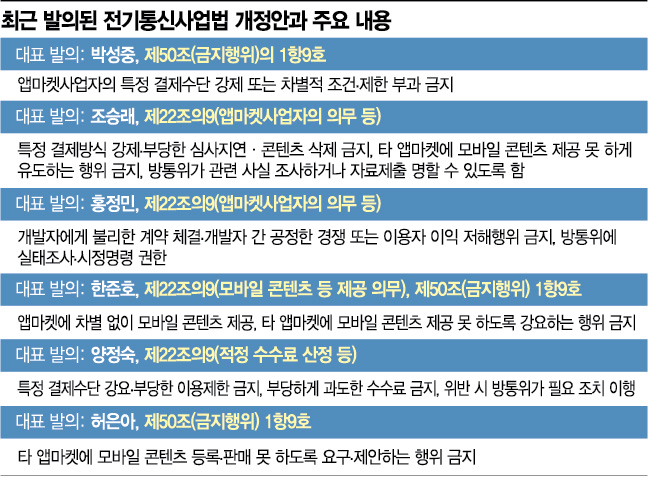 As of mid-October 2020. Since then, Assemblyman Jo Myeong-hee of the People Power Party also took the lead in proposing an amendment to the Telecommunications Business Act aimed at prohibiting app market operators from forcing payment methods and resolving related disputes.
© The Asia Business Daily(www.asiae.co.kr). All rights reserved.













