"National Intellectual Property Strategy Advanced Course Expanded to Seoul Metropolitan Council and Seoul City Officials"
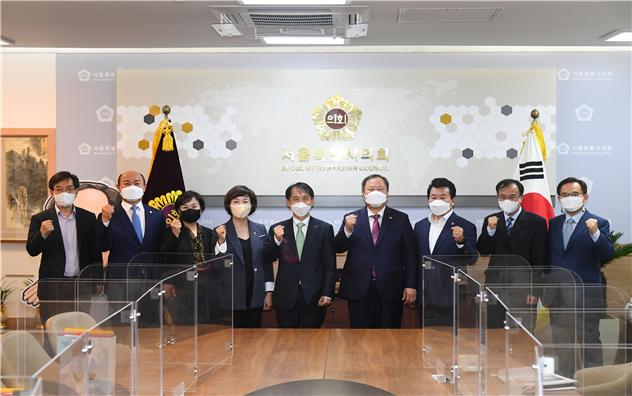 From the left, Jin-ha Park, KAIST Executive Program Steering Committee Member; In-gu Hwang, Seoul Metropolitan Council Member; Ga-hee Lee, KAIST Academic Committee Member; Kyung Kim, Chair of the Seoul Metropolitan Council Budget Policy Research Committee; Kwang-hyung Lee, President of KAIST; In-ho Kim, Chair of the Seoul Metropolitan Council; Ji-kwon Jung, Chair of the Seoul Metropolitan Council Policy Committee; No-won Seo, Director of the Seoul Metropolitan Council Secretariat; Cheong-sik Kim, Chief Secretary to the Chair of the Seoul Metropolitan Council
[Asia Economy Reporter Jongil Park] On the morning of the 14th at 11 a.m., Kim In-ho, Chairperson of the Seoul Metropolitan Council, met with Lee Kwang-hyung, President of KAIST, to discuss expanding the educational content of the KAIST National Intellectual Property Strategy Executive Program to Seoul Metropolitan Council members, as well as officials from the Seoul Metropolitan Government and Seoul Metropolitan Office of Education.
Present at the meeting were six Seoul Metropolitan Council officials including Chairperson Kim In-ho, Councilor Hwang In-gu, Policy Committee Chair Jeong Ji-gwon, Budget Policy Research Committee Chair Kim Kyung, Secretariat Director Seo No-won, and Chairperson’s Secretary Kim Cheong-sik, along with three KAIST representatives: President Lee Kwang-hyung, Executive Program Operations Committee member Park Jin-ha, and Academic Committee member Lee Ga-hee.
This meeting to explore the expansion of intellectual property education between the Seoul Metropolitan Council and KAIST was initiated under the leadership of Councilor Hwang In-gu, who was the first in the nation to enact the ‘Ordinance on Intellectual Property Education.’
Chairperson Kim In-ho emphasized, “Perceptions of intellectual property are completely changing, and we expect intellectual property to become a growth engine for Seoul in the future. Many Seoul Metropolitan Council members are very interested in intellectual property education, so I ask for KAIST’s strong support to actively participate in this program and ultimately expand Seoul’s awareness of intellectual property.”
Councilor Hwang In-gu, who organized this meeting, said, “At a time when intellectual property education is needed for the younger generation, if this program is expanded to council members and all Seoul city officials, intellectual property education for Seoul citizens will naturally be established. I would also like to invite President Lee Kwang-hyung to the Seoul Metropolitan Council plenary session to give a lecture on intellectual property.”
KAIST President Lee Kwang-hyung added, “I am impressed by the Seoul Metropolitan Council’s efforts and interest in recently enacting intellectual property-related ordinances and expanding the National Intellectual Property Executive Program throughout Seoul. I hope the Seoul Metropolitan Council will visit KAIST so we can continue to explore cooperation in new growth areas such as intellectual property and AI.”
Kim Kyung, who created the ‘Ordinance on the Promotion of Citizen Intellectual Property Education,’ stated, “If Seoul city officials take the lead in recognizing intellectual property rights, we can grow into a leading intellectual property nation.”
Policy Committee Chair Jeong Ji-gwon added, “If you provide ideas related to intellectual property or new growth policies, the council will reflect them in ordinances.”
The ‘KAIST National Intellectual Property Strategy Executive Program,’ which will be expanded to the Seoul public sector, includes content on national future strategies for intellectual property, intellectual property strategies in public administration, and overseas intellectual property strategies. The program is aiming to open its first session in September.
Once applied in Seoul, the program plans to offer lectures to 50 participants including Seoul Metropolitan Council members, officials from the Seoul Metropolitan Government and Seoul Metropolitan Office of Education, and businesspeople based in Seoul.
© The Asia Business Daily(www.asiae.co.kr). All rights reserved.

![Clutching a Stolen Dior Bag, Saying "I Hate Being Poor but Real"... The Grotesque Con of a "Human Knockoff" [Slate]](https://cwcontent.asiae.co.kr/asiaresize/183/2026021902243444107_1771435474.jpg)














