Jungsubon Announces Adjustment of High Pathogenic Avian Influenza (AI) Crisis Alert Level and Quarantine Promotion Plan
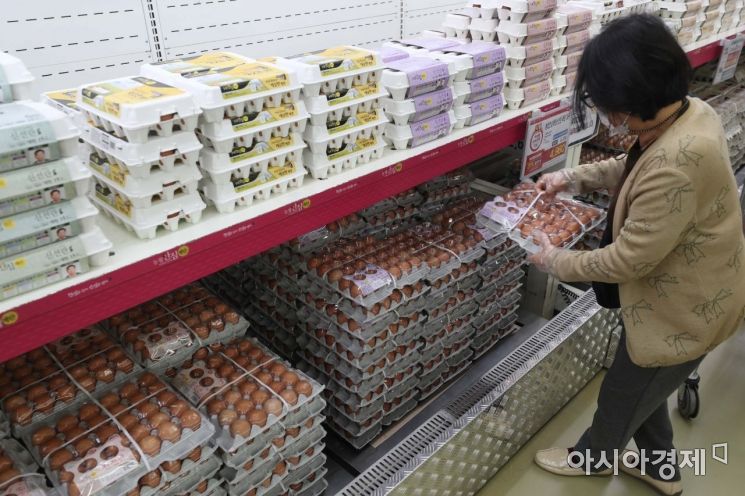 On the 4th, citizens shopping at Nonghyup Hanaro Mart Yangjae Branch in Seocho-gu, Seoul. Photo by Mun Ho-nam munonam@
[Sejong=Asia Economy Reporter Moon Chaeseok] As most migratory birds have headed north and no highly pathogenic avian influenza (AI) virus has been detected in the past month, authorities have lowered the crisis alert level from 'Severe' to 'Attention.' This is the first time in six months since the highly pathogenic AI outbreak at the end of November last year. The quarantine measures will also shift to a 'prevention' focus.
The AI Central Accident Response Headquarters announced that no AI virus has been detected in wild birds since March 30. Additionally, no new AI virus outbreaks have occurred in poultry farms since the 6th of last month. All 10,306 environmental tests conducted nationwide on poultry farms returned negative results. Accordingly, the headquarters decided to lower the crisis alert level from 'Severe,' which was raised on November 28 last year, to 'Attention.'
The headquarters stated that quarantine measures for native chickens and ducks will continue to be implemented. Traditional markets where native chickens are traded will undergo a complete closure and disinfection twice a month. Starting next month, quarantine facilities of farms newly introducing ducks will be inspected. Poultry inspections will shift to a routine system, but enhanced measures will be maintained for ducks and native chickens until the end of this month: twice monthly inspections for breeding ducks, three inspections before shipment for meat ducks, and twice monthly plus pre-shipment inspections for native chickens. Farms with AI outbreaks will undergo quarantine inspections and environmental tests before restocking. From this month until September, nationwide poultry farms will be subject to a comprehensive inspection of disinfection and quarantine facilities.
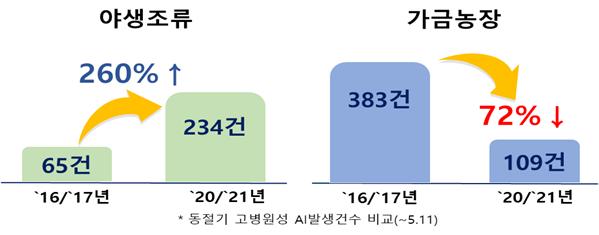 Comparison of AI outbreaks between 2016-17 and 2020-21. (Data from the Central Avian Influenza Control Headquarters)
According to the headquarters, 109 AI cases occurred from November 26 last year to the 6th of last month. Although the number of highly pathogenic AI cases in wild birds was 260% higher than during the severe 2016-2017 period, AI outbreaks in poultry farms were 72% lower.
The headquarters is preparing countermeasures to address vulnerabilities identified after investigating the recent AI outbreak farms. These measures focus on farm biosecurity, quarantine by responsible parties, and proactive prevention. Standards for quarantine facilities will be supplemented to prevent the virus from entering farms, and compliance standards for disinfection management of people, vehicles, and equipment will be strengthened. Quarantine measures will be improved for poultry farmers, integrated operators, and livestock-related facilities. Furthermore, preventive functions will be enhanced through pre-inspection and supplementation of quarantine practices, improvement of testing systems for early virus detection, and strengthening of epidemiological investigations.
Kim Hyun-soo, Minister of Agriculture, Food and Rural Affairs and head of the Central Accident Response Headquarters, urged, "As the domestic inflow of contamination sources is becoming annual, it is necessary to promptly supplement insufficient disinfection and quarantine facilities such as vehicle and personnel disinfection facilities, anterooms, and nets at poultry farms and livestock-related facilities." He added, "Please make it a habit to comply with quarantine rules such as hand disinfection and changing boots when entering livestock barns, and thorough daily disinfection inside and outside the farms."
With the headquarters lowering the AI crisis alert, attention is also focused on whether egg prices will stabilize in the future. According to the Korea Agro-Fisheries & Food Trade Corporation (aT), as of the 10th, the retail price of eggs (30 pieces, medium grade special eggs) was 7,323 won, down 3.2% from 7,564 won a month ago but up 37.4% from 5,331 won a year earlier. Earlier, according to the consumer price trends announced by Statistics Korea on the 4th, the overall consumer price index last month, including eggs, rose 2.3% compared to the same month a year ago.
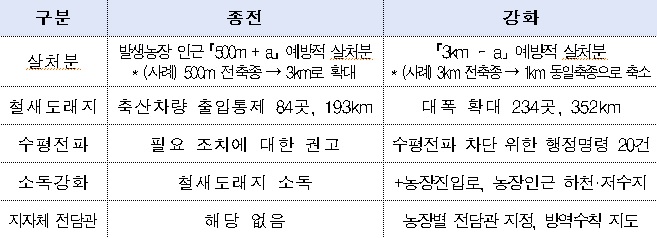 Strengthened quarantine measures compared to before. (Source: Avian Influenza (AI) Central Accident Response Headquarters)
© The Asia Business Daily(www.asiae.co.kr). All rights reserved.