Proposal to switch to local taxes with nationwide shared use
Authority to allocate comprehensive real estate tax from central government to local governments
Legal amendment... Key is response from National Assembly and other local governments
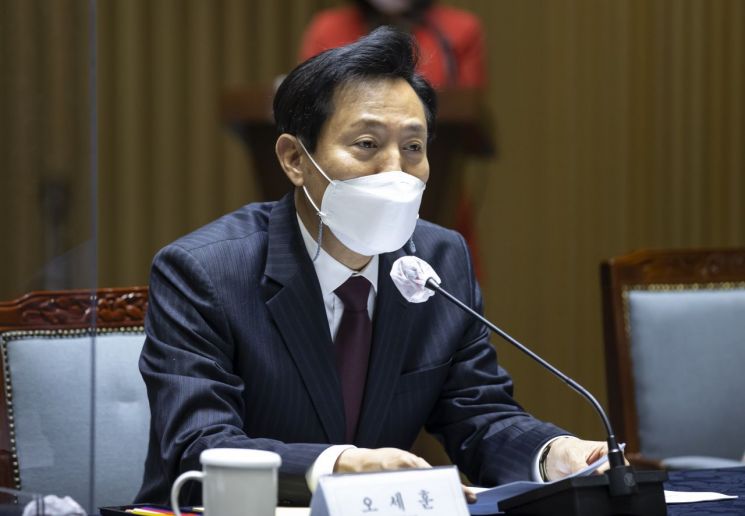
[Asia Economy Reporter Kim Hyemin] Seoul Mayor Oh Se-hoon has officially requested the government to convert the comprehensive real estate holding tax (종합부동산세, Jongbuse) from a national tax to a local tax. At the same time, he proposed a nationwide 100% joint taxation system. This is a demand to effectively transfer the central government's authority over the distribution of Jongbuse to local governments across the country. However, this is a legislative amendment issue that Seoul City cannot pursue alone, and it is uncertain whether the National Assembly and other local governments will respond positively.
Mayor Oh made this claim on the 20th while attending his second Cabinet meeting since taking office. At his first Cabinet meeting, he pointed out issues with apartment official prices and requested that local governments be given authority to participate in the decision-making process. This time, he again challenged the central government, this time regarding Jongbuse. Mayor Oh demanded, "Please actively consider this to alleviate fiscal disparities between regions and to realize true local autonomy through fiscal decentralization." This is part of Mayor Oh’s campaign promises.
Jongbuse is a tax levied by aggregating nationwide housing and land holdings, collected as a national tax by the state. The comprehensive land tax (종합토지세, Jongtojese), which was previously a local tax, was restructured into Jongbuse and converted into a national tax during the Roh Moo-hyun administration. However, the government does not use this for national finances but distributes it entirely to local governments according to the Local Allocation Tax Act.
Currently, Seoul bears about 60% of the total Jongbuse burden nationwide. However, the amount redistributed back to Seoul is less than 10%. This is because the distribution considers local governments’ fiscal conditions, social welfare, and collection amounts. The goal of balancing local finances is also related to this structure.
Mayor Oh’s position is that Jongbuse should be converted into a local tax from the perspective of local governments’ taxation autonomy. This seems to reflect dissatisfaction with Seoul bearing most of the Jongbuse burden. In fact, Mayor Oh stated the reason for his proposal as, "The current real estate allocation tax from Jongbuse is in an unbalanced situation," and "It is intended to compensate for the decrease in local government revenue if the burden of property tax (a local tax) is eased."
Instead of using the local tax solely as Seoul’s revenue, he also proposed a joint taxation system where 100% of the tax revenue is shared with other local governments. This means not breaking the current structure where Jongbuse is distributed to local governments based on certain criteria. A Seoul city official said, "Currently, Jongbuse is shared nationwide, but the government sets the criteria," adding, "The intention is not to keep Jongbuse as a government-dependent resource but to have local governments negotiate and establish the criteria."
Mayor Oh has previously introduced a joint taxation system at the city level. To reduce the gap between Gangnam and Gangbuk districts, 50% of the property tax paid separately by the 25 autonomous districts was equally distributed among them. This reduced the revenue gap between Gangnam and Gangbuk by more than one-third.
However, converting Jongbuse into a local tax and implementing 100% joint taxation is a legislative amendment issue that Seoul City cannot pursue alone. Amendments to the Local Tax Act, Jongbuse Act, and Local Allocation Tax Act are required, and cooperation from the National Assembly is essential. The Ministry of Economy and Finance, the relevant department, is reportedly negative about this.
It is also uncertain whether other local governments will support this. Especially in cities, counties, and districts where the proportion of real estate grants relative to Jongbuse burden is high, there may be opposition fearing a reduction in grant amounts. Conversely, in areas with a high Jongbuse burden, there may be resistance to joint taxation. In fact, when Mayor Oh previously pushed for joint property tax, the three Gangnam districts, which had to surrender their tax bases to the city, strongly opposed it, even filing a constitutional complaint.
Seoul City’s stance is that if the fundamental principle of converting Jongbuse to a local tax and sharing 100% of it is established, coordinating interests will not be a problem. A Seoul city official said, "There is a difference between using someone else’s money and collecting and deciding on our own," adding, "It’s a matter of whether the significance lies in the distribution of Jongbuse or in fiscal independence."
Additionally, there are concerns that if Jongbuse is transferred to local government authority, local leaders, who are elected by citizens, may be reluctant to raise tax rates arbitrarily, which could effectively render the system ineffective.
© The Asia Business Daily(www.asiae.co.kr). All rights reserved.












