Analysis of Overseas Direct Investment and Foreign Direct Investment Statistics in Manufacturing by Hankyung Research Institute
[Asia Economy Reporter Kim Heung-soon] A private economic research institute has claimed that more than 70,000 manufacturing jobs were lost overseas last year due to various regulations constraining companies and the rigidity of the labor market.
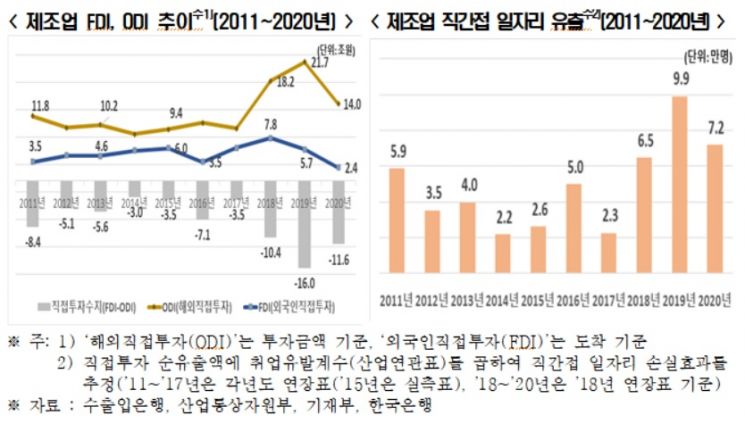
The Korea Economic Research Institute (KERI), under the Federation of Korean Industries, announced on the 19th that based on statistics of overseas direct investment (ODI) and foreign direct investment (FDI) in manufacturing, it estimated the direct and indirect job creation effects and analyzed that 72,000 manufacturing jobs were lost overseas last year. KERI argued, "If only the 72,000 manufacturing jobs lost overseas had been secured, the unemployment rate last year would have improved by 0.3 percentage points from 4.0% to 3.7%."
Net Outflow of Manufacturing Direct Investment of 7.5 Trillion KRW Annually Over 10 Years
"Losing 49,000 Employment Opportunities Every Year"
Over the past decade, overseas investments by manufacturing companies have significantly outweighed foreign investments flowing into Korea, resulting in job losses. According to KERI, from 2011 to 2020, overseas direct investment in manufacturing averaged 12.4 trillion KRW annually, while foreign direct investment was less than half of that at 4.9 trillion KRW per year. During the same period, the net outflow of manufacturing direct investment (FDI-ODI) amounted to 7.5 trillion KRW annually, leading to an estimated annual loss of 49,000 direct and indirect jobs (a cumulative total of 491,000 jobs).
By industry, last year’s overseas direct investment was highest in semiconductors at 2.6 trillion KRW, followed by electrical equipment (2.3 trillion KRW) and automobiles (2.2 trillion KRW). In the same period, foreign direct investment amounted to 40 billion KRW in semiconductors, 90 billion KRW in electrical equipment, and 440 billion KRW in automobiles, which was lower than domestic companies’ overseas direct investment.
As foreign investment decreased, the net outflow of direct investment last year was significant, with semiconductors at -2.5 trillion KRW, electrical equipment at -2.2 trillion KRW, and automobiles at -1.8 trillion KRW. The scale of direct and indirect job losses was highest in electrical equipment (155,000), automobiles (145,000), food products (93,000), pharmaceuticals (51,000), and semiconductors (49,000). These figures represent an increase of approximately 1.9 to 37.6 times compared to 2011. KERI analyzed, "Among industries with high net outflows of direct investment, job losses are particularly notable in electrical equipment, automobiles, and food products, which have relatively high employment inducement effects."
"Strict Labor Regulations Hamper Domestic Investment and Employment"
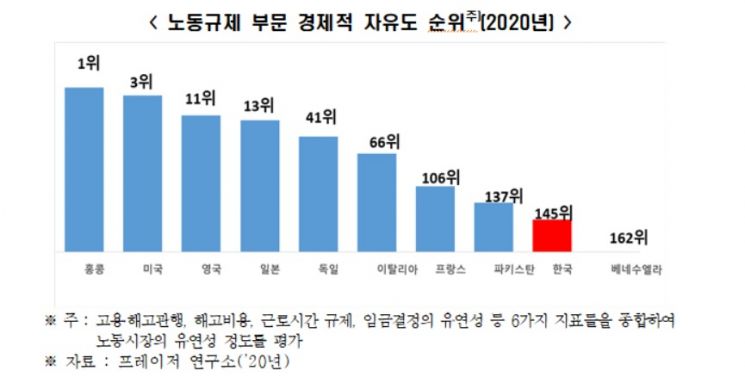
Regarding the causes of manufacturing jobs moving overseas, KERI stated, "Various corporate-related regulations in Korea, especially the rigid labor market, appear to be hindering domestic investment and employment." According to the Fraser Institute, a Canadian policy research organization, Korea ranked 145th out of 162 countries in economic freedom related to labor market regulations as of last year, indicating very strict labor regulations.
In the 2019 World Economic Forum (WEF) labor market competitiveness ranking, Korea was also in the lower tier, ranking 97th out of 141 countries surveyed. KERI pointed out, "Labor market rigidity makes it difficult for companies to respond flexibly to changes in the business environment, hindering growth and negatively affecting investment and jobs."
Choo Kwang-ho, Director of Economic Policy at KERI, emphasized, "The increase in overseas investment should not be viewed negatively, but the problem lies in the lack of corresponding domestic investment inflows. To alleviate the worsening domestic unemployment problem, jobs lost overseas due to rigid labor markets and various regulations must be prevented."
© The Asia Business Daily(www.asiae.co.kr). All rights reserved.













