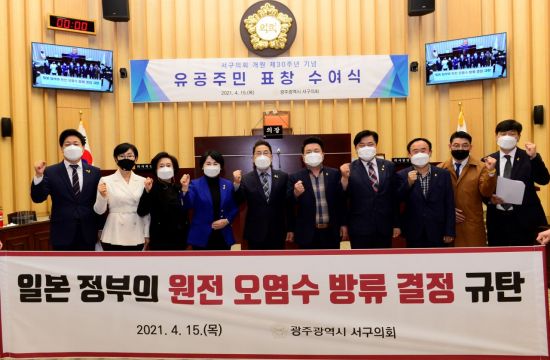
[Asia Economy Honam Reporting Headquarters Reporter Yoon Jamin] The Seo-gu Council of Gwangju Metropolitan City (Chairman Kim Taeyoung) has urged the Japanese government to retract its decision to discharge contaminated water from nuclear power plants.
They also demanded that the government, in solidarity with domestic and international civic groups, pressure the Japanese government and impose a complete ban on the import of Japanese seafood to protect the lives and safety of the people.
On the 15th, the Seo-gu Council stated in a press release, “We can never tolerate the worst decision made by the Japanese government on the 13th to discharge contaminated water generated after the Fukushima nuclear accident into the sea.”
They continued, “Seventy percent of the Japanese people, as well as neighboring countries including our own, view the discharge of contaminated water as dangerous and harmful to the body,” adding, “The Japanese government must not overlook the fact that this decision, forced through despite public opposition to the marine discharge of contaminated water, puts all humanity worldwide at risk once again after COVID-19.”
They also emphasized, “The discharged contaminated water contains radioactive substances including tritium and deadly cesium and strontium, raising serious concerns about pollution of the world’s oceans,” and “Experts predict that if radioactive contaminated water is discharged, it will take only about seven months to reach our country’s coast, making the safety of the people of the Republic of Korea the utmost concern.”
Furthermore, they added, “We cannot contain our anger at the Japanese government’s behavior that has thrown the entire world into fear over the discharge of nuclear power plant contaminated water,” and “We will devote all efforts to fight to the end and block the discharge through solidarity with councils nationwide.”
Meanwhile, the Japanese government officially announced on the 13th, through a meeting of relevant ministers, the ‘Basic Policy on the Disposal of Treated Water’ to discharge contaminated water stored in tanks at the Fukushima Daiichi Nuclear Power Plant into the ocean.
It is known that currently, 1,250,844 tons of radioactive contaminated water are stored in tanks at the Fukushima Daiichi Nuclear Power Plant. The marine discharge of contaminated water is expected to pose a significant risk to seafood contamination and the health and safety of people in neighboring countries.
© The Asia Business Daily(www.asiae.co.kr). All rights reserved.












