Bio=KOSDAQ Formula Broken... Caution on Sectoral Differentiation>
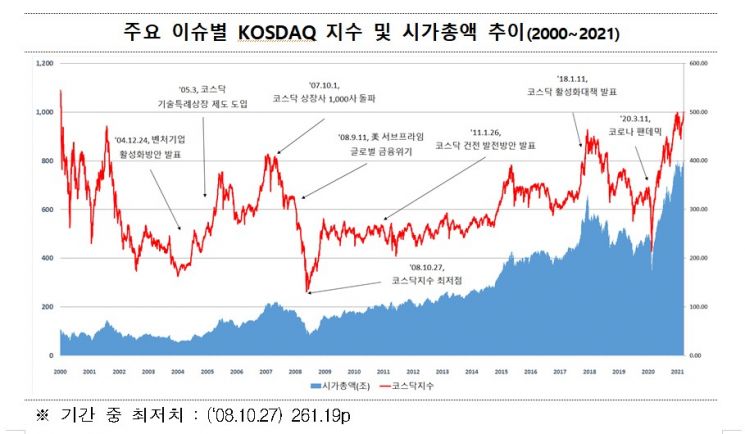
[Asia Economy Reporter Lee Seon-ae] As the era of 'Cheonsdak' has begun, there is a growing voice in the securities industry emphasizing the need to pay attention to small and mid-cap stocks on the KOSDAQ. With the KOSDAQ index closing above the 1000 mark for the first time in 20 years and 7 months, a new chapter has opened, and the prevailing forecast is that the KOSDAQ will continue its upward trend for the time being. Moreover, there are observations that the resumption of short selling in May could create a supply-demand environment favorable to small and mid-cap stocks on the KOSDAQ.
According to the Korea Exchange on the 13th, the KOSDAQ index started at 1001.00, up 0.35 points (0.03%). As of 9:27 a.m., it recorded 1003.63, up 0.30%.
The previous day, the KOSDAQ closed at 1000.65, up 11.26 points (1.14%) from the previous trading day, surpassing the 1000 mark for the first time in 20 years and 7 months based on the closing price. The last time the KOSDAQ index closed above 1000 was on September 14, 2000 (1020.70). Earlier, on January 26, the KOSDAQ briefly reached 1007.52 during the session, raising expectations for Cheonsdak, but it fell near the end of the session and ultimately closed below 1000.
◆Shift from Large Caps to Small and Mid Caps=With no significant negative factors, buying momentum from foreigners, institutions, and individuals is expected to continue, supporting the KOSDAQ's upward trend for the time being. Kim Yong-gu, a researcher at Samsung Securities, explained, "The market focus is expected to shift from KOSPI large caps to KOSDAQ small and mid caps," adding, "There is a high possibility that a rotation favoring the KOSDAQ will fully materialize." An So-eun, a researcher at IBK Investment & Securities, said, "Until last week, foreign investors mainly focused on the KOSPI, but recently they have been entering the KOSDAQ," explaining, "Foreign demand is supporting the market, and with high expectations for manufacturing and Korean exports, a favorable trend is likely to continue for the time being."
The continued inflow of individual buying is also positive for the KOSDAQ market. The KOSDAQ index generally moves in the same direction as the KOSPI but tends to rise following the KOSPI's price increases. This is based on the judgment that during periods when the KOSPI's price stabilizes after rising, investors seek alternative investment opportunities in KOSDAQ small and mid caps, expecting higher returns.
◆Resumption of Short Selling Also Favorable for Small and Mid Caps=In particular, with the resumption of short selling scheduled for May, there is a strong view that a favorable market environment for KOSDAQ small and mid caps will continue. Han Kyung-rae, a researcher at Daishin Securities, analyzed, "Short selling, which was banned since March last year, is scheduled to resume on May 3, but it will be limited to large caps such as KOSPI 200 and KOSDAQ 150," adding, "This measure could be advantageous for KOSDAQ small and mid caps, which account for more than half of the KOSDAQ's market capitalization."
Looking at past short selling trends in the KOSPI and KOSDAQ, the proportion of short selling in KOSPI 200 has accounted for 88-97% of total KOSPI short selling since 2010, dominating the market. Although the short selling proportion of KOSDAQ 150 increased from 32% in 2010 to 89% in 2020, it remains relatively low compared to the KOSPI. Based on market capitalization, the KOSPI 200 accounts for about 90% of the total KOSPI market cap, whereas KOSDAQ 150 accounts for about 46-48% of the total KOSDAQ market cap.
Han said, "While the KOSPI 200 dominates the KOSPI market capitalization, the KOSDAQ 150 accounts for less than half," emphasizing, "Therefore, the short selling restrictions on KOSPI 200 and KOSDAQ 150 will generally benefit small and mid caps in terms of supply and demand, especially favoring KOSDAQ small and mid caps."
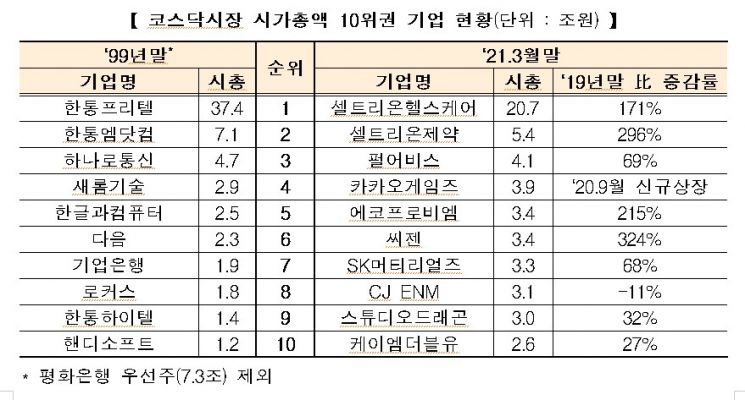
◆Market Leadership Shift: ‘De-Bio’=However, differentiation by sector within the KOSDAQ index is expected. Until early this year, the KOSDAQ index was heavily influenced by the bio and pharmaceutical sectors, exposing it to the volatility of the bio industry. However, the formula "KOSDAQ = Bio" has been broken this year. Semiconductor equipment, secondary battery materials, and media, content, and entertainment-related stocks have shown strength, emerging as new drivers leading the KOSDAQ index. Studio Dragon, a drama content stock, has notably risen back to 10th place in market capitalization. A Korea Exchange official explained, "Last year, pharmaceutical and bio stocks showed strong performance due to the spread of COVID-19," adding, "However, this year, sectors such as New Deal and secondary batteries have recorded high growth rates, supporting the index's rise."
Jang Hwa-tak, head of the research center at DB Financial Investment, explained, "The KOSDAQ index, which had been driven mainly by bio, is now diversifying its growth momentum centered on IT and entertainment sectors," adding, "It is positive for the KOSDAQ market that industries with high mid- to long-term growth potential are becoming leading sectors."
© The Asia Business Daily(www.asiae.co.kr). All rights reserved.













