Cargo Ships and Oil Tankers Delayed... International Oil Prices Surge
Taiwan "Industrial Water Use Reduced by 15%"... Concerns Over Semiconductor Production Disruptions
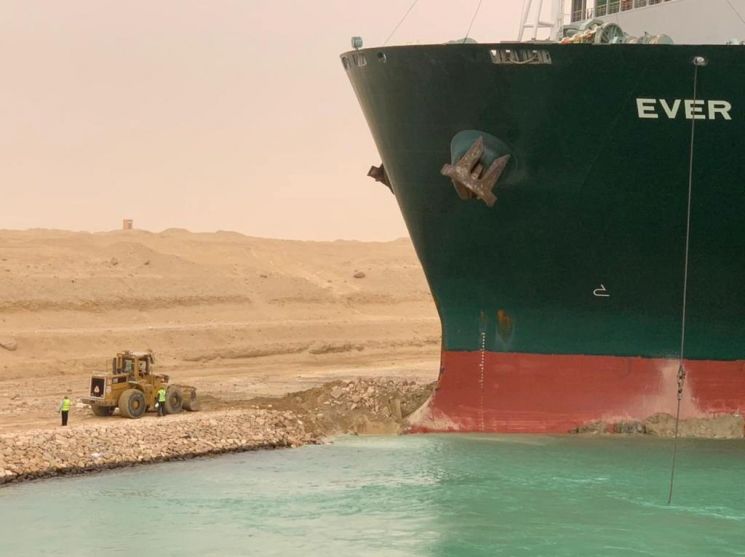
[Asia Economy Reporters Byunghee Park and Hyunwoo Lee] The Suez Canal, the main artery of global logistics, has been blocked due to a ship grounding accident, raising concerns about the already strained global supply chain. Taiwan, a major semiconductor supplier, has announced restrictions on industrial water use due to severe drought, further heightening the sense of crisis.
According to the AP News and major foreign media on the 24th (local time), the Suez Canal Authority (SCA) in Egypt stated that it is expected to take about two days to resolve the accident involving the 220,000-ton large container ship Ever Given, which ran aground while crossing the canal, and to resume canal operations.
◆Will a logistics crisis erupt from Suez... Concerns of 'arteriosclerosis' due to delayed accident recovery
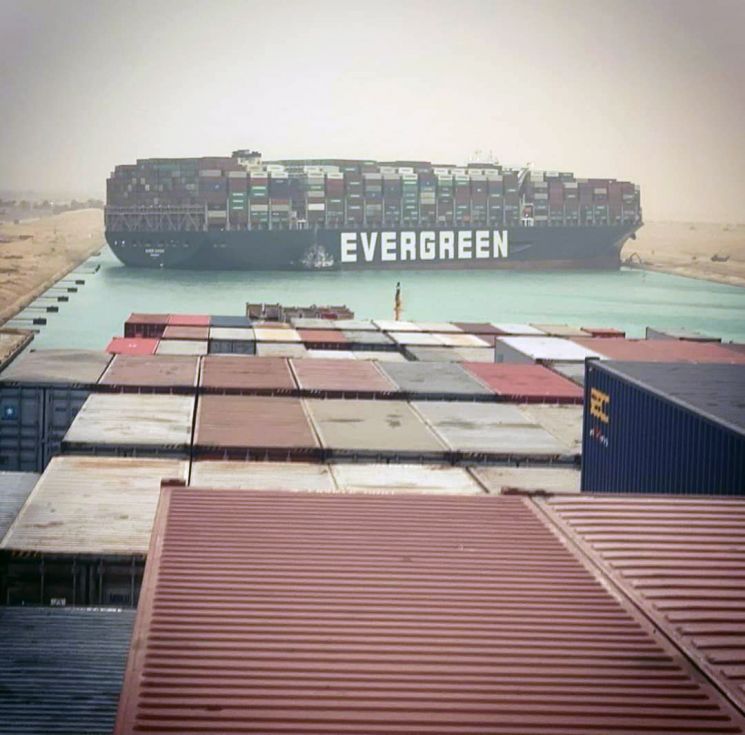
The SCA succeeded in refloating part of the hull using heavy equipment, but reported difficulties in accident recovery due to strong sandstorms and the hull being deeply buried in sandbanks. Currently, about 100 ships are anchored around the canal waiting for operations to resume.
The suspension of navigation in the Suez Canal has increased concerns about a global logistics crisis. According to The New York Times (NYT), about 55,000 containers are transported daily through the Suez Canal, accounting for approximately 30% of the world's container cargo volume. If the situation prolongs, there are fears that the supply chain crisis will intensify due to rising freight costs.
According to The Wall Street Journal (WSJ), Clarkson Platou Securities in the U.S. explained that "if the suspension of navigation in the Suez Canal is prolonged, cargo ships traveling between Asia and Europe will have to go around the southern tip of Africa, extending the voyage by more than seven days and significantly increasing shipping costs," adding, "Since countries are prioritizing the transport of COVID-19 vaccines, general cargo transport is already delayed, which could worsen delivery conditions."
As oil tankers heading to Europe and Asia were stranded, international oil prices surged sharply. On the same day, West Texas Intermediate (WTI) crude oil on the New York Mercantile Exchange (NYMEX) closed at $61.18 per barrel, up $3.42 (5.9%) from the previous session. WTI prices, which had temporarily dropped to the $57 level due to concerns over declining oil demand from Europe the day before, returned to the $60 level within a day.
◆Taiwan issues ‘Water Supply Red Alert’... Restrictions on semiconductor industrial water use
Adding to the woes, Taiwan’s severe drought is also fueling the global supply chain crisis. The Taiwanese government announced restrictions on industrial water use at major semiconductor complexes, raising fears of worsening semiconductor supply disruptions. According to Bloomberg News, the Taiwanese government issued a ‘Water Supply Red Alert’ for the first time in six years. Wang Mei-hua, Taiwan’s Deputy Minister of Economic Affairs, announced, "Starting from the 6th of next month, the amount of industrial water supplied to the Taichung Science Park, where major semiconductor companies are concentrated, will be reduced by about 15%."
As a result, concerns are growing that production processes at major Taiwanese semiconductor companies such as TSMC and Micron, which account for more than half of the global foundry semiconductor market, will be disrupted. Semiconductors consume a huge amount of water during production for equipment operation and cleaning processes. TSMC is known to use about 156,000 tons of industrial water daily. TSMC stated, "We will increase the use of water trucks to secure sufficient water, and a considerable amount of water has already been secured," assuring that factory operations will not be immediately affected. Micron has not yet commented.
With these overlapping adverse factors, the automotive industry, which has already announced repeated production halts due to semiconductor shortages, is facing deeper concerns. According to CNBC, on the same day, General Motors (GM), a leading U.S. automaker, decided to reduce production of mid-size pickup trucks due to semiconductor shortages. Major global automakers such as Ford, Toyota, Volkswagen, and Honda have also announced plans to suspend operations at some factories due to semiconductor shortages. Global consulting firm AlixPartners forecasted that the automotive industry’s sales will decrease by $60.6 billion (approximately 69 trillion KRW) this year due to the semiconductor supply shortage crisis.
© The Asia Business Daily(www.asiae.co.kr). All rights reserved.

![Clutching a Stolen Dior Bag, Saying "I Hate Being Poor but Real"... The Grotesque Con of a "Human Knockoff" [Slate]](https://cwcontent.asiae.co.kr/asiaresize/183/2026021902243444107_1771435474.jpg)
















