Overlap with Existing Measures to Expand In-Person Classes
Support Cooperative Teaching by Deploying Contract Teachers
Recommend Customized Problems Linked to EBS On-Call
Maintain CSAT Difficulty and Simplify College Admission Process
[Asia Economy Reporter Han Jinju] The Ministry of Education plans to provide dedicated basic academic skill teachers, online tutors, and AI-based personalized learning environments to reduce private education expenses.
On the 9th, the Ministry of Education presented the results of the private education expense survey along with countermeasures including ▲strengthening support for basic academic skills and self-directed learning ▲responding to high school students' demands for supplementary and advanced learning ▲stable operation of the college entrance examination system ▲and strengthening support to reduce educational disparities.
The Ministry will assign 2,000 fixed-term teachers to alleviate overcrowded classes in grades 1 to 3 of elementary school to enhance cooperative teaching and expand the number of teachers focused on basic academic skills. For elementary grades 4 to 6 and middle school students, online tutors will be introduced starting in May to support basic academic skill learning guidance and counseling.
The online learning content "Basecamp," which utilizes questions from the basic academic skill diagnosis and correction system as materials, will also be expanded. Content that allows elementary students to self-direct their learning in subjects such as English, math, and reading using artificial intelligence technology will be provided.
The Ministry also plans to actively respond to high school subject learning and demands for supplementary and advanced learning. Learning support will be strengthened through learning consulting and customized responsible guidance for high school students. Student-tailored learning guidance will be provided mainly through research and pilot schools implementing the high school credit system, which accounts for 60% of all high schools, with enhanced responsible guidance to ensure students reach minimum academic achievement levels.
Learning support using EBS educational materials will be strengthened. College Scholastic Ability Test (CSAT)-related textbooks will provide level-based content and complement school education by linking with learning management services. The AI-based learning diagnosis system for major high school subjects will be advanced, and from September, a service recommending level-based customized problems linked with the EBS online class will be provided.
The Ministry aims to improve the quality of remote classes to minimize academic disparities during the COVID-19 situation. It plans to expand real-time interactive communication classes and strengthen class feedback by providing same-day alternative learning materials to students who miss classes.
The increasing burden of private education expenses after entering high school is ultimately linked to college entrance exams. Measures are needed to reduce educational polarization caused by income and to improve the quality of public education.
The Ministry also presented plans to simplify the college entrance examination system focusing on student records and the CSAT to operate the system stably. It will encourage the reduction of essay and special talent screening and establish a foundation to strengthen self-verification of school life records. The list of prohibited words in the Education Administration Information System (NEIS) will be expanded, and a program to detect suspected violations in descriptive items for each student will be developed and distributed.
They plan to revise the "Public Education Normalization Act" to maintain stable CSAT difficulty and allow weighted penalties based on the number of violations if advance questions are used in university-specific exams.
The Ministry is pushing for the legislation of the "Social Integration Screening" that mandates the selection of socially disadvantaged candidates linked to university financial support projects. The target for free EBS textbooks will be expanded to include recipients of educational benefits.
Management and supervision of private education institutions will also be strengthened. In cooperation with metropolitan and provincial education offices, monitoring of academy fee changes will be conducted once every six months, and inspections targeting high-cost entrance exam academies and private tutoring will be intensified. Inspections of illegal and irregular operations of unauthorized educational facilities such as international schools will be promoted, and legal actions such as prosecution will be considered depending on the degree of legal violations.
Many of the countermeasures for declining basic academic skills and high school student learning support are included in this year's academic operation plan, giving the impression that the Ministry merely listed existing policies rather than presenting policies specialized for reducing private education expenses.
Hong Gi-seok, Director of School Innovation Policy at the Ministry of Education, explained, "Setting a target for reducing private education expenses next year is realistically difficult. Operating education policies uniformly and stably and gaining public trust while strengthening public education will be the stable direction to reduce private education. We will continuously monitor and supervise the excessive rise in academy fees, which increase the burden on parents among private education expenses."
The Korea Federation of Teachers' Associations criticized, "Low-income groups who could not participate in private education in addition to non-face-to-face classes are further marginalized in both public and private education, deepening educational inequality. They pointed out that only ineffective measures such as patchwork personnel supply like fixed-term teachers and online tutors and the unclear implementation of the high school credit system are being presented."
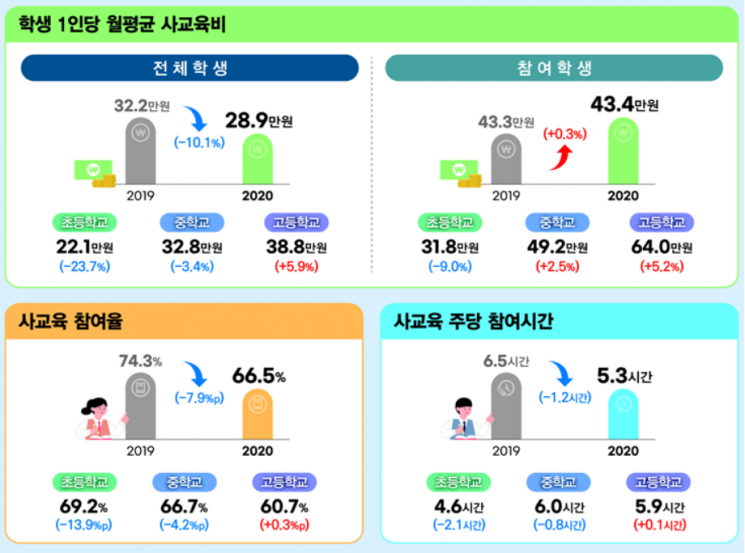
The Ministry of Education announced the 2020 private education expense survey results on this day. Due to the impact of COVID-19 last year, total private education expenses amounted to 9.3 trillion won, a decrease of 11.8% compared to the previous year. The participation rate in private education was 7.9%, and weekly participation time decreased by 1.2 hours to 5.3 hours. The average monthly private education expense per student by school level was ▲220,000 won for elementary school ▲328,000 won for middle school ▲388,000 won for high school. While expenses decreased by 23.7% for elementary and 3.4% for middle school, high school expenses increased by 5.9%.
© The Asia Business Daily(www.asiae.co.kr). All rights reserved.












