Draft Released at Public Hearing... "Minimize Gathering Bans and Reclassify Multi-use Facilities"
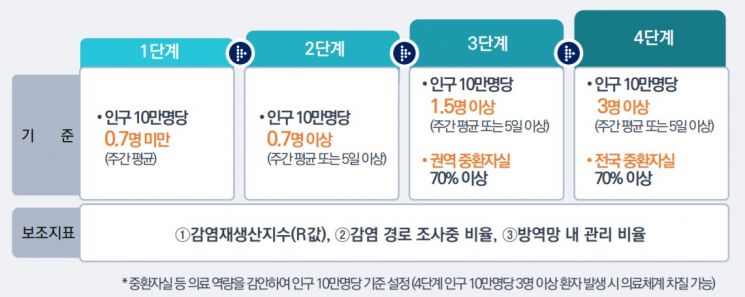
[Asia Economy Reporter Seo So-jeong] The current five-level social distancing system will be simplified to four levels, and the criteria for adjusting distancing stages will change from the weekly average daily confirmed cases to the weekly daily average number of patients per 100,000 population.
The 'ban on private gatherings of five or more people' measure will apply from level 3, while gatherings of up to eight people will be allowed at level 2. Applying the new criteria, the Seoul metropolitan area, which recently had an average of 295.4 confirmed cases per day over the past week, will be subject to level 2.
◆Level 2 in the Seoul Metropolitan Area Allows Gatherings of Up to 8 People= The Central Disaster and Safety Countermeasures Headquarters of the Ministry of Health and Welfare held a public hearing on the 'Social Distancing System Reform (Draft)' on the 5th at the LW Convention in Jung-gu, Seoul, and disclosed the draft of the distancing system.
Son Young-rae, head of the Social Strategy Division at the Central Disaster and Safety Countermeasures Headquarters, said, "The existing five-level system was overly segmented, making public behavioral response messages unclear. As medical capacity has expanded with increased severe patient beds and residential treatment centers, we plan to reflect this and minimize gathering bans that could disrupt livelihoods, such as those affecting self-employed individuals, by reorganizing the distancing stages."
According to the distancing reform draft released that day, the current five-level system will be reduced to four levels. Based on the weekly daily average number of patients per 100,000 population, level 1 is below 0.7, level 2 is 0.7 or higher, level 3 is 1.5 or higher, and level 4 is 3 or higher. Auxiliary indicators include the infection reproduction number, the proportion of cases under investigation for infection routes, and the management rate within the quarantine network.
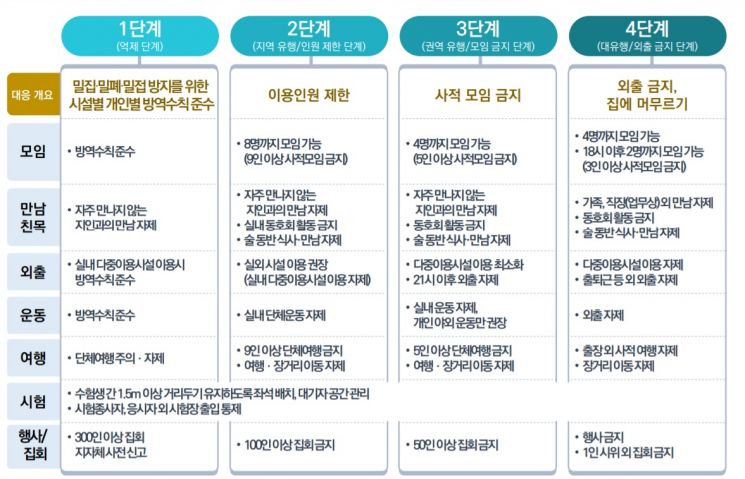
Private gathering criteria are also presented by level. At level 2, restrictions on the number of people begin, and private gatherings of nine or more people are prohibited. At level 3, private gatherings of five or more people are banned, and at level 4, gatherings of three or more people after 6 p.m. are additionally prohibited, encouraging people to refrain from going out altogether.
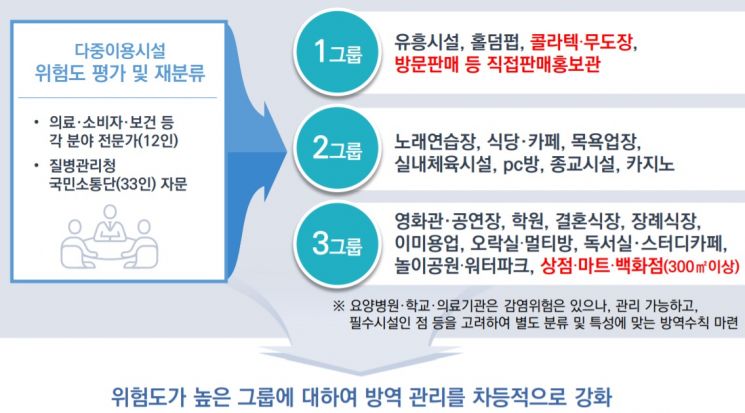
Multi-use facilities are classified by risk assessment into ▲Group 1: entertainment facilities, holdem pubs, colatecs and dance halls, direct sales promotion centers such as door-to-door sales ▲Group 2: karaoke rooms, restaurants and cafes, bathhouses, indoor sports facilities, PC rooms, religious facilities, casinos ▲Group 3: movie theaters and performance halls, academies, wedding halls, funeral halls, beauty salons, arcades and multi-rooms, reading rooms and study cafes, amusement parks and water parks, stores, marts, and department stores (over 300㎡).
◆Only Some Facilities Like Clubs Are Banned at Level 4= From level 2, the standard is one person per 8㎡, adjusted according to the characteristics of the industry. At level 3, operation hours for Groups 1 and 2 are limited to 9 p.m., and at level 4, Groups 1 through 3 are restricted to 9 p.m. Restaurants and cafes must maintain a 1-meter distance between tables from level 1 and only allow takeout and delivery after 9 p.m. Gathering bans apply only at level 4 to Group 1 facilities such as clubs (including nightclubs), hunting pubs, and emotional pubs.
For indoor sports facilities, discussions are underway with related associations and organizations to allow operation after 9 p.m. if risk factors such as treadmill speed limits, shower use restrictions, and food sales bans are implemented.
Quarantine management for high-risk vulnerable facilities will be strengthened. For religious facilities, occupancy limits are set at 50% for level 1, 30% for level 2, 20% for level 3, and non-face-to-face use at level 4. Choirs (except for one person) and loud prayers are prohibited at all levels. From level 2, gatherings, meals, and overnight stays are banned.
For nursing hospitals, workers including caregivers must undergo PCR testing twice a week from level 2, and nursing facility workers are required to have PCR tests once a week.
Son said, "This reform draft is preliminary, and the final version will be announced in March. The timing of implementation will be decided after comprehensively reviewing vaccination status, school openings, and epidemic trends."
© The Asia Business Daily(www.asiae.co.kr). All rights reserved.














