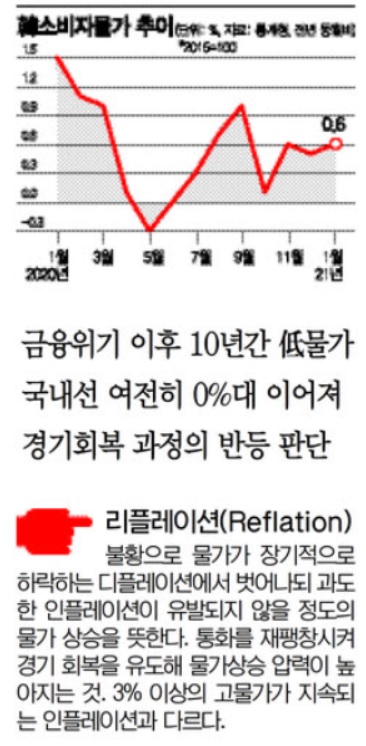
[Asia Economy Reporter Eunbyeol Kim] While concerns about inflation are rising as international oil prices, commodity prices such as grains and copper, and stock prices all surge simultaneously, economic experts diagnose the current situation as ‘reflation.’ Due to more than a decade of low inflation trends following the financial crisis, domestic inflation remains in the 0% range, and it is considered appropriate to view the recent price rebound as part of the economic recovery process. However, with the repeated waves of COVID-19, uncertainty about when vaccine effects and economic recovery will become visible, whether rising prices signify economic recovery remains a continuous topic of debate.
According to the U.S. Department of Commerce on the 17th, the core Personal Consumption Expenditures (PCE) price index, which the U.S. Federal Reserve (Fed) refers to, rose 1.5% year-on-year last month. This inflation rate had dropped to 1.0% in May and June of last year when the COVID-19 situation worsened, but due to ongoing monetary easing and economic recovery trends, it has risen to the mid-1% range. Although it is expected to soon reach the Fed’s target level of ‘2%,’ the Fed has indicated it will tolerate inflation above 2% for the time being, suggesting that accommodative monetary policy may continue.
In Korea, the low inflation trend is more severe, and many view it as premature to worry about inflation. According to Statistics Korea, the consumer price inflation rate last month was 0.6% year-on-year. While this is a significant rebound compared to the negative inflation (-0.3%) recorded in May last year, it is still interpreted as an upward trend due to last year’s base effect.
Kim Sung-taek, Senior Fellow at the International Finance Center, stated, "The probability of ‘good inflation,’ where prices gradually rise with economic expansion after reflation, and the possibility of returning to disinflation are appearing similarly." This means there is a considerable chance that prices may briefly rebound and then fall again, as after the financial crisis. Kim Jeong-sik, Professor Emeritus of Economics at Yonsei University, explained, "The higher prices felt in daily life are not so much due to increased demand but rather due to higher costs from rising labor, oil, and raw material prices. If the COVID-19 recovery is slow, demand will not increase much, making it difficult for the official inflation indicators to rise."
However, experts unanimously agree, as the Bank of Korea and others assess, that preparations for monetary policy normalization should be made once prices rise to a certain extent. The market expects that when the U.S. PCE inflation exceeds 2.5% and approaches 3%, and the U.S. 10-year Treasury yield nears 1.8%, discussions about monetary policy normalization will arise, potentially causing shocks. Professor Kim added, "Central banks need to proactively monitor inflation and review money supply, so they should start considering the timing of monetary policy normalization now."
© The Asia Business Daily(www.asiae.co.kr). All rights reserved.











