Lower than IMF forecast of 8.1%... Among 29 regions, 8 set targets above 8%
Guangdong and other large GDP regions aim for 6% range
[Asia Economy Beijing=Special Correspondent Jo Young-shin] Among China's 31 provinces, 29 provincial-level local governments have set this year's economic growth targets ranging from a minimum of 6% to over 10%. The provincial-level economic growth targets are reported at the National People's Congress and the Chinese People's Political Consultative Conference, the largest political events in China, and serve as the basis for the central government's economic goals.
Since the Chinese government is unlikely to present an economic growth target this year after the sessions, this year's economic growth rate in China can be gauged by the provincial-level targets.
According to the state-run Xinhua News Agency on the 5th, except for Hebei Province and Heilongjiang Province, which could not hold the sessions due to the COVID-19 pandemic, 29 provincial-level autonomous regions held local sessions.
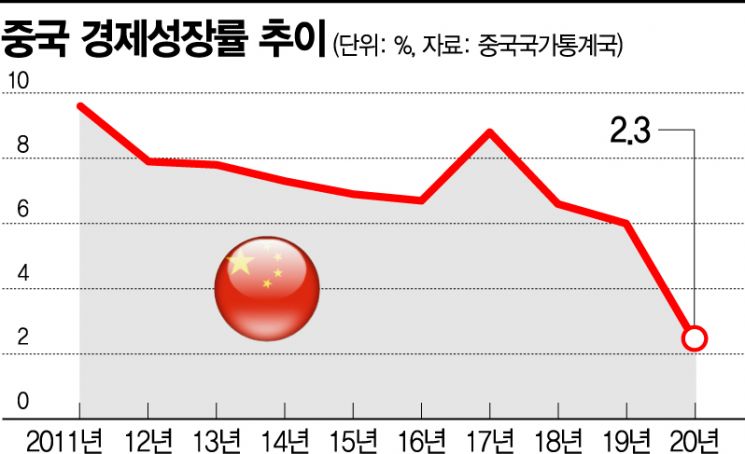
Among them, 15 provincial-level autonomous regions including Beijing City, Shanghai City, and Jilin Province set this year's economic growth target at 6% or higher. Six regions, including Henan Province and Sichuan Province, set targets of 7% or higher, and five provinces including Yunnan Province set targets of 8% or higher.
Hubei Province, which recorded negative growth due to the spread of COVID-19 at the end of last year, and Hainan Province, known as China's Hawaii, set targets of over 10%.
Su Hongchai, Deputy Director of the China Policy Research Institute, explained, "Last year, Hubei Province was greatly affected by the epidemic, resulting in a very low growth rate," adding, "In the case of Hubei Province, the gross domestic product (GDP) scale is small, so it can record a high growth rate this year." He explained that a high growth rate can be expected due to the base effect and other factors.
Hainan Province, which grew by 3.5% last year, is known to have set a target of over 10% this year through early initiation of the free trade port and attracting tourists.
Above all, Hainan plans to achieve its economic growth target by expanding its duty-free business. This year's duty-free sales target alone reaches 60 billion yuan (approximately 10.413 trillion Korean won). Last year, Hainan's duty-free sales amounted to 32 billion yuan.
The Hainan provincial government has increased the number of duty-free shops to nine and introduced a duty-free product delivery service. The per capita duty-free purchase limit for domestic citizens has also been expanded from the previous 30,000 yuan to 100,000 yuan.
Tibet Autonomous Region, Guizhou Province, and Yunnan Province also set high targets of 8-9%.
However, the economic growth targets for this year in Guangdong Province, Jiangsu Province, Shandong Province, Shanghai, Beijing, and other eastern coastal regions of China with large GDP scales are around 6.5%. The International Monetary Fund (IMF) recently projected China's economic growth rate this year at 8.1%, which is higher than these targets. Only eight out of the 29 provincial-level local governments set targets similar to the IMF forecast.
Regarding this, Deputy Director Su said, "There are many uncertainties regarding the epidemic situation and external environment (US-China relations)," adding, "It seems that China's provincial-level local governments have set conservative targets considering these circumstances." He further added, "Each local government has set targets focusing on sustainability and stability this year."
© The Asia Business Daily(www.asiae.co.kr). All rights reserved.












