Personal Business Loans from Shinbo Foundation Also Available at K-Bank and K-Bank
Business Scope Expected to Expand Amid Credit Loan Growth
Some Criticize, "Internet Banks Should Fulfill Their Role"

[Asia Economy Reporters Kim Hyo-jin and Won Dara] Internet-only banks such as KakaoBank and K Bank are accelerating their expansion into the loan market. Their influence in the credit loan market is growing, and competition in the mid-interest loan sector is heating up. Soon, they are expected to enter the corporate (individual business owner) loan market, drawing attention to the potential impact on the overall loan market landscape. With the upcoming launch of Toss Bank, the competitive dynamics are expected to become even more complex.
According to banking and political sources on the 1st, KakaoBank and K Bank will begin offering non-face-to-face loans with personal business owner guarantees backed by the Korea Credit Guarantee Fund (KODIT) starting in the second half of this year. These banks signed a 'Smart Guarantee' business agreement with the Ministry of SMEs and Startups and KODIT in June last year. KODIT is currently working on building the necessary IT systems for loan processing through these banks.
Based on explanations from bank and KODIT officials, it is anticipated that from as early as July, KakaoBank and K Bank will be able to offer personal business owner guaranteed loans through regional credit guarantee foundations. Toss Bank, which is set to launch in the second half of the year, has also decided to participate. A bank official stated, "If there are no special issues, loans should be available from July, and at the latest, within the third quarter."
KODIT expects that this will significantly expand the channels for financial support to small business owners and self-employed individuals in the non-face-to-face domain, greatly enhancing convenience. From the banks' perspective, handling guarantee-based corporate loans, which carry relatively lower default risk, will allow them to expand their business more stably.
Internet banks are also accelerating the expansion of mid-interest loans. KakaoBank recently lowered the limit on its high-credit employee credit loans by 50 million KRW to create room for expanding mid-credit loans. K Bank, which plans a capital increase of 400 billion KRW in the first half of this year, also intends to introduce mid-interest loan products.
After about two years of preparation, K Bank is focusing on expanding its loan portfolio based on the apartment mortgage loans it launched in August last year. KakaoBank has also informed Rep. Park Yong-jin of the Democratic Party that it is preparing to launch a non-face-to-face mortgage loan using electronic registration. The launch date has not yet been finalized.
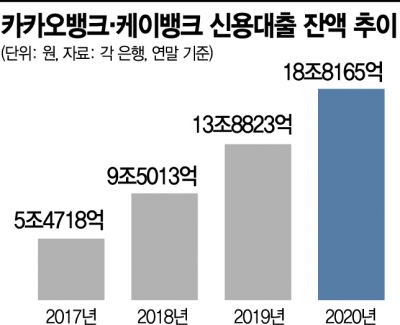
KakaoBank and K Bank’s Credit Loan Balances Reach 18.81 Trillion KRW at End of Last Year
Thanks to the spread of non-face-to-face transaction culture, KakaoBank and K Bank have rapidly grown their presence in the credit loan market. The combined credit loan balance of the two banks was 5.4718 trillion KRW at the end of their first year in 2017, rising sharply to 9.5013 trillion KRW at the end of 2018, 13.8823 trillion KRW at the end of 2019, and 18.8165 trillion KRW at the end of last year. This represents nearly a fourfold increase in just three years.
Some voices have raised concerns that if internet banks focus on expanding operations centered on interest rate margins like traditional commercial banks, the original purpose of financial innovation could be undermined.
Rep. Park, who recently received reports from KakaoBank on plans for personal business owner loans and mortgage loans, criticized, "This is essentially following the criticized interest margin-centered business practices of commercial banks." He added, "Rather than expanding business with a 'safe bet' approach, internet-only banks should faithfully fulfill their original role as catalysts for innovation in the financial sector."
© The Asia Business Daily(www.asiae.co.kr). All rights reserved.












