Last Year Semiconductor Operating Profit Nears 19 Trillion Won, Up 4.8% YoY
Foundry Business Records Quarterly Highest Sales
Last Year Semiconductor Facility Investment 3.29 Trillion Won
Cautious on Additional Facility Investment... Plan to Expand Investment Over Next 3 Years
[Asia Economy Reporters Suyeon Woo, Hyunjin Jeong, Eunmo Koo] Samsung Electronics set a record last year with semiconductor operating profit approaching 19 trillion won, marking the start of a full-fledged V-shaped recovery. This was influenced by the ‘untact effect’ caused by the COVID-19 pandemic, which led to a real shortage of semiconductors across all industries including home appliances, smartphones, and automobiles.
As the untact industry enjoys an unprecedented boom, forecasts are emerging that a ‘super cycle’ will return to the semiconductor market, a core component. Accordingly, predictions are gaining traction that Samsung Electronics, competing for the global semiconductor market share No. 1 spot, will enter a phase of significant performance improvement this year.
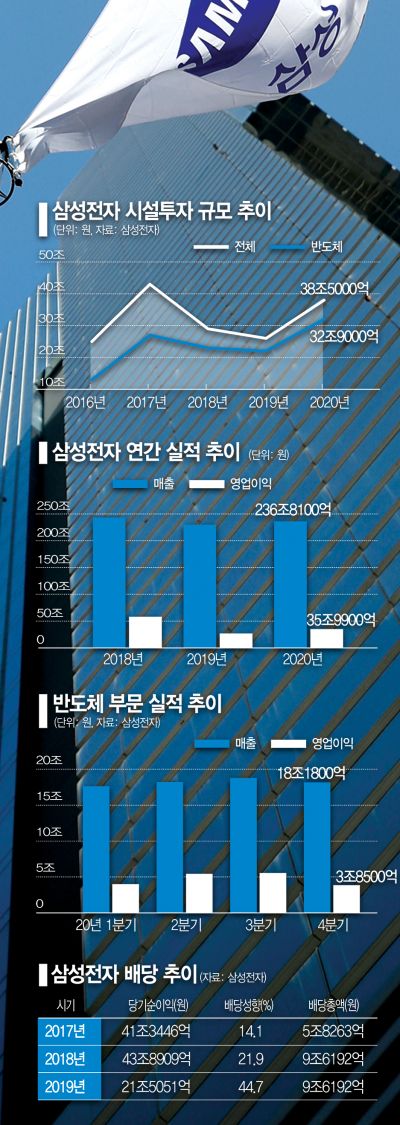
◆Foundry Business Sets Record Quarterly Sales= On the 28th, Samsung Electronics announced that its semiconductor division recorded sales of 72.86 trillion won and operating profit of 18.81 trillion won last year. These figures represent increases of 12% and 4.8%, respectively, compared to the previous year. Notably, memory semiconductor sales rose 11% year-on-year to 55.54 trillion won last year.
In the fourth quarter, semiconductor division sales increased 8% year-on-year to 18.18 trillion won, and operating profit rose 0.4% to 3.85 trillion won. Although the memory business was sluggish due to unfavorable exchange rates and falling selling prices, the overall performance was supported by a rapid recovery in the DRAM market. The DRAM business showed steady demand due to smartphone sales recovery, expansion of data centers, and strong PC demand. The foundry business also set a record quarterly sales driven by increased demand for 5G mobile chips and sensors.
◆‘Rosy Outlook’ for Semiconductor Market… Samsung: Foundry Supply Shortage to Persist in 1Q= Samsung Electronics also views the global semiconductor market positively this year. First, Samsung expects the memory semiconductor market in the first quarter to improve overall due to various new mobile product launches and expanded demand from data centers and notebooks. In response, Samsung plans to enhance cost competitiveness by expanding the share of 10-nanometer class (1z-nanometer) DRAM and accelerating the transition to 6th generation V-NAND. Additionally, it aims to strengthen market leadership by introducing next-generation product lineups such as the world’s first multi-step EUV-applied 1a-nanometer DRAM and 7th generation V-NAND.
The foundry sector, which is experiencing a global supply shortage, is expected to continue facing supply constraints through the first quarter. Samsung plans to operate lines flexibly and increase production of advanced processes to secure a foundation for future growth. It also intends to focus on developing advanced processes such as 3-nanometer 1st and 2nd generation to secure next-generation growth engines.
Regarding foundry investment plans for this year, Samsung did not disclose specific figures but expressed its intention to expand strategic facility investments over the next three years and to pursue meaningful M&A activities.
Last year, Samsung Electronics made facility investments totaling 38.5 trillion won, of which 32.9 trillion won was invested in semiconductors and 3.9 trillion won in displays. In the memory sector, advanced process expansions were carried out to meet future demand increases, while foundry investments significantly increased year-on-year through expansions such as EUV 5-nanometer processes.
◆Display and IM Divisions Also Show Clear Performance Improvement= In the fourth quarter of last year, the display and mobile divisions showed clear recovery, leading to a performance rebound. The display division recorded quarterly record results with sales of 9.96 trillion won and operating profit of 1.75 trillion won, driven by a significant increase in small- and medium-sized panel utilization rates and improved large panel market conditions.
The IM (IT & Mobile) division, responsible for the smartphone business, recovered operating profit to the 10 trillion won level last year. In the fourth quarter, the IM division posted sales of 22.34 trillion won and operating profit of 2.42 trillion won. The IM division plans to accelerate performance improvement by launching the premium smartphone ‘Galaxy S21’ early in the first quarter of this year.
© The Asia Business Daily(www.asiae.co.kr). All rights reserved.

![Clutching a Stolen Dior Bag, Saying "I Hate Being Poor but Real"... The Grotesque Con of a "Human Knockoff" [Slate]](https://cwcontent.asiae.co.kr/asiaresize/183/2026021902243444107_1771435474.jpg)














