[Asia Economy Reporter Eunbyeol Kim] It has been pointed out that big tech companies such as KakaoPay must clearly state in their apps that prepaid recharge funds are not covered by the Depositor Protection Act, unlike deposits in financial institutions.
On the 25th, the Bank of Korea disclosed the results of the "Regular Evaluation of the Payment Settlement System Operated by the Korea Financial Telecommunications and Clearings Institute (KFTC)," which included this content.
According to the results, among the 13 small payment systems of the KFTC, four financial market infrastructures (FMIs) (Bill Exchange System, Interbank Network, Electronic Financial Network, and Open Banking Network) were evaluated for compliance with international standards. Out of 17 principles, 11 were rated as "satisfied," while the remaining six were classified as "largely satisfied."
In particular, it was diagnosed that there is room for improvement in the response and operation system to payment defaults in the "Open Banking Network," which has included non-financial operators such as big tech companies since December 2019.
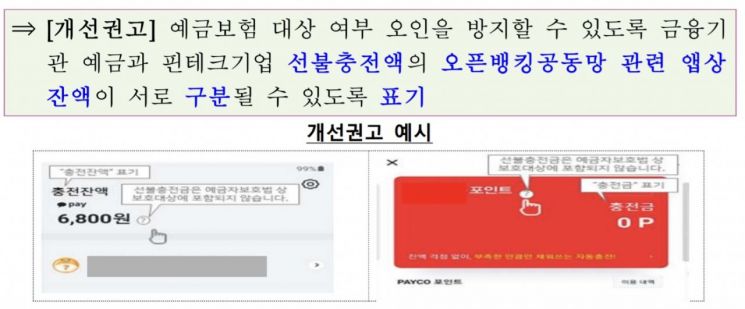
The Bank of Korea explained that on the app screens of fintech companies issuing prepaid payment instruments, both the prepaid recharge amount, which is not covered by depositor protection, and the deposit amount in financial institutions, which is protected, are displayed identically as "balance," potentially misleading consumers into believing that prepaid recharge funds are also protected.
The Bank of Korea recommended the KFTC, the operator of the Open Banking Network, to clearly distinguish prepaid recharge funds from deposits by labeling them as "recharge funds" or "recharge balance," and to include a phrase such as "Prepaid recharge funds are not covered by the Depositor Protection Act."
Additionally, the Bank of Korea conducted a self-assessment of its five responsibilities as the policy authority of the KFTC.
While the items of FMI supervision and monitoring, FMI policy disclosure, and adoption and application of PFMI (Principles for Financial Market Infrastructures) received a "satisfied" rating, the items "possession of monitoring authority and resources" and "mutual cooperation among policy authorities" were rated as "largely satisfied."
The Bank of Korea's self-diagnosis pointed out a lack of legal grounds for effective measures to verify the authenticity of data, conduct on-site investigations for accident prevention, and enforce improvement recommendations, as well as insufficient official consultation channels among related authorities for information sharing and cooperation.
© The Asia Business Daily(www.asiae.co.kr). All rights reserved.












