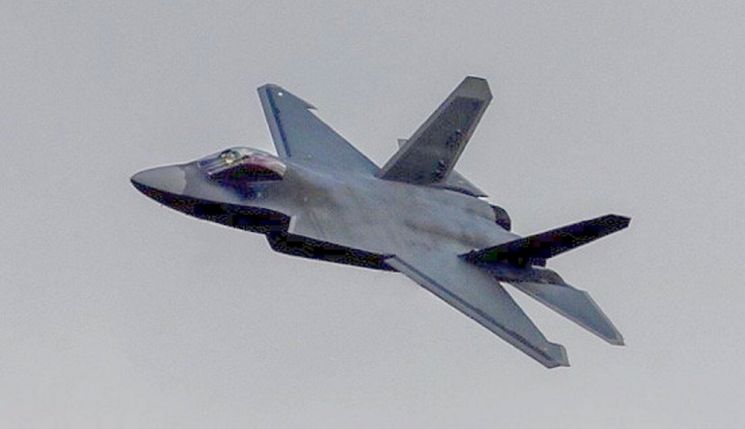
[Kim Daeyoung, Military Analyst] The FC-31 is a stealth fighter jet developed by the Aviation Industry Corporation of China (AVIC), a leading Chinese aircraft manufacturer. Its design closely resembles the American F-35 fighter jet, earning it the nickname "knockoff F-35." However, it is highly likely that the FC-31 will move beyond the prototype stage to become a key fighter for the Chinese Navy and Air Force. In particular, China is positioning the FC-31 as a rival to the F-35 fighter jet.
The FC-31 prototype No. 1 made its first public demonstration flight at the China International Aviation & Aerospace Exhibition, also known as the Zhuhai Airshow, on November 11, 2014. Among the aircraft displayed at the Zhuhai Airshow that year, the FC-31 prototype No. 1 was the only one not exhibited on the runway. Instead, it performed demonstration flights and was shown only in a hangar to select overseas VIPs. The existence of the FC-31, confirmed since 2012, has been developed at AVIC’s Shenyang Aircraft Corporation in Shenyang. For reference, the Shenyang factory, along with AVIC’s Chengdu factory, is known as one of the two main hubs for Chinese military fighter development and production.
Unlike the J-10 produced at the Chengdu factory and the J-20, China’s first stealth fighter, the FC-31 does not have canards?small auxiliary horizontal wings attached to the front of the aircraft fuselage. Since the 1980s, the Chengdu factory has developed the J-10, China’s first 4th generation fighter, as a variable-geometry aircraft utilizing canards. In contrast, the Shenyang factory naturally acquired Leading-Edge Root Extension (LERX) technology while producing licensed versions of the Russian Su-27 fighter. Based on this technical foundation, the FC-31’s exterior design incorporates radar cross-section reduction through aligned reflection angles.
Additionally, with each successive prototype, extensive low-observable design features have been applied, including recessed antennas and internal weapons bays. In December 2016, the upgraded prototype No. 2 successfully completed its flight. Although there was no official announcement, photos of prototype No. 2 circulating on Chinese internet suggest it was equipped with radar and avionics systems. Later, in September 2020, prototype No. 3, an upgraded version of prototype No. 2, appeared and successfully flew. Unlike prototype No. 1, prototype No. 3 is powered by the Chinese-made WS-13 turbofan engine.
China has never officially disclosed how it plans to use the FC-31 in its military. However, it appears highly likely that the aircraft will be employed as a carrier-based fighter jet, operating from aircraft carriers. The currently operated J-15 was developed based on the Soviet Su-33 carrier-based fighter prototype. However, the J-15 is considered too large and heavy to operate efficiently from China’s current aircraft carriers. Notably, China’s carriers use the STOBAR (Short Take Off But Arrested Recovery) system, which relies on the fighter’s own power for short takeoff and arrestor wires for landing, rather than catapults. Facing similar challenges, the Russian Navy introduced the smaller MiG-29K as a carrier-based fighter. Therefore, it is highly probable that the FC-31 will be selected as the carrier-based fighter for China’s next-generation aircraft carriers.
© The Asia Business Daily(www.asiae.co.kr). All rights reserved.

![Clutching a Stolen Dior Bag, Saying "I Hate Being Poor but Real"... The Grotesque Con of a "Human Knockoff" [Slate]](https://cwcontent.asiae.co.kr/asiaresize/183/2026021902243444107_1771435474.jpg)














