Shinhan Bank Raises Bar for Jeonse and Credit Loans
Other Banks Also Considering Regulatory Measures Like Limit Reductions

[Asia Economy Reporter Kim Hyo-jin] With the resurgence of the ‘Debt Investment (borrowing to invest in stocks)’ craze at the start of the new year, a sharp increase in unsecured loans has reappeared, and as financial authorities continue to issue management orders, moves to tighten loan regulations in the banking sector are becoming more visible.
As Shinhan Bank has proactively begun management, there is speculation that if other banks follow suit with regulatory measures, another wave of loan tightening could occur following the end of last year.
According to the banking sector on the 19th, Shinhan Bank raised the interest rates on jeonse (key money deposit) loans starting today to manage the total volume of household loans. The preferential interest rates on Shinhan Jeonse Loans guaranteed by Seoul Guarantee Insurance were lowered by 0.1 percentage points for each category, and the adjustment rates for Shinhan Jeonse Loan products guaranteed by the Korea Housing Finance Corporation and Housing and Urban Guarantee were reduced by 0.1 percentage points. Lowering preferential rates effectively raises the loan interest rates by the same margin.
Additionally, Shinhan Bank lowered the credit loan limits for four products, including ‘Elite Loan I & II’ and ‘Solpyeonhan Salaryman Loan S I & II’, which are targeted at employees of designated companies, from 150 million to 200 million KRW down to 100 million to 150 million KRW. Shinhan Bank explained that this adjustment was made because the stock market has overheated since the beginning of the year and household debt has increased, necessitating a partial adjustment of high-value unsecured loan limits.
Other major banks are also analyzing recent loan handling trends and considering additional regulatory measures beyond existing management plans. A representative from Bank A said, "Following the authorities’ orders, we are reviewing various options including interest rate hikes," adding, "It is possible that these will be applied to major unsecured loan products soon."
In the case of Bank B, if measures such as limit reductions maintained since the end of last year fail to produce significant effects, the bank plans to expand the target products and increase interest rates to manage loans. A representative from Bank C explained, "We are closely monitoring daily loan handling status, especially for products targeting professionals," and added, "We will decide on additional regulations depending on future trends."
Unsecured Loans at the Five Major Banks Jump by 1.8804 Trillion KRW in Two Weeks
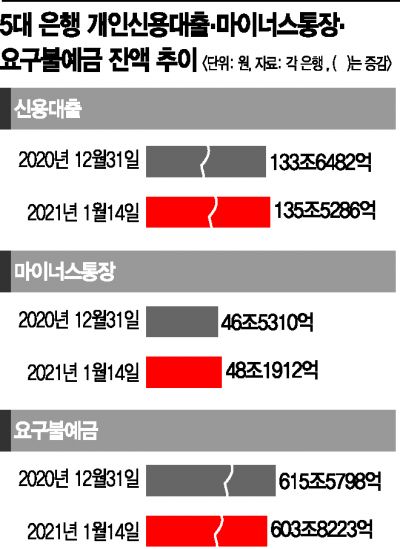
The balance of unsecured loans in the banking sector has shown a sharp increase similar to last year until mid-this month. As of the 14th, the balance of unsecured loans at the five major banks?KB Kookmin, Shinhan, Hana, Woori, and NH Nonghyup?stood at 135.5286 trillion KRW, up 1.8804 trillion KRW from 133.6482 trillion KRW at the end of December last year.
From the beginning of this year until the 14th, 20,588 new overdraft accounts were opened at the five major banks alone, and the balance of overdraft unsecured loans rose by 1.6602 trillion KRW from 46.531 trillion KRW at the end of December last year to 48.1912 trillion KRW.
On the other hand, deposits and savings have noticeably decreased. The balance of time deposits at the five major banks, which was 640.7257 trillion KRW at the end of October last year, dropped by 9.7399 trillion KRW to 630.9858 trillion KRW as of the 14th of this month. The balance of installment savings, which was 41.4277 trillion KRW at the end of November last year, also decreased by 2.337 billion KRW to 41.194 trillion KRW as of the 14th.
Demand deposits, which are freely accessible and often serve as waiting funds yet to find investment destinations, decreased by 11.7575 trillion KRW from 615.5798 trillion KRW at the end of December last year to 603.8223 trillion KRW as of the 14th this year.
A bank official said, "As demand for unsecured loans to quickly invest in stocks continues, the ‘money move’?the rapid transfer of funds from time deposits and savings to the stock market?is also accelerating," adding, "Young office workers who have postponed plans to buy homes due to soaring housing prices may continue to flock to the stock market, so this trend is likely to persist for some time."
© The Asia Business Daily(www.asiae.co.kr). All rights reserved.

![Clutching a Stolen Dior Bag, Saying "I Hate Being Poor but Real"... The Grotesque Con of a "Human Knockoff" [Slate]](https://cwcontent.asiae.co.kr/asiaresize/183/2026021902243444107_1771435474.jpg)















