KOSPI Falls Over 2% for Two Consecutive Days... Drops Below 3100
Correction Phase, Opportunity to Increase Weighting
[Asia Economy Reporter Song Hwajeong] Recently, as the KOSPI fell below the 3100 level and entered a correction phase, it seems necessary to pay attention to cyclical stocks or earnings improvement stocks during the adjustment period, considering the future economic recovery.
According to the Korea Exchange on the 19th, the KOSPI fell more than 4% over the past two trading days, breaking below the 3100 level. The KOSPI, which had maintained a steep upward trend since the beginning of this year, recorded a decline of more than 2% for two consecutive days, entering a correction phase.
Since it rose sharply in a short period, a correction is expected to be inevitable for the time being. Lee Kyungmin, a researcher at Daishin Securities, said, "Expectations for growth relative to inflation have weakened, leading to overheating in global asset markets and valuation burdens, which have resulted in increased volatility." He added, "Especially since the fourth quarter of last year, the KOSPI has shown relative strength compared to global stock markets, and the short-term volatility expansion of the KOSPI, which had extreme overheating and valuation burdens, is inevitable."
However, the correction is analyzed as an opportunity to increase weighting. Lee said, "If fundamental momentum that outweighs inflation and interest rate increases flows in, the KOSPI will resume its upward trend." He continued, "The GDP growth rates for the US and Europe in the second quarter of this year are expected to reach 10.2% and 13.8%, respectively. This is why the recent volatility expansion is expected to be short-term and why a strong KOSPI rise is forecast after the second quarter. Short-term volatility expansion is an opportunity to increase weighting."
As economic recovery is expected to be the driving force for the KOSPI to exit the correction and resume its rise, interest in cyclical stocks during the adjustment period is expected to increase. According to Korea Investment & Securities, exports in the fourth quarter of last year increased by 4.3% compared to the previous year. This is the first positive quarterly record in the past two years when Korea's export economy was in recession due to the US-China trade dispute and the impact of COVID-19. Kim Daejun, a researcher at Korea Investment & Securities, said, "Even if the rapid rise in interest rates is limited, the trend will inevitably move upward in the future." He added, "Attention is required for materials, industrial goods, consumer discretionary, and IT sectors that are not sensitive to discount rates and benefit from economic recovery and increased demand."
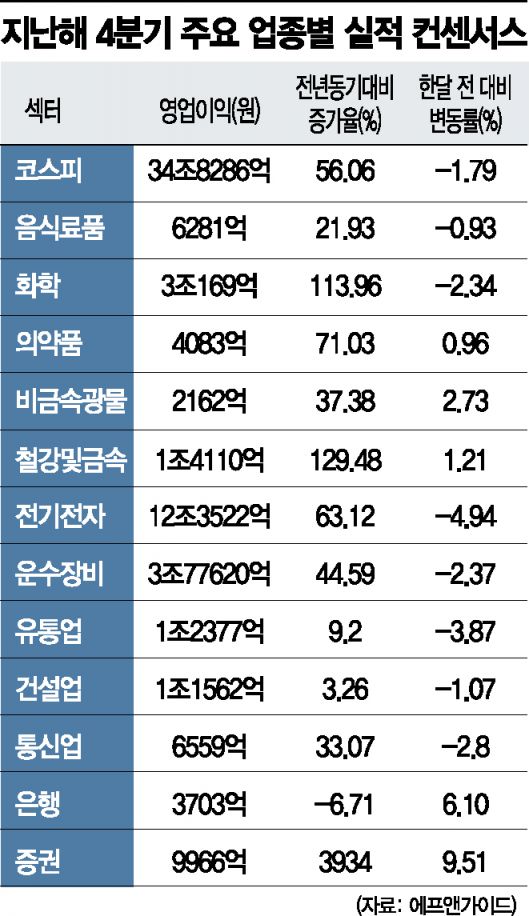
It is also necessary to pay attention to stocks with rising earnings forecasts. Since earnings forecasts for the fourth quarter of last year are being revised downward, sectors or stocks with high visibility of earnings improvement are expected to attract attention. According to financial information provider FnGuide, the consensus operating profit forecast for the KOSPI in the fourth quarter is 34.8286 trillion won, down 1.79% compared to a month ago. Kim Jiyoon, a researcher at Daishin Securities, explained, "The fourth-quarter earnings last year are likely to fall short of expectations, which could temporarily trigger market anxiety due to disappointing results." She added, "Reflecting rising expectations for economic recovery, earnings forecasts are rising mainly in energy, materials, industrial goods, and IT sectors."
In particular, cyclical stocks are expected to see earnings improvements. Choi Jaewon, a researcher at Kiwoom Securities, said, "Due to the low base effect, the profit growth of cyclical sectors will be prominent." He added, "It is necessary to pay attention to IT, steel, and raw materials, which have strong earnings improvement momentum."
© The Asia Business Daily(www.asiae.co.kr). All rights reserved.












