World's First Discovery of 'Avalanche Nanoparticles' Exhibiting Chain Amplification of Light
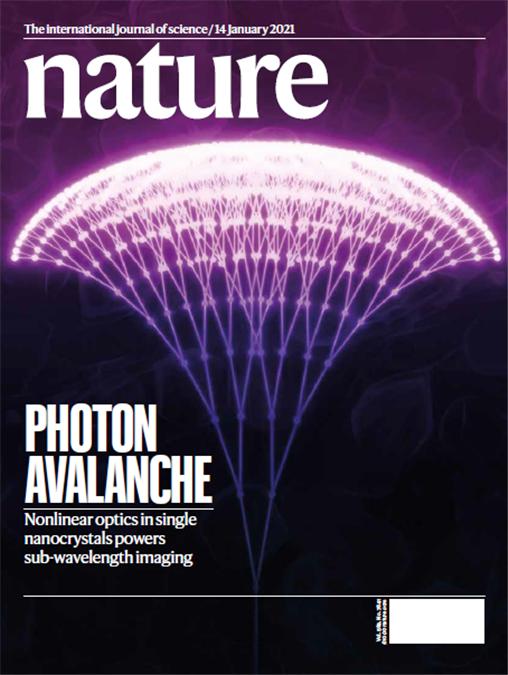
[Asia Economy Reporter Junho Hwang] Nanoparticles that cause the 'light avalanche phenomenon' have been captured for the first time in the world. The light avalanche phenomenon occurs when small light energy is irradiated onto specific nanomaterials, triggering a chain amplification reaction of light within the material, resulting in the massive emission of larger light energy. It is expected to contribute to the advancement of various future technologies such as solar power generation that converts light energy into electrical energy, virus diagnosis using light, and securing competitiveness of LiDAR, known as the eyes of autonomous driving.
The research team led by Dr. Youngdeok Seo and Dr. Sanghwan Nam from the Korea Research Institute of Chemical Technology, in collaboration with research teams from the United States and Poland, discovered this phenomenon. Their related research paper was published as the cover article in the international journal Nature on the 15th.
Emitting Large Light When Irradiated with Small Light
Generally, when nanomaterials absorb light, some of it is consumed as heat, and the rest is emitted as light with lower energy than the original. Unlike this down-conversion process, some nanomaterials exhibit up-conversion, emitting larger light energy by absorbing small light energy.
The research team synthesized the element Thulium (Tm) into a specific atomic lattice nanostructure and discovered that even when irradiated with weak light of small energy, the light inside the material undergoes a chain amplification reaction, emitting light of higher energy with strong intensity. They confirmed that irradiating this particle with light as weak as a laser pointer level causes it to emit very strong light. The team named these nanoparticles causing optical chain amplification reactions 'light avalanche nanoparticles,' inspired by the similarity to how an avalanche occurs with snow.
The light avalanche nanoparticles discovered by the team have a light conversion efficiency of 40%, making them applicable in various fields. The light conversion efficiency of existing up-conversion nanomaterials is only about 1%. Light conversion efficiency refers to the ratio of the amount of emitted light (intensity) to the amount of incident light (intensity). It indicates the efficiency of how many photons out of 100 undergo up-conversion.
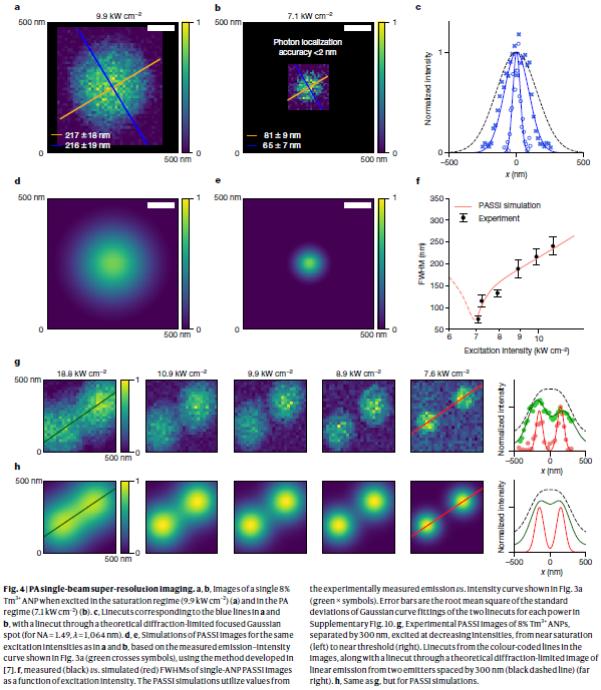
The research team also succeeded in observing extremely small materials of 25 nm (nanometers), which are difficult to observe using conventional methods, at high resolution using the light avalanche nanoparticles. Materials smaller than the visible light wavelength range of 400?700 nm are hard to observe at high resolution, but they succeeded in observing them more simply than existing technologies.
Application in Perovskite Solar Cell Development
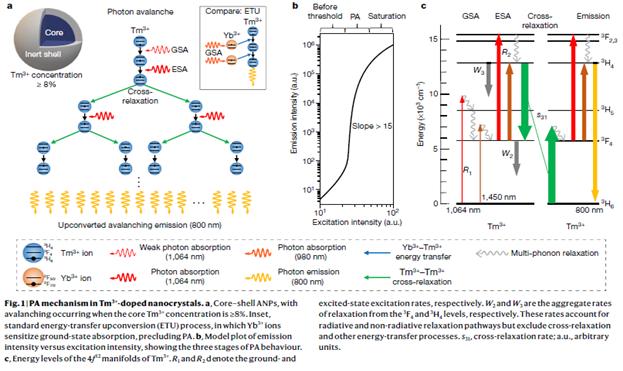 Mechanism of Photon Avalanche (PA) Chain Amplification Reaction of Light Inside Nanoparticles Doped with Thulium Ions (Tm3+)
The research team plans to conduct applied research to improve the efficiency of solar cells in collaboration with the perovskite solar cell research team at the Korea Research Institute of Chemical Technology. Light avalanche nanoparticles can absorb light with longer wavelengths than the range that existing solar cells can absorb or utilize. This can maximize the efficiency of the cells. Additionally, the team expects to apply light avalanche nanoparticles in biomedical technologies for in vitro diagnostics such as virus diagnostic kits in the form of pregnancy test kits, optical sensor applications like laser surgical equipment and endoscopes, and micro-laser technologies implanted in the body used for cancer treatment and skin care. To this end, the team is conducting research to induce the light avalanche phenomenon using LED light weaker than a laser pointer.
Dr. Youngdeok Seo of the Korea Research Institute of Chemical Technology stated, "This research achievement can be widely used in all industries and technologies that utilize light, making it highly likely to be used as a future new technology. It can be broadly applied in fields such as bio-medical, autonomous vehicles, advanced IoT sectors like artificial satellites, photogenetics research using light, and photo-switching technologies such as optical materials. We will increase the possibility of commercialization through follow-up research."
He added, "Typically, the light source of LiDAR, which acts as the eyes of autonomous vehicles, uses near-infrared light of 900?1500 nm and employs semiconductors made of expensive and hard-to-obtain compounds such as indium, gallium, and arsenic," and explained, "By applying nanoparticles that cause light avalanche here, it will be possible to enhance LiDAR performance and improve price competitiveness."
© The Asia Business Daily(www.asiae.co.kr). All rights reserved.














