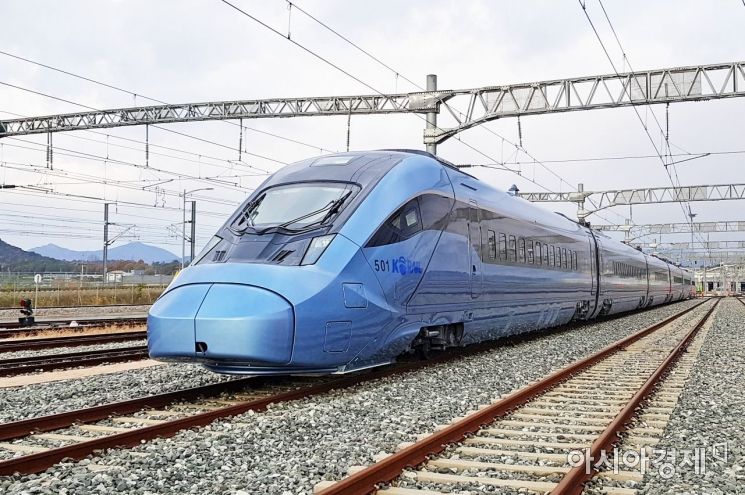
[Asia Economy Reporter Ki-min Lee] Hyundai Rotem announced on the 5th that the country's first distributed power high-speed train has started commercial operation on the Jungang Line (Cheongnyangni~Singyeongju) section. The distributed power high-speed train consists of a total of 130 cars (21 trainsets), and Hyundai Rotem received an order worth about 430 billion KRW from Korea Railroad Corporation in 2016 for two types of high-speed trains with maximum speeds of 260 km/h and 320 km/h.
The trains deployed for this opening are distributed power high-speed trains with a maximum speed of 260 km/h, with a total of 5 trainsets being introduced, and the remaining trainsets and 320 km/h trains will be added sequentially. The name of the country's first distributed power high-speed train is ‘KTX-Eum’. ‘Eum’ is a pure Korean word meaning ‘to connect,’ symbolizing connecting regions by railway.
With the start of commercial operation of the KTX-Eum, Hyundai Rotem has secured operational records for both the KTX-Sancheon, a concentrated power high-speed train with power cars at the front and rear of the train, and the distributed power high-speed train with power sources distributed across each passenger car. Over the past five years, distributed power trains have accounted for 75% of the global high-speed train market, and Hyundai Rotem is one step closer to its first overseas export of high-speed trains based on this commercial operation record. The distributed power high-speed train introduced this time has superior transport capacity and excellent acceleration and deceleration performance compared to concentrated power trains, making it advantageous for Korea’s railway environment, which has many curved tracks and short distances between stations.
Hyundai Rotem explained that it has made every effort to improve vehicle performance and customer convenience. The airflow and resistance at the front end of the train were calculated to realize the optimal shape, and energy efficiency was increased by lightweighting the body, flooring, and seats. Additionally, a double gangway (passage between trains) was applied to reduce passage noise compared to the KTX-Sancheon, and the passage was widened to enhance passenger mobility. Furthermore, the world’s first low- and high-platform compatible boarding device was applied, allowing free operation on lines with different platform heights. Moreover, individual monitors were installed on the back of first-class seats so passengers can access the internet and watch videos onboard, and a wireless charging system for mobile phone batteries was applied in all passenger cars.
A Hyundai Rotem official said, "As the KTX-Eum is a high-speed train that plays a major role in transporting passengers in the central inland region, we will spare no company-wide support to ensure that the high-quality vehicle operates safely.”
© The Asia Business Daily(www.asiae.co.kr). All rights reserved.












