'International Comparison and Implications of Wage Payment for Full-time Union Officials'
[Asia Economy Reporter Dongwoo Lee] Concerns have been raised that labor-management disputes may intensify if the government’s amendment to the Labor Union Act allowing payment of wages to full-time union officials passes.
According to a report titled "International Comparison and Implications Regarding Wage Payment to Full-Time Union Officials," commissioned by the Korea Economic Research Institute and authored by Professor Sanghee Lee of Korea University of Technology and Education, the government’s amendment, which deletes the prohibition on wage payment to full-time union officials but invalidates collective agreements or employer agreements exceeding the limit of working hour exemptions, is ineffective, the report stated on the 30th. This is because, in reality, it is difficult for employers to claim invalidity of agreements made with unions.
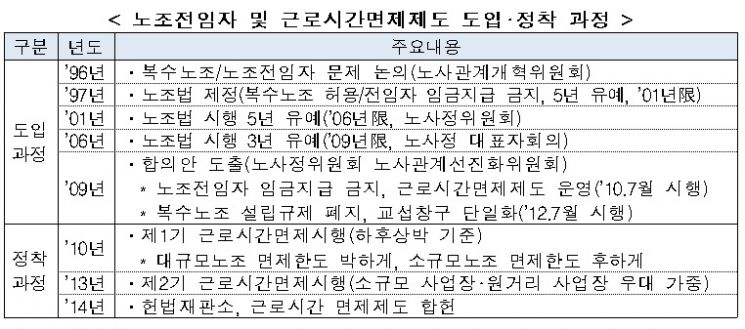
The report noted that the ban on wage payment to full-time union officials was introduced in 1997 to balance the power between labor and management following the allowance of multiple unions. Furthermore, in 2014, the Constitutional Court ruled that the ban on wage payment to full-time union officials and the working hour exemption system (time-off system), which guarantees union work within the exemption limit, are constitutional.
Professor Lee argued, "Under the government’s amendment, there is concern over a surge in union demands, especially from large company unions, to increase the working hour exemption limit," adding, "It is necessary to explicitly allow employers to exercise the right to refuse negotiations regarding demands that exceed the working hour exemption limit."
The report emphasized that major advanced countries have different labor-management relations environments from Korea, and financial support for full-time union officials is not an issue at all. In countries such as the United States, the United Kingdom, Germany, and France, full-time union officials work outside the company, and their wages are paid by the affiliated cross-company unions, with no financial support from employers.
In Japan, which also centers on enterprise-based unions like Korea, financial support for full-time union officials mostly relies entirely on union finances. In the United States, employer financial contributions or support are generally considered unfair labor practices, but paid treatment for collective bargaining, arbitration, and grievance handling is regarded as lawful.
Choo Kwang-ho, Director of Economic Policy at the Korea Economic Research Institute, pointed out, "The government’s plan is centered on allowing employers to pay wages to full-time union officials while maintaining the existing working hour exemption system. Particularly, deleting the prohibition and penalty provisions on strikes demanding exceeding the exemption limit while simultaneously stipulating that agreements or accords exceeding the exemption limit are invalid may fuel conflicts between labor and management."
© The Asia Business Daily(www.asiae.co.kr). All rights reserved.












