'Monetary Policy Committee Plenary Meeting' Held on the 26th... Base Interest Rate Frozen at 0.50% per Annum
Export Rebound and Removal of Market Uncertainty Factors After US Presidential Election
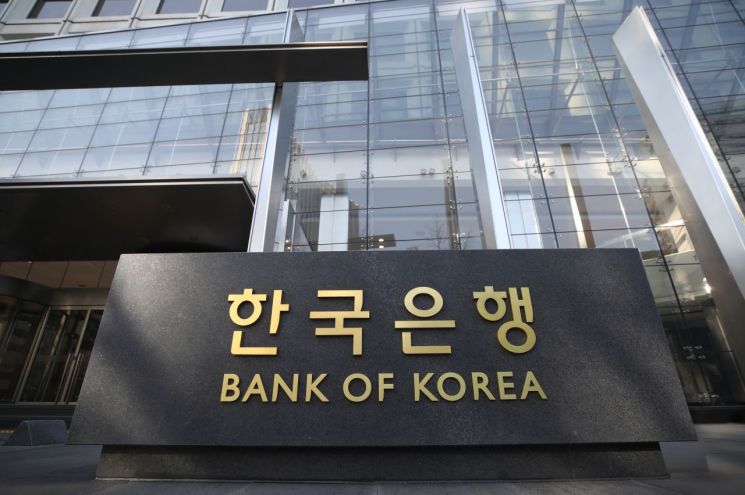
[Asia Economy Reporter Jang Sehee] The Bank of Korea has revised its economic growth forecast for this year upward to -1.1%. This is a 0.2 percentage point increase from the growth forecast of -1.3% made in August.
The Monetary Policy Committee of the Bank of Korea held a plenary session on the 26th and projected the growth rates for this year and next year at -1.1% and 3.0%, respectively. Although there are signs of a resurgence of COVID-19 in the country, the gradual recovery in exports has continued, leading to the upward revision of this year's growth rate. In fact, exports in October recorded $44.98 billion, down 3.6% compared to the same period last year. However, considering that the number of working days was two days fewer, the average daily exports increased by 5.6%, marking a positive growth for the first time in nine months. Additionally, thanks to COVID-19 vaccines and the proactive stimulus measures of the incoming Biden administration, next year's growth rate was also revised upward.
Although the growth forecast was raised by 0.2 percentage points, negative growth is expected to continue due to the impact of COVID-19. Since the Bank of Korea began compiling Gross Domestic Product (GDP) statistics in 1953, the Korean economy has experienced negative growth only twice: in 1980 (-1.6%) during the second oil shock and in 1998 (-5.1%) during the foreign exchange crisis.
The Bank of Korea forecasted next year's growth rate at 3.0%, and consumer price inflation for this year and next year at 0.5% and 1.0%, respectively.
Meanwhile, the Bank of Korea's Monetary Policy Committee decided to keep the base interest rate steady at 0.50% during the plenary session on the same day. This reflects the judgment to maintain an accommodative monetary policy amid the ongoing spread of COVID-19. It is also interpreted as a decision considering the risk of liquidity flooding the market rapidly flowing into asset markets such as real estate and stocks.
In March, when the financial market fluctuated due to the initial spread of COVID-19, the Bank of Korea held an emergency Monetary Policy Committee meeting and sharply lowered the base interest rate from 1.25% to 0.75%. After lowering the base rate once more to 0.50% in May, it has kept the rate steady at the current level through three sessions in July, August, and October.
Experts cited 'export rebound and removal of market uncertainties' as factors for the upward revision of the growth forecast.
Professor Andonghyun of Seoul National University’s Department of Economics said, "It seems that the growth rate was revised upward due to a rebound in exports in the fourth quarter that was better than expected," adding, "Also, the economic rebound in China was stronger than anticipated, which likely had a positive effect on the growth rate." Professor Inho Lee of Seoul National University’s Department of Economics said, "With Joe Biden elected as the President of the United States, some market uncertainties have been removed, which appears to have led to the upward revision of the growth rate," but added, "However, if the spread of COVID-19 continues, the potential growth rate could decline in the medium to long term."
© The Asia Business Daily(www.asiae.co.kr). All rights reserved.












